What should you look for?
Directional dynamic USB microphone
Choose this if: you’re recording speech on its own and can keep the microphone consistently close to your mouth.
Keep in mind: speaking from a fixed, close position takes space and may require a boom arm or stand; the microphone won’t make the room reverberation-free.
Dynamic microphone with a hypercardioid pattern
Choose this if: you can aim the front of the microphone precisely at your voice and want to compare a narrower pickup angle.
Keep in mind: a narrower pickup angle doesn’t prove that the microphone will sound better in your room or eliminate reflections.
USB condenser microphone
Choose this if: you deliberately want to speak from further away or capture a more spacious sound too.
Keep in mind: greater distance can change the balance between your direct voice and audible room reflections, so test your recording space first.
When recording poetry commentary in a room with audible reverberation, clarity, control over your delivery, connectivity and a complete set-up are all important buying priorities.
| Concern |
What to look for |
Who is this important to? |
| Clarity despite reverberation |
Make short test recordings in the same place at different speaking distances; check the microphone’s orientation and whether a mount can bring it close to you. |
If I’m recording commentary in a reverberant room, I want to know whether my words will stay clear. Around 42% of consumers put clarity first. |
| Control over quiet and loud passages |
Check whether the model has a headphone output and useful level controls; listen back to both quiet and more powerful passages. |
When giving a reading with a varying vocal level, I want to assess quiet and emphatic passages. Around 25% of consumers prioritise this level of control. |
| Easy to connect |
Compare the USB connection and supplied cable with your computer or other recording device. |
If I want to record directly via USB, I want to know whether the connection works with my device. For around 17% of consumers, ease of connection is the top priority. |
| Complete set-up |
Check whether a stand or boom arm, mount, cable and windscreen are included with the version you’re considering. |
When I want to get into a usable speaking position straight away, I look at what’s included. Around 16% of consumers prioritise a complete set-up. |
Joybuy products for voice recording
This Joybuy selection includes products for voice recording, including USB microphones and wireless lavalier models. Check that the connection and positioning suit your recording device and room for each model.
 No image available
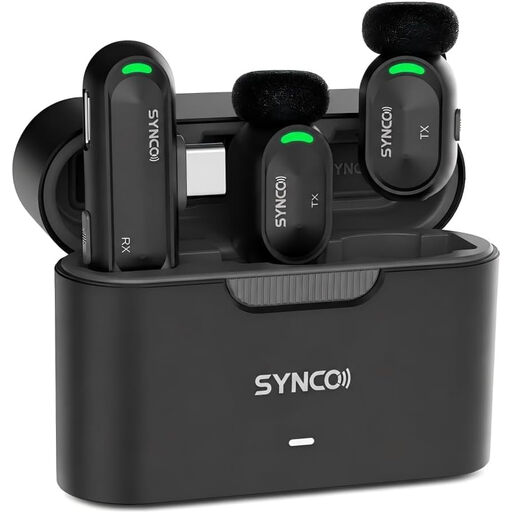
SYNCO P2XT wireless USB-C microphone
A wireless lavalier option for spoken content; the product title lists a USB-C receiver. According to the product information, OTG is required for Android devices with USB-C.
View at Joybuy
 No image available
SYNCO SMIC AI wireless USB-C lavalier microphone for Android
A clip-on lavalier option for voice recordings with an Android USB-C set-up. The connection described requires OTG support.
View at Joybuy
 No image available
USB condenser microphone with cardioid pickup pattern
A USB condenser microphone for voice recording; the product description lists cardioid pickup, headphone monitoring, gain control and a boom arm stand included.
View at Joybuy
 No image available
HyperX SoloCast 2 USB microphone, black
A USB condenser microphone for podcasts and more; the product information lists a cardioid pickup pattern, pop filter, shock mount and mute control. The cable supplied has USB-C on one end and USB-A on the other.
View at Joybuy
 No image available
Razer SEIRÉN V3 MINI Quartz USB microphone
A compact USB microphone for recording speech at a desk; the product information lists a supercardioid pickup pattern and tap-to-mute control.
View at Joybuy
Frequently asked questions
Can a USB microphone remove the reverberation in my room?
No, a microphone can’t remove room reflections. Shure explains that a microphone can’t effectively separate direct speech from reflected speech. Speak close to the microphone and keep your position consistent, then listen back to a test recording. Shure describes its denoiser as dealing with certain persistent background sounds, not as a general solution for room reverberation.
How should I start positioning and adjusting the microphone?
Point the active side towards your mouth and start with a short test recording. For the PodMic USB, RØDE recommends around 5–10 cm; don’t automatically use the same distance for other models. Listen back to quiet and powerful passages, then adjust the position and recording level if needed.
Do I need to buy anything else besides the microphone?
That depends on the exact package and your workspace. Samson lists a desk stand and cables among the accessories supplied with the Q2U; for other models, check separately whether a mount and a suitable USB cable are included.
Can I recite a poem in published commentary?
Not automatically. Under the Copyright Act, in force from 1 January 2026, making protected work available to the public is generally a right reserved for the rights holder. Auteursrecht.nl explains that a relevant quotation may be allowed in certain circumstances, including crediting the source and keeping the length justified by the purpose. Don’t assume this covers reciting an entire poem; check the rights for the specific poem before publishing.
Can I return a microphone bought online if it doesn’t work well in my room?
For online consumer purchases in the Netherlands, there is generally a statutory 14-day cooling-off period from delivery, with some exceptions. ACM ConsuWijzer explains how this period works; check the terms that apply to your purchase. Bear in mind that your statutory rights if a product is faulty are different from returning it because you’ve changed your mind.


