Who is this choice relevant to?

Interviewer with one storyteller

If you’re mainly recording one voice and can position the microphone close by, you can assess the speech against the sound in the rehearsal room in a test recording. Shure and RØDE describe models for close-up speech recording; test your set-up in the room where you’ll be having the conversation.

Interviewer with several speakers

If the storyteller and interviewer are speaking from different positions, microphone placement will affect how clearly you can hear both voices. Zoom describes several recording patterns for the H2essential; make a test recording to check how it performs from the intended seating positions.

Oral history archive creator

If you want to preserve or share conversations, you’ll need to think about consent, access and future use as well as the microphone. The Oral History Association emphasises informed consent and, where possible, giving the storyteller the opportunity to approve the oral history before it is published publicly.

What should you look for when choosing?

One voice up close

Best when: the storyteller can speak from a fixed position close to the microphone and clear speech is the priority.

Trade-off: this set-up won’t necessarily capture several speakers sitting further apart with equal clarity.

Fixed USB desktop set-up

Best when: you can keep the room quiet and position the microphone close to the intended speaker.

Trade-off: a cardioid recording pattern doesn’t mean everyone around the table will be captured equally well.

Recorder with multiple recording patterns

Best when: you want to capture voices from different directions or deliberately record more of the room’s sound.

Trade-off: a wider recording pattern may also pick up more background noise; assess it with a test recording.

Factor to consider What should you check? Who is this important for?
Clear main speaker Check the recording position, distance from the speaker and sound quality in a test recording. If I’m recording one storyteller, I want to assess their voice in the actual room. Around 36% of consumers prioritise capturing one voice clearly.
Several voices Ask everyone to speak from their intended seat, then play back the recording. If the storyteller and interviewer are sitting opposite one another, I want to know whether both voices are audible. Around 29% of consumers prioritise capturing several voices.
Connection and monitoring Check the USB connection, the cable supplied and whether you can monitor the recording through headphones. If I want to get started without a complicated set-up, I need to be able to connect and check the recording easily. Around 21% of consumers say this is their main need.
Portability and room sound Check how the device records via USB and which storage medium and recording pattern it uses. If I want to move the recording location or preserve the room as context, the way I record needs to suit that. Around 14% of consumers prioritise this need.

Common buying mistakes

  • Expecting one microphone in the middle of the table to capture everyone equally clearly

    A set-up focused on one speaker may capture another participant at a lower volume. A wider recording pattern may pick up more sound from the rehearsal room instead.

    First, work out where everyone will sit, then test each voice from that position in the actual room.

    If the test recording isn’t satisfactory, you may need to reposition the microphone or add another one.

  • Assuming noise cancellation will eliminate rehearsal noise

    Claims about automatic processing are specific to the model and come from the manufacturer. They don’t prove how a microphone will sound in your recording conditions.

    Make a test recording in the room and assess the result, with and without processing where available.

  • Comparing microphones alone

    Connections, cables, stands and controls vary between models and can affect positioning and connectivity.

    Before buying, check the exact model, what’s in the box and the connections on your recording device.

    You may need a different cable or mount to use your chosen set-up.

Brands to consider

Shure

The MV7+ is a USB and XLR speech microphone for a fixed, close-up speaking position.

  • Shure says the MV7+ has automatic level adjustment, a headphone output and features for reducing background noise.
  • These features don’t prove that noise from the rehearsal room will disappear. Also check that the required app is compatible with your device.

RØDE

The PodMic USB is designed for close-up speech and offers USB and XLR; the NT-USB Mini is a more compact USB desktop option.

  • RØDE says both models let you monitor audio directly. For the PodMic USB, RØDE recommends keeping it around 5–10 cm from the speaker.
  • The NT-USB Mini has a cardioid condenser capsule. That doesn’t automatically make it suitable for recording several speakers evenly around a table.

Zoom

The H2essential is a recorder that can also be used as a USB microphone, for example when your set-up or the amount of room sound you want to capture varies.

  • Zoom lists multiple recording patterns and the option to use it as a microphone via USB while also recording to a card.
  • A wider recording pattern may pick up more unwanted noise from the rehearsal room. Test the actual positioning and recording setting.

Sennheiser

The Profile USB Microphone is a USB-C desktop set-up with controls on the microphone.

  • Sennheiser says this model has a cardioid condenser capsule, gain, mix and volume controls, a headphone output and a table stand.
  • Check whether the table stand brings the microphone close enough to the intended speaker.

Joybuy product picks

These products offer a range of options for recording speech, including fixed USB microphones and portable microphones. Check the connection for each model and make sure it suits your recording device and seating arrangement.
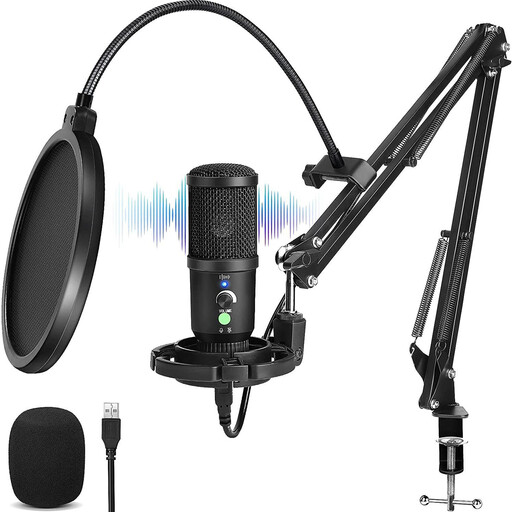
Cardioid USB condenser microphone

Cardioid USB condenser microphone

An option for a speaker in a fixed position who wants to monitor audio while recording.

The product title lists a cardioid pattern and latency-free monitoring via a headphone output.

View at Joybuy
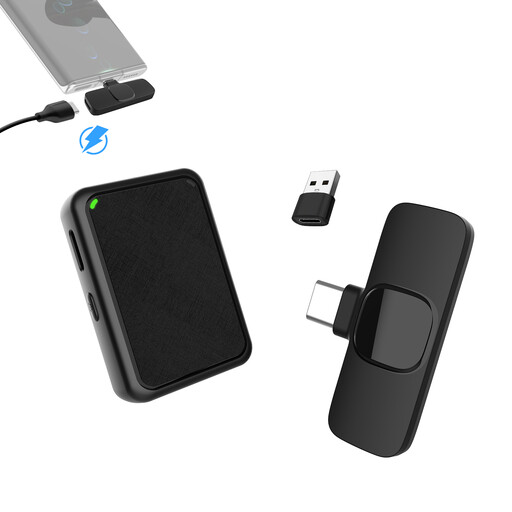
Moman MB1C clip-on microphone set with USB-C

Moman MB1C clip-on microphone set, USB-C

A clip-on option for a speaker to wear during an interview.

The title lists one transmitter and one receiver (1TX+1RX) and compatibility with iPhone 18/17/16. Check that this connection and model are suitable for your device.

View at Joybuy
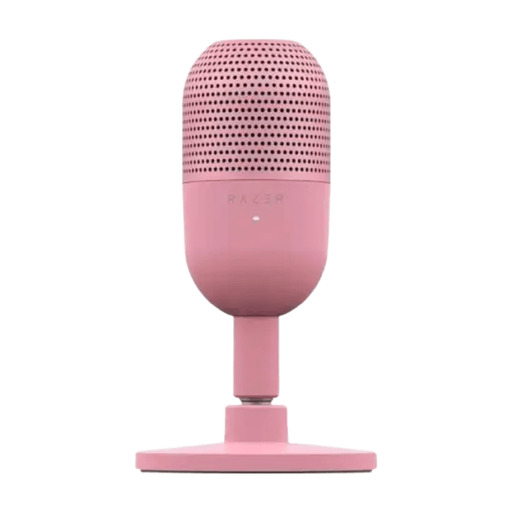
Razer Seiren V3 Mini Quartz USB microphone

Razer Seiren V3 Mini Quartz USB microphone

A compact USB option for a fixed recording position at a desk.

The product title lists tap-to-mute controls.

View at Joybuy
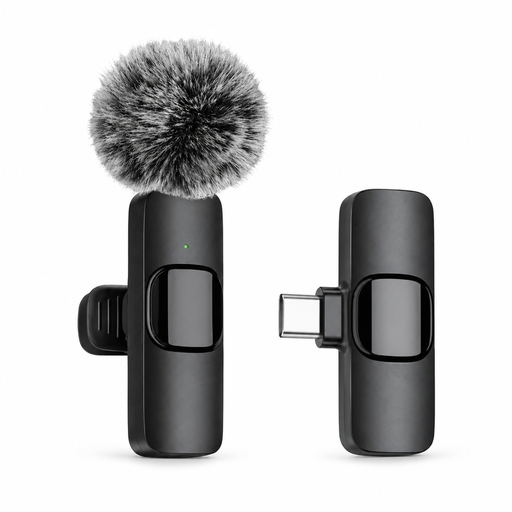
Verbex K9-Black wireless lavalier microphone with Type-C interface

Verbex K9-Black wireless lavalier microphone

A portable lavalier option for interviews where the speaker wears the microphone.

The product title lists a Type-C interface. Check that this connection is compatible with your recording device.

View at Joybuy

Frequently asked questions

Can one USB microphone record the storyteller and interviewer at the same time?

Some devices and recording patterns can do this, but that doesn’t automatically mean both voices will be equally clear. Ask both people to speak from their actual seats and play back a test recording; if one position doesn’t sound clear enough, you may need a microphone closer to each speaker.

What should you check just before the interview?

Check that the right input device is selected, ask each participant to speak, listen through headphones and play back a short recording. Also agree how the conversation will be recorded and whether it will be kept or shared later.

Do you have to pay extra for a legal guarantee on a microphone bought in the Netherlands?

No. Your legal guarantee applies alongside any manufacturer’s or seller’s guarantee. According to ACM ConsuWijzer, there is no fixed legal guarantee period of exactly two years; what you can expect from a product depends on factors including the product itself and normal use. If a product is faulty, the seller is your point of contact.

Can you publish an oral history recording without further consideration?

Don’t assume you can: agree with the storyteller what the recording is for and who will have access to it. If the GDPR applies to the processing of personal data, you must establish an appropriate legal basis; consent is one possible basis, but it is not automatically the only one. The Dutch Data Protection Authority describes a limited exception for personal or household use only, which does not automatically apply to public publication or use by an organisation.
