
Speaking alone at a noisy desk
You mainly want to record your own words clearly and can speak close to a directional USB microphone.


If you usually speak on your own at your desk, a USB microphone you can position close to your mouth is a sensible place to start. If you also need people further along the table to feature in the summary, consider a USB speakerphone designed for several speaking positions; it may pick up more sound from the room, too. Test both set-ups with your usual background noise, and check separately how recording and storage are handled.
You mainly want to record your own words clearly and can speak close to a directional USB microphone.
Your summary needs to include contributions from people sitting elsewhere. Microphone placement and range become more important.
You want to check what has been recorded. To do that, your audio input, recording software and storage need to work well together.
Best if: you mainly record your own contribution or a summary spoken afterwards, and can speak close to the microphone.
Bear in mind: voices from people further along the table may not be captured as you’d like; noise processing doesn’t guarantee that other sounds will disappear.
Best if: people are speaking from different positions around a small table and you need to capture their contributions.
Bear in mind: placing it in the centre can also pick up background noise. Jabra specifies four beamforming microphones and a range of up to 2.3 m for the Speak2 55; this is a manufacturer specification, not a guarantee of clear speech in your flat.
| What to consider | What should you look for? | Who is this important for? |
|---|---|---|
| Keeping your own voice clear | Check the microphone’s polar pattern and how far it is from your mouth; make a test recording from your usual speaking position. | If I mainly need my own words and can sit close to the microphone, I want to hear how the background noise affects my voice. Around 36% of consumers prioritise recording their own voice over background sound. |
| Recording voices around the table | Check the stated range and test the recording from every seat. | If contributions from people on the other sides of the table need to feature in my notes, I don’t want to hear only the nearest speaker. Around 29% of consumers prioritise voices from different seats. |
| Recording and listening back | Select the right audio input and make a test recording to check where it is saved. | If I want to listen back to the meeting before writing my summary, the microphone needs to work well with my computer and recording software. Around 21% of consumers prioritise a recording set-up that works from start to finish, including playback. |
| Changing recording set-ups | Check whether you can adjust the polar pattern and gain, and listen back to a recording from each set-up. | If I sometimes speak alone and sometimes want to record someone sitting opposite me, I want to be able to adjust the settings for each position. Around 14% of consumers prioritise switching between recording set-ups. |
A microphone doesn’t change the room’s acoustics. Software processing or a stated recording range won’t tell you how clearly you’ll be able to hear your meeting above the noise at home.
Make a test recording from the actual speaking distance, with your usual background noise present.
A microphone designed to record speech from close up may miss contributions from further away. A centrally placed speakerphone makes a different trade-off between voices around the table and room noise.
Before buying, decide whether you need to capture only your own words or everyone’s.
The microphone provides the audio input, but your computer and software also determine whether the meeting is recorded and whether you can find the file afterwards.
Before an important meeting, test the whole process, from microphone input to saved file.
The MV7+ is a dynamic USB microphone for speech recorded close to the microphone.
The ATR2100x-USB combines single-speaker recording with USB-C and XLR.
The NT-USB Mini is a compact USB desk set-up for speech, with direct monitoring.
The Speak2 55 is a USB speakerphone for conversations with people sitting in different places around a small table.
The Yeti is a USB desktop microphone with several selectable polar patterns for different set-ups.
This selection includes directional USB microphones for one speaker and speakerphones for meetings with several people.
 No image available
A directional set-up designed to record mainly the speaker close to the microphone.
The product information lists gain control, mute and headphone monitoring.
 No image available
A cardioid USB microphone for a set-up where your voice is the focus of the recording.
The product information lists a mute function, shock mount and pop filter; the title specifies the black version.
 No image available
The supercardioid set-up is designed to focus the recording on the speaker.
The product information lists tap-to-mute and USB plug-and-play connectivity.
 No image available
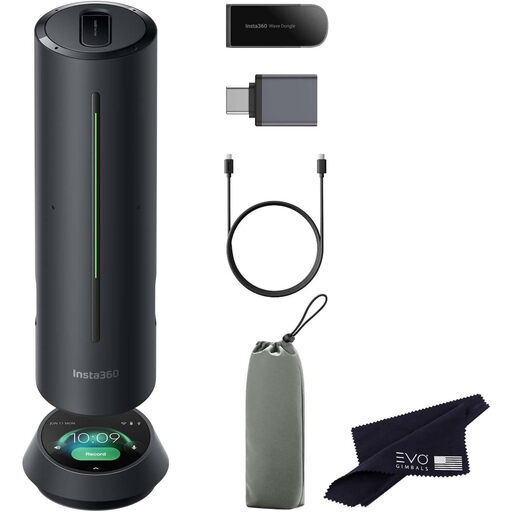
A speakerphone alternative if you want to record contributions from several people.
The product information lists an eight-microphone array, five recording patterns, and transcription and summary features. The title specifies the black version.
 No image available
A USB speakerphone for meetings where people speak from different positions around the table.
Jabra specifies four beamforming microphones and recommends USB for use with a computer.
No, a USB microphone provides audio input for a connected device. Select the microphone in your recording software and test the file; you’ll also need suitable software for transcription or a summary.
Check that the port and cable are compatible with your computer, select the right audio input and make a short recording from your actual speaking position. The RØDE NT-USB Mini comes with a USB-C-to-USB-A cable; the manual describes a different cable for a USB-C input.
You don’t need an extended warranty to have your statutory rights. ACM ConsuWijzer explains that if a product breaks sooner than you could reasonably expect under normal use, the retailer must provide an appropriate solution at no extra cost; an extended warranty you buy separately doesn’t replace that right.
No, don’t assume that you can. If an organisation processes personal data in a recording, the Dutch Data Protection Authority says it must determine an appropriate legal basis under the GDPR before processing the data, and clearly inform the people involved. Consent is one possible legal basis, but it isn’t automatically the only or always the right one; also check your organisation’s policy and the meeting software being used.