What should you look for when choosing?
When practising a talk next to a fan, clarity while speaking, listening back and choosing a suitable setup all matter in different ways.
| What to consider |
What to look for |
Who is this important for? |
| Clarity with fan noise |
Record full sentences with the fan on, and consider speaking direction and a practical distance. RØDE recommends around 5–10 cm for the PodMic USB. |
If the fan is audible while I’m speaking, I want to know whether my voice will still be clear; around 50% of consumers prioritise clarity over fan noise. |
| Listening back to your pronunciation |
Check for a headphone socket and volume control, then listen back to a complete passage. Audio-Technica and Sennheiser describe headphone monitoring on the models mentioned. |
I want to assess names, articulation and speaking pace while practising; around 30% of consumers prioritise being able to monitor what they’ve said straight away. |
| Connection and setup |
Compare your device’s port and system requirements with the exact version, and check which stand or cable is included. XLR use requires a compatible input. |
If I want to connect the microphone to my device or might consider a different setup later, I want to know what I’ll need in advance; around 20% of consumers prioritise a suitable, flexible setup. |
Joybuy products for voice recordings
The Joybuy products below are microphones for voice recordings. For each version, check that its connection and recording method suit your practice setup.
 No image available
HyperX SoloCast 2, cardioid USB microphone, black
Could suit desk-based practice; make a test recording to hear how your voice and the fan sound together.
The product name specifies USB, plug-and-play and a cardioid pickup pattern.
View at Joybuy
 No image available
Razer Seiren V3 Mini Quartz, USB microphone
An option to consider for voice recordings over USB; make a test recording to check whether your voice sounds clear enough in your space.
The product name specifies a compact USB microphone with tap-to-mute controls.
View at Joybuy
 No image available
Verbex K9-Black, wireless mini microphone with Type-C interface
The product name lists recording and interviews as possible uses. Check whether this wireless version suits the way you want to practise a talk.
The product name specifies a Type-C interface; check that your recording device has the required connection.
View at Joybuy
 No image available
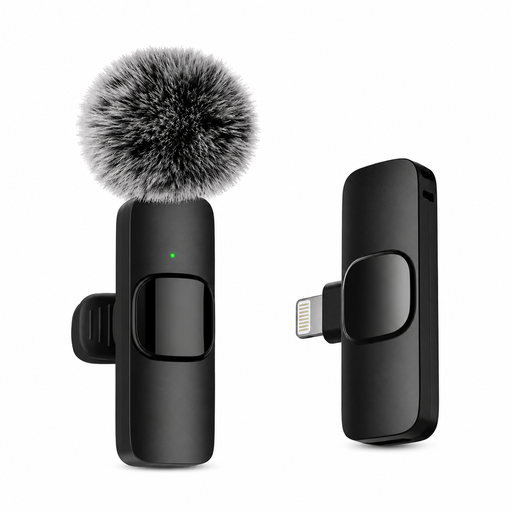
Verbex K9-Black, single microphone with iOS interface
The product name describes a wireless clip-on microphone for recordings and interviews. Check that its connection and how it works suit your practice setup.
This version is described in the product name as a single microphone with an iOS interface.
View at Joybuy
Frequently asked questions
Will a noise gate help with fan noise while I’m speaking?
According to RØDE, a noise gate can reduce signals below a set threshold, particularly when you’re not speaking. Record full sentences with the fan on: the described operation doesn’t show that fan noise will disappear beneath your voice.
How should I position the microphone for my first test recording?
With the PodMic USB, speak into the front and start at the approximately 5–10 cm distance RØDE recommends for this model. Record a full passage with the fan on, listen back, then adjust the position and gain. This distance is specific to this model and won’t necessarily apply to every USB microphone.
Do I also need a microphone arm for practising?
Not always. Audio-Technica lists a desktop stand with the ATR2100x-USB, and Sennheiser does the same for the standard Profile USB; according to Sennheiser, the separate Profile Streaming Set includes an arm. Choose a setup that lets you maintain your usual speaking posture.
Does a USB microphone need a CE mark to be sold in the Netherlands?
That depends on the product rules that apply. According to the European Commission, CE marking is only mandatory when EU harmonisation legislation applicable to the product requires it. Check the EU version and its accompanying documentation for a specific model; a CE mark says nothing in itself about sound quality.
What if the microphone doesn’t work properly after I buy it?
For a consumer purchase in the Netherlands, the product must be fit for purpose under Dutch government rules, and the seller is your point of contact for a solution. The Netherlands doesn’t have a fixed statutory guarantee period for all products; an additional guarantee doesn’t replace your statutory rights.


