If you’re recording in a noticeably echoey room and can stay close to the microphone, compare dynamic USB microphones. In a quiet space, a cardioid USB condenser microphone is also worth considering if you want to assess vocal nuances. Make a test recording in your own room, with both soft and loud passages, and listen for echo, plosives and distortion. Shure notes that a microphone cannot improve the acoustics of the room itself.
Who is this guide for?
Voice artist in an echoey room
You’re recording a solo voice where reflections or background noise are audible, and you can speak close to the microphone. Prioritise your speaking position and the room over extra digital features. Shure explains that microphone placement affects the balance between direct voice and reflections.
Narrator with both soft and powerful passages
You want to assess the clarity and level of expressive lines using a test recording and headphones, without leaving the delivery entirely to automatic processing. Compare the recording in the place where you actually plan to make it.
Creator with a quiet recording space
You’re recording a single voice directly to a computer in a quiet place, and want to listen back to the nuances without a separate audio interface. Check that the USB connection and supplied cable are compatible with your recording device.
What should you look for?
Start with the room acoustics and speaking distance. Then compare the controls and any level features.
| What to consider |
What to look for when buying |
Who is this important for? |
| Room echo and speech clarity |
Compare a dynamic USB microphone for close-up speaking, and make a test recording in the room you intend to use. |
If I’m recording in an echoey room, I want to keep my words clear without relying on digital features. Around 31% of consumers say reducing room echo is their top priority. |
| Vocal nuances in soft passages |
Check headphone monitoring and listen for soft articulation and room noise from your actual speaking position. |
In a quiet space, I want to be able to listen back clearly to soft passages and articulation. Around 31% of consumers prioritise assessing vocal nuance. |
| Peaks and plosives |
Test your loudest line and words with p and b sounds; check which connections any level features work with. |
For a delivery with both soft and powerful lines, I want to be able to assess distracting peaks and plosives without losing the expression I’m after. Around 23% of consumers say level differences and peaks are their top priority. |
| Connecting and listening back |
Check your device port, the supplied cable and stand, and whether you can connect headphones directly to the microphone. |
If I want to record without extra equipment, the connections and components need to suit my set-up. Around 15% of consumers prioritise a simple recording set-up. |
Common buying mistakes
-
Thinking noise cancellation will fix an echoey room
Reflections are picked up along with the voice. Shure explains that a microphone won’t automatically improve the acoustics of your recording space.
Test the room and a consistent, short speaking distance before basing your choice on digital features.
You may need different recording equipment to use XLR.
-
Looking only at the maximum sample rate
A high specified recording setting alone doesn’t tell you how clear a voice will sound in your room. The maximum setting for the AKG Lyra also depends on the device and software.
Prioritise a test recording, microphone placement and a headphone check over a single specification.
-
Assuming every model comes with the same accessories
Cables, stands and other supplied components vary by model. For example, Audio-Technica lists the shock mount for the AT2020USB-X as optional.
Compare what’s in the box with the ports and recording space you actually have.
Relevant brands
Shure
Shure describes the MV7+ as a dynamic USB-C/XLR microphone for close-up speech recording, with a headphone output and Auto Level.
- Shure describes voice isolation and a digital pop filter; check how well they work with a test recording in your own space.
- The MV7+’s DSP works over USB, not XLR. Also check the desktop app requirements.
RØDE
RØDE says the dynamic PodMic USB offers USB and XLR for speech, while the NT-USB Mini is a compact cardioid USB condenser microphone.
- RØDE lists headphone monitoring and pop protection for these models.
- Capsule type, connections and supplied components vary. The NT-USB Mini is listed with a USB-C-to-USB-A cable; check your device’s port.
Audio-Technica
Audio-Technica describes the AT2020USB-X as a cardioid USB condenser microphone with direct headphone monitoring and a control for mixing microphone and computer audio.
- Audio-Technica lists a desktop stand and cable with adapter among the supplied components.
- The shock mount is optional. The specified maximum setting of 24-bit/96 kHz doesn’t prove that a voice recording will sound better in every room.
Elgato
Elgato describes the Wave:3 MK.2 as a cardioid USB condenser microphone with Auto Gain, Clipguard 2.0 and a headphone output.
- The listed features give you settings to test with both soft and loud passages.
- These are features specified by Elgato, not the results of a comparative test for gallery recordings. Check that you’re looking at the MK.2 version; information about the MK.1 doesn’t automatically apply to this model.
AKG
AKG describes the Lyra as a USB microphone with selectable recording modes; for a single spoken voice, the front-facing mode is worth assessing.
- AKG lists headphone and mix controls.
- The maximum 24-bit/192 kHz setting depends on the device and software. Some mobile devices may need a separate adapter.
USB microphones on Joybuy
These products are USB microphones for voice recording. Check that each model’s pickup pattern, connection and supplied components suit your space and equipment.
 Image unavailable
Cardioid USB condenser microphone
An option to consider for voice recording in a quiet space.
The product title mentions a cardioid pickup pattern, noise cancellation and zero-latency monitoring.
View on Joybuy
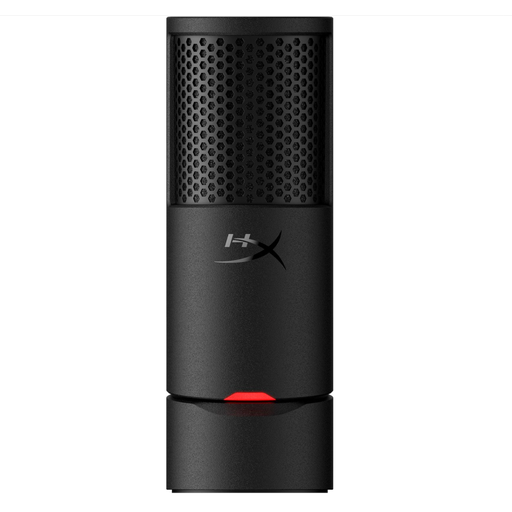 Image unavailable
HyperX SoloCast 2
A USB option to compare for a desktop set-up and voice recording.
The product title mentions a cardioid pickup pattern, plug-and-play functionality and a black finish.
View on Joybuy
 Image unavailable
Razer Seiren V3 Mini Quartz
A compact USB option if you’re looking for a small desktop set-up.
The product title mentions an ultra-compact design and tap-to-mute control.
View on Joybuy
Frequently asked questions
How do I make a test recording of an expressive gallery label?
Read the softest and loudest passages from the position you intend to use, then listen through headphones for echo, plosives and distortion. For the Wave:3 MK.2, Elgato recommends speaking towards the front from a distance of around 10–20 cm.
What can I do if my recording still sounds echoey with a new microphone?
First, try recording in a different place or moving the microphone, then record another short clip. Shure explains that a microphone can’t improve the room’s acoustics, so digital features aren’t a guaranteed solution for reflections.
Can I use a USB microphone without a computer or other recording device?
You need a compatible device to make the recording. For example, RØDE describes the NT-USB Mini as suitable for use with a computer or supported tablet; check the port, cable and compatibility for the model you choose.
What are my return and warranty rights as a consumer in the Netherlands?
For an online purchase of a standard product, you generally have up to 14 days after delivery to change your mind; ACM ConsuWijzer lists some exceptions. In addition, if a product doesn’t meet expectations under normal use, the seller must resolve the issue in accordance with statutory rules. This right isn’t simply limited to the length of a manufacturer’s warranty.
Can a gallery record and publish someone else’s voice?
If personal data is processed, the Dutch Data Protection Authority says there must be a valid legal basis under the GDPR. Consent is one possible legal basis, but it isn’t automatically the only one. What’s required in a particular situation depends on who is being recorded and how the recording is used.


