
Facilitator supporting remote participants
You’re facilitating a conversation in which participants speak from separate devices. You want every speaker to be easy to hear and for participants to take turns smoothly.


If each participant speaks through their own device, a wired USB headset per speaker is a suitable set-up. Consider the microphone, connection and fit. If several speakers are using one computer, a personal headset is not a proven way to record everyone: consider a USB speakerphone or another shared-room set-up. In a noisy room, microphone noise reduction and wearing comfort are separate factors to bear in mind.
You’re facilitating a conversation in which participants speak from separate devices. You want every speaker to be easy to hear and for participants to take turns smoothly.
Several participants are sitting around one computer. First decide whether a personal headset is suitable for the recording set-up you need, or whether you need shared audio equipment.
You’ll be speaking for an extended time in a room with background noise, so you’re weighing up the microphone features, focus and fit.
Choose this when: each participant speaks and listens through their own computer.
Bear in mind: each headset is designed for the person wearing it. Also check that the USB plug is compatible with their device.
Choose this when: one participant is speaking from a noisy workspace.
Bear in mind: noise reduction on the microphone is different from sound isolation or ANC for the listener.
Choose this when: several participants are joining from one computer around a table.
Bear in mind: a speakerphone doesn’t give each participant their own microphone. Test how clearly people can be heard from the different seats.
| What to consider | What to look for when buying | Who is this important for? |
|---|---|---|
| Making sure every speaker can be heard | Decide how many people will be speaking through the same computer. For a shared set-up, test how clearly people can be heard from every seat. | If I’m sharing one computer with several people, I want to know everyone can be heard before choosing a headset. For around 36% of consumers, choosing the right group set-up is their top buying priority. |
| Microphone performance with background noise | Check that the microphone has noise reduction and test it in the environment where you’ll usually use it. | When I’m teaching from a noisy room, I want the other participants to hear my voice clearly. Around 29% of consumers prioritise making their own voice clear when there’s background noise. |
| Comfort during longer lessons | Check the adjustability and whether the exact model is mono or stereo. Assess the fit during a session that reflects how you’ll use it. | For longer lessons, I want a fit that suits me and doesn’t get in the way of how I listen. Fit and listening comfort are the most important factors for around 21% of consumers. |
| Connection and controls | Check whether the computer and headset use USB-A or USB-C, and whether the version you’re considering includes the mute control or Teams feature you want. | If I want to connect and control my headset without interruptions, I check the plug and features for the specific version. For around 14% of consumers, connection and call controls are the top priority. |
A personal microphone and a shared-room set-up address different recording needs. Logitech and Jabra describe microphone noise reduction on specific headsets; Microsoft also explains the adjustable noise suppression settings in Teams. Check which component processes the sound, then test the settings with the lesson audio you need to keep audible.
A headset with a microphone positioned near the wearer is not the same as audio equipment designed for several people in a room.
First decide whether each speaker will use their own device. If everyone is sharing one computer, you could consider a speakerphone or another room set-up and test the recording from different seats.
A shared lesson set-up may still need separate audio equipment for the room.
A feature that reduces sound for the wearer doesn’t prove that the microphone will keep background speech out of the call.
Compare the microphone feature separately and make a test call with the kind of background noise you’d normally hear during a lesson.
Connections and features can vary between versions. A feature on one model doesn’t automatically apply to every variant.
Before buying, check the full model name, USB plug and controls you need. If you need a Teams feature, check that it’s available on the specific version.
If the plug isn’t compatible, you may need a suitable adapter or a different version.
The H390 is a wired USB-A headset for an individual computer set-up. Logitech also offers equipment for group rooms, which is designed for a different use case.
The Ayda USB-ENC is an on-ear headset for individual calls on a PC.
The Blackwire 3200 series includes wired personal USB headsets in mono and stereo styles.
The Evolve2 30 is a personal wired headset for calls.
The ADAPT 160T USB II is a wired, binaural headset for individual use.
The models below are personal wired USB headsets for one participant per device. They aren’t shared microphone solutions for several people using one computer.
 No image available
An option to consider for a participant joining a call from their own device.
 No image available
A wired headset for an individual speaker joining via USB.
 No image available
An option for a participant looking for a wired USB headset for calls.
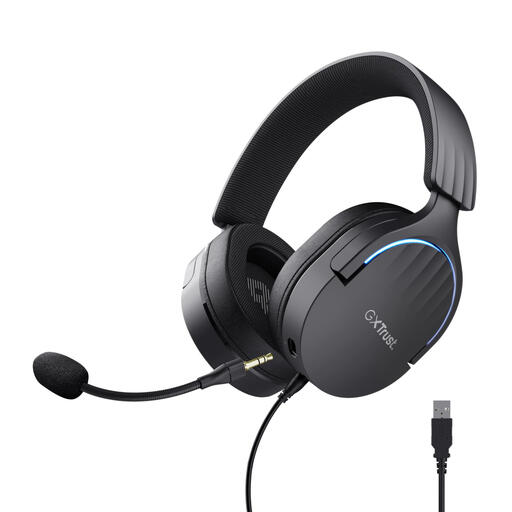 No image available
A personal wired USB headset to consider when one participant is communicating via a PC.
 No image available
A personal headset to consider for a participant making calls from a computer.
Don’t assume so without testing: a personal headset has a microphone positioned near the wearer. For several people using one computer, you could consider a USB speakerphone or another room set-up. Test the sound from every seat.
In Teams and, where relevant, your browser, select the right microphone and speaker. Check the audio source and mute status before joining. Microsoft Support also explains Teams noise suppression settings; adjust them to suit the sounds that need to remain audible during the lesson.
Not as a general requirement for every conversation lesson. If synchronised muting or other integrated Teams controls are important, check the certification for the specific version. Microsoft describes these features for certified personal peripherals.
Not automatically; buying a headset doesn’t in itself give you permission to record. The Dutch Data Protection Authority points out that schools and universities must assess privacy risks and minimise the impact on privacy when making video calls online. Whether a DPIA is required depends, among other things, on the risk of the specific processing activity. Also check the institution’s policy before recording.
Before a session, check the microphone position and the condition of the cable and connection. Follow the manufacturer’s cleaning instructions for the model you’ve chosen, especially for shared ear cushions.