
Presenting to online attendees
You’re sharing research findings on a computer and want to be able to mute and unmute the microphone quickly while speaking.


If you mainly present to online attendees, choose a wired USB headset with a microphone, connection and mute control that suit your computer and the way you work. If you also want to hear questions from people in the room, consider a mono model. And if everyone in the room needs to hear you, a personal USB headset is no substitute for suitable room audio. Before your presentation, test which microphone your meeting app is using and make sure you can find the mute control quickly.
You’re sharing research findings on a computer and want to be able to mute and unmute the microphone quickly while speaking.
You’re addressing online attendees but also want to hear questions from people in the room; a mono headset may be a good fit.
You’re looking for a comfortable headband and a cable that reaches your speaking position, as well as a connection that works with your computer.
Choose this option: if you mainly follow online attendees and need to focus on sound from your computer.
Bear in mind: two earcups are less suitable if you also want to follow conversations around you; a cable limits where you can stand.
Choose this option: if people in the room as well as online attendees may ask questions, and you want to keep one ear free.
Bear in mind: mono doesn’t offer the same listening isolation as stereo; check the fit of the exact model.
Choose this option: if several people in the room need to hear you through loudspeakers.
Bear in mind: a personal USB headset isn’t a standalone sound system for a room; first work out how you’ll connect to the equipment available.
| What to consider | What should you check? | Who should prioritise this? |
|---|---|---|
| Microphone and muting | Where is the mute control, how can you tell when the microphone is muted, and does your meeting app select the headset microphone? | For an online presentation, I want to speak clearly and mute without having to search for the control. Around 33% of consumers prioritise speaking and microphone controls most. |
| Staying connected to the room | Are you expecting questions in person, and is the exact model mono or stereo? | If questions may come from the room, I want to stay involved online while also hearing people in person. Around 27% of consumers prioritise staying connected to the room. |
| Connection and cable reach | Compare the connector and any adapter with the available computer ports, and check that the cable reaches your speaking position. | I want to know whether the headset will work with my computer and reach my speaking position. Around 20% of consumers prioritise connection and set-up most. |
| Comfort for extended wear | Check the fit and adjustability; if possible, try the headset on before wearing it for a long time. | For a longer presentation, I want a comfortable headband and earcups. Around 20% of consumers prioritise wearing comfort. |
The USB headsets described are designed for personal computer and call use, not as standalone sound systems for a room.
First work out who needs to hear you and how your voice will reach them.
The Trust Ayda USB-ENC and an Ayda model with a 3.5 mm connection don’t have the same connector.
Compare the full model name and connector, not just the brand and range name.
Controls vary by model, and Microsoft Teams may also have its own mute setting.
Practise using the physical control where you’ll be speaking, and check the mute status in your meeting app.
The H390 is worth considering if you’re looking for a wired computer headset with a boom microphone and in-line controls.
The Ayda USB-ENC is an on-ear USB model to compare if you’d find a flip-up mute microphone useful.
The Blackwire 3200 series is worth considering if you want to compare wired USB models in mono and stereo.
The wired Evolve 20 range is worth considering if you want to compare mono and stereo models, as well as different USB versions.
Browse these wired headsets for computer use and online calls. For each model, check that its connection and mute controls suit your presentation.
 No image available
A wired stereo headset to compare if you mainly follow online attendees.
USB connection; the product description lists in-line volume controls.
 No image available
A wired computer headset to compare for online calls.
The product description lists digital stereo audio, plug-and-play USB connectivity and an adjustable microphone.
 No image available
A wired option to compare if you have online meetings and want a physical mute control.
The product description lists USB-A with a USB-C adapter cable, stereo playback and a flip-up microphone that mutes when raised.
 No image available
A wired USB headset to compare for computer use and online communication.
The product description lists volume adjustment and microphone muting via the USB controls; the title mentions stereo playback and a microphone.
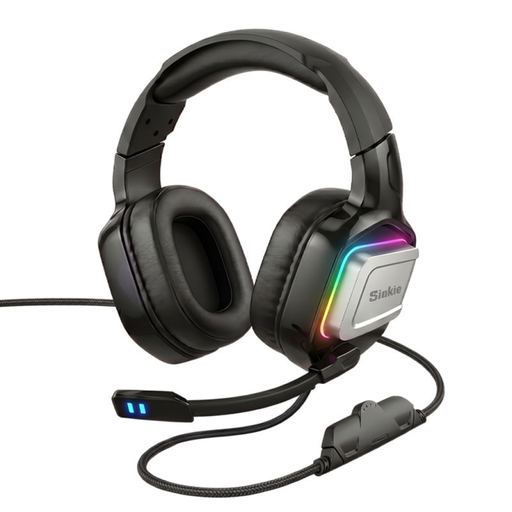 No image available
A wired headset to compare if you need both USB and a 3.5 mm connection.
The product title lists USB and 3.5 mm connections.
In your meeting app’s settings, select the connected headset as your microphone and speaker. Microsoft Support also explains how to make a test call in Teams; check that both the physical mute control and the mute setting in Teams work properly.
Don’t assume it will. The products described are personal computer headsets; treat questions from the room and any sound amplification as separate parts of your set-up.
For an eligible distance purchase from a business, you’ll generally have a 14-day cooling-off period, according to the Dutch government. If the product develops a fault, contact the seller about your statutory warranty rights; the Dutch government states that there is no fixed statutory warranty period in the Netherlands.
No. The European Commission describes CE marking as the manufacturer’s declaration that the product complies with applicable EU rules, not an independent assessment of how clearly you’ll be heard during a presentation. The rules that apply depend on the product.