Start by asking who is affected by the office noise: your conversation partner or you. If it is distracting the person at the other end, choose a headset with a noise-cancelling microphone. If you are struggling to hear your practice partner, compare mono headsets, passively isolating ear cushions and any ANC, while considering whether you need to remain approachable. Also check the connection, fit and mute controls on the exact model; manufacturer specifications are not a like-for-like test in real-world conditions.
Who is this buying guide for?
Trainers who want to be clearly understood
They practise conversations while colleagues are talking nearby and want to stop their voices from reaching the person at the other end. Stichting Hoormij cites colleagues talking and making calls as examples of workplace noise.
Trainers who want to hear others clearly
They find it hard to follow their practice partner over office chatter and need to balance blocking out sound with remaining approachable.
Trainers with long or changing sessions
They switch between conversations or workspaces and focus on a comfortable fit, the right USB connector and easily accessible mute controls.
What should you look for when choosing?
Noise-cancelling microphone
Choose this if: the person at the other end mainly hears your colleagues’ voices.
Bear in mind: microphone noise cancellation does not automatically reduce the noise you hear; manufacturers do not provide comparative measurements for your office.
Stereo headset with isolating ear cushions
Choose this if: you find it hard to follow your practice partner and can cover both ears.
Bear in mind: passive isolation can also make it harder to hear colleagues.
Mono headset
Choose this if: you need to remain approachable during practice and want to keep one ear free.
Bear in mind: your free ear will also let in background noise.
Headset with ANC
Choose this if: the noise you hear is disrupting your practice and you’re looking for a model with active noise cancellation for the listener.
Bear in mind: ANC for your ears says nothing about how well the microphone works for the person at the other end.
Stichting Hoormij describes colleagues talking and making calls as workplace noise. So first work out which person on the call is affected by the noise, then consider fit, connection and controls.
| What to consider |
What should you check? |
Who is this important for? |
| How clearly your voice comes across |
Check the microphone features, its position near your mouth and how easy it is to reach the mute control. |
When I practise conversations next to colleagues who are talking, I want the person at the other end to be able to follow what I’m saying. Around 36% of consumers prioritise how clearly their own voice comes across. |
| Hearing your practice partner |
Compare mono with stereo and check whether the model you’re considering has passive isolation or ANC. |
When I miss what the other speaker is saying over the background chatter, I want a quieter listening experience without losing sight of whether I need to hear colleagues. Around 29% of consumers prioritise being able to follow the person at the other end. |
| Comfort during longer practice sessions |
Look for adjustability and ear cushions; if possible, try the fit during a typical session. |
When my practice sessions run longer, I want a comfortable fit that suits how much background noise I still need to hear. Around 21% of consumers focus mainly on wearing comfort during longer sessions. |
| Connection and controls |
Check that the USB connector fits your computer’s port and where the mute and volume controls are located. |
When I move between workspaces, I want to be able to connect my headset and mute it quickly during a practice session. Around 14% of consumers prioritise connection and call controls. |
Common buying mistakes
-
Confusing a noise-cancelling microphone with ANC for your ears
The microphone feature is designed to affect what the person at the other end hears from your side; ANC affects the sound you hear while listening. Having one feature does not prove that the other is included.
First decide who is affected by the noise, then check both features separately on the exact model. Position the microphone near your mouth as directed in the manual.
-
Assuming every version in a headset range is the same
Fit, USB connection and microphone features can vary between versions.
Before ordering, compare the full model name and connection with the port on your work computer.
-
Focusing only on isolation when you need to hear your colleagues
Stereo ear cushions and a mono headset suit different listening needs; blocking out sound can affect how much of your surroundings you hear.
Decide in advance whether you need to keep one ear free during practice, then compare mono and stereo options accordingly.
Relevant brands to consider
Logitech
The Zone Wired and H540 are wired USB options with different microphone and control configurations.
- Logitech describes the Zone Wired as having two noise-cancelling microphones and in-line controls.
- Logitech describes the H540 as having a noise-cancelling microphone; the stated specifications do not provide a performance comparison with the Zone Wired or other brands.
Jabra
The Evolve2 40 SE may be worth considering if you’re looking for passive listening isolation.
- Jabra attributes the passive noise reduction to the ear cushions.
- Check the USB and platform version; details for earlier models do not automatically apply to every SE version.
HP Poly
The Blackwire 5200 series includes mono and stereo versions to suit different listening needs.
- HP mentions passive isolation from the ear cushions and a microphone that reduces background noise.
- Check the exact version; you can’t tell which connections and adaptors are included from the series name alone.
EPOS
The IMPACT SC 230 USB MS II is a mono option for calls; the IMPACT 860 ANC is a separate ANC model.
- EPOS specifies a noise-cancelling microphone for the IMPACT 200 series and ANC for one version of the IMPACT 800 series.
- The ANC feature on an IMPACT 800 version does not automatically apply to the SC 230.
Yealink
The UH37 range offers wired USB versions for office communications.
- Yealink describes the UH37 as having two microphones for noise reduction and isolating ear cushions.
- These are manufacturer descriptions, not an independent comparison with other headsets.
Trust
The Ayda USB-ENC is a version with a noise-cancelling microphone and flip-to-mute.
- Trust describes these features for the Ayda USB-ENC.
- The Ayda USB without ENC is a different version; don’t assume it has noise cancellation just because it shares the same family name.
USB headsets on Joybuy
These Joybuy products are wired USB headsets for conversation training; check the connection, fit and controls on each version to make sure they suit your workspace.
 No image available
Logitech PC 960 USB
A wired USB headset to consider if you want an easy way to mute during calls; check the controls on the exact version.
Joybuy
 No image available
Logitech H340 USB headset, black, wired
A wired USB headset for computer calls; check that the fit and controls suit your practice sessions.
Joybuy
 No image available
Kingston USB Hi-Fi headphones with microphone
USB headphones with a microphone to include in your comparison; check the connection and fit for your workspace and session length.
Joybuy
 No image available
Trust Ayda USB headset
A wired headset for calls; check the full model details and make sure its microphone and mute features suit your training setup.
Joybuy
 No image available
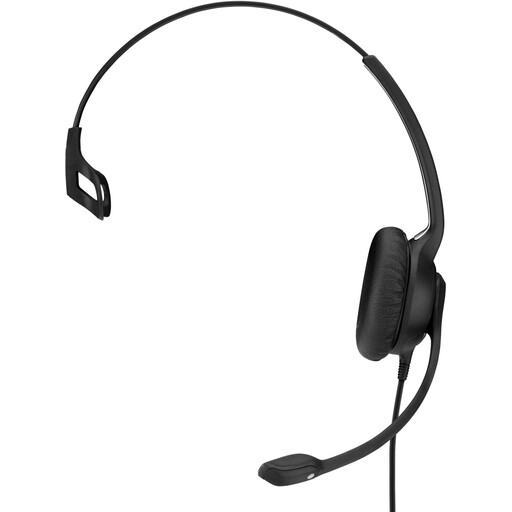
EPOS IMPACT SC 230 USB MS II
EPOS describes this model as a mono headset with a noise-cancelling microphone; this is a manufacturer specification, not a comparative performance measurement.
Joybuy
Frequently asked questions
Is microphone noise cancellation the same as ANC for my ears?
No. Check separately what the microphone does for the person at the other end and how much office chatter you hear while listening. EPOS lists ANC for the IMPACT 860 ANC; noise cancellation on another model does not prove that it has ANC.
How do I set up a USB headset for a practice call?
First check that the connector fits your computer, then select the headset as the input and output device in your calling software. Adjust the headband and position the microphone boom close to your mouth; Jabra also recommends this position in its Evolve2 40 support information.
Can the ear cushions on a USB headset be replaced?
It depends on the model. Yealink describes the UH37 ear cushions as replaceable and says replacement cushions must be bought separately; check this separately for other versions.
Can I record conversations during training without asking?
Don’t assume that you can. The Dutch Data Protection Authority states that employees must know when their conversations are being recorded and that the person at the other end of the call must also be informed in advance. Whether a particular training recording is otherwise permitted depends on how it is processed; buying a headset does not in itself give you permission to record.
What should I look for in the product safety of a USB headset in the Netherlands?
Electrical and electronic equipment sold in the Netherlands must comply with the applicable European safety requirements. The rules and any CE marking that apply to a specific headset must be determined for each product. Business.gov.nl explains that CE marking is not a general product quality mark.


