
Online meeting host
You’re discussing the draft with remote participants and want to be able to mute the microphone quickly if you need to get the room’s attention.


A personal USB headset is a good fit when one person is speaking online or listening to feedback individually. In that case, focus on the right USB connection, the mute controls and the fit. If several colleagues in the room need to join in through one computer, a personal headset may not be the right choice; a meeting speakerphone could work better for your setup. Manufacturer specifications don’t tell you how clearly people will be heard in your classroom.
You’re discussing the draft with remote participants and want to be able to mute the microphone quickly if you need to get the room’s attention.
Several colleagues in the classroom need to be able to join in. Decide in advance whether a personal headset is the right type of device for this.
You’re listening to recorded feedback for longer periods and are mainly concerned with the connection and fit, without using the headset as a group microphone.
A good fit when: one person is speaking to remote colleagues or listening to feedback individually.
Bear in mind: the microphone is designed for the wearer, and a wired model limits your freedom to move around.
A good fit when: several people in the room need to take part in the call through one computer.
Bear in mind: the conversation can be heard in the room, so it’s less private. A stated microphone range doesn’t prove that every voice will be clear in a noisy room.
| What to consider | What should you look for? | Who is this important for? |
|---|---|---|
| Clarity and muting | Check the microphone boom, mute controls and connection on the exact model. Test it in the room where you’ll use it. | When I’m discussing the draft online, I want my voice to come across clearly and to be able to mute the microphone quickly. Around 33% of consumers put the clarity of their own voice first. |
| Taking part around the table | Work out how many people need to be heard remotely, then compare the microphone setup and stated range with the table and room. | If several colleagues need to speak at once, I want to know whether everyone can join through one computer. Around 27% of consumers put participation by the whole group first. |
| USB connection | Check whether the exact model uses USB-A or USB-C, and compare the connector with the computer’s ports. | When switching between devices, I don’t want to choose the wrong connector. Around 20% of consumers put device connectivity first. |
| Fit and comfort | Check whether the exact model is mono or stereo, and consider how well it fits for the intended length of time. | If I’m listening to feedback for longer or want to hear colleagues directly, I look at the fit and whether one ear remains uncovered. Around 20% of consumers prioritise fit and staying aware of their surroundings. |
A headset microphone is designed for the wearer. That doesn’t mean it will pick up several colleagues speaking from further away in the room clearly.
Decide in advance how many people need to speak remotely, and assess a speakerphone in the space where you’ll actually use it. A separate group microphone may be needed if several people are taking part.
A claim about the microphone doesn’t automatically tell you how much background noise you’ll hear as the wearer.
Assess the microphone features and listening experience separately. Don’t assume the room will sound quiet based on a microphone specification.
A product family may include different USB connections and mono or stereo versions.
Compare the full specification of the model with the ports on your laptop or classroom computer. Also check whether any stated adapter is included with the version you’ve chosen.
The H390 is a personal USB headset for calls; the manufacturer offers it with different USB connections.
The Evolve 20 is available as a personal mono or stereo headset; the Speak2 55 is a separate type of speakerphone.
According to HP Poly, the wired Blackwire 3200 series includes mono and stereo styles for personal use.
The Ayda USB-ENC is a personal on-ear headset with microphone and volume controls.
The Joybuy products below are wired options for personal listening and calls. The selection includes USB-C earphones and personal headsets; a personal model may not be suitable if several colleagues need to take part at once.
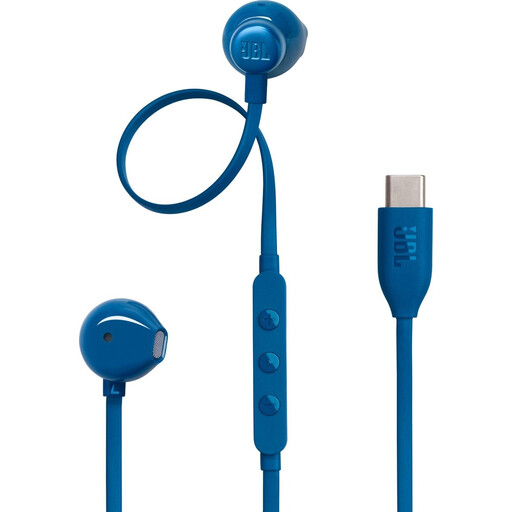 No image available
A personal option if your device has USB-C and you want to use a built-in microphone during calls.
USB-C connection, built-in microphone and in-line controls.
Keep the listening volume moderate, especially during extended use.
 No image available
A personal headset option for calls, provided the connection is compatible with your computer.
The product description lists USB-A, stereo and two integrated microphones, as well as compatibility with a USB-C adapter. Check whether the adapter is included with the version you’ve chosen.
Keep the listening volume moderate during extended use.
 No image available
A wired personal option if you want to be able to adjust and mute the microphone during a call.
The product description lists stereo audio, an adjustable microphone, a mute indicator and in-line controls.
Keep the listening volume moderate during extended use.
 No image available
A personal headset option for calls on a computer with a compatible USB connection.
The product description lists stereo audio, an adjustable headband and a noise-cancelling microphone.
A microphone specification doesn’t tell you how much background noise you’ll hear as the wearer. Keep the listening volume moderate during extended use.
 No image available
A personal option for online calls if USB Type-A is compatible and you want to be able to mute quickly.
The product description lists volume control and a flip-up microphone that mutes when raised. A USB-C adapter is also mentioned; check whether it’s included with this version.
Keep the listening volume moderate during extended use.
Connect the model to the compatible USB port and, if needed, select the headset as the recording and playback device on your computer and in your meeting app. Check the mute function beforehand and test with the participants that the right voices can be heard.
Start with the volume low and turn it up only if needed. The Dutch Arboportaal warns that excessive sound levels in the ear canal can cause hearing damage; a headset isn’t a substitute for measures to protect you from harmful workplace noise.
For a consumer purchase in the Netherlands, statutory guarantees apply to products that meet reasonable expectations, with no fixed statutory guarantee period. The Dutch government states that a 14-day cooling-off period applies in many cases to distance purchases; check the terms and exceptions for your specific purchase. This information doesn’t necessarily apply to a school buying for business purposes.
A headset doesn’t in itself give you permission to record. The Dutch Data Protection Authority’s guidance on online video calls in education includes agreeing on recording arrangements and informing those involved. Whether a particular recording is permitted depends on how it is processed and the circumstances.