
Two devices, one socket
You want to charge your speaker and phone at the same time without using two wall sockets. If so, check how much power is available from each port when both are in use.


If you want to charge your speaker and, for example, your phone from a single socket, choose a multi-port USB charger with the right connections and check the power available when several devices are plugged in at once. If you also need standard mains sockets, consider a USB power strip. In either case, first check your speaker model’s charging requirements and make sure the mains-powered charger carries the required CE marking.
You want to charge your speaker and phone at the same time without using two wall sockets. If so, check how much power is available from each port when both are in use.
You want to check first that the plug, cable and charger output are suitable for your speaker model, especially if it’s an older one.
You want to charge your speaker via USB while keeping standard mains plugs connected at the same time.
When sockets are in short supply, your choice mainly depends on what you want to connect at the same time, which cable fits your speaker and whether you need to keep standard mains sockets free.
| What to consider | What to look for | Who is this important for? |
|---|---|---|
| Charging multiple devices at once | Check the port types and the power available from each port when you connect several devices. | If I want to charge my speaker and phone from one socket, I look at both the connections and the shared power output. For around 36% of consumers, charging multiple devices at once is the main reason to buy. |
| Speaker compatibility | Check the connection, charging voltage and current for your exact speaker model in its manual, and choose a suitable cable. | I want to make sure the charger and cable are compatible with my speaker. For around 29% of consumers, compatibility is the main reason to buy. |
| Standard mains sockets | Decide how many mains sockets you still need and check the USB output of a power strip. | If I need standard mains sockets as well as USB, I want to keep using those connections. That’s the main reason to buy for around 21% of consumers. |
| Safe use | Check that a mains-powered charger carries the required CE marking, and don’t use damaged cables or chargers. | I want to be able to check the required product marking and use my charging setup carefully. Safety is the main reason to buy for around 14% of consumers. |
The power output for one port doesn’t necessarily tell you how much power will be available per port when you connect several devices. IKEA lists 45 W for the SJÖSS 805.744.38 when using one USB-C port, and 22 W per connection when using two.
Compare the stated output for the number of devices you actually want to charge at once with your speaker’s charging requirements.
Belkin lists a wall charger as included with the WCB006vfWH. The cable must also be compatible with both the charger and your speaker.
Check what’s included in the box and both ends of the cable before buying. If you don’t already have a suitable cable, you may need to buy one separately.
Brandweer Nederland warns that connecting too many power strips together can cause overloading and fire.
Choose a suitable charging setup and don’t connect power strips to each other without careful consideration.
The SJÖSS range includes USB-C wall chargers; according to IKEA, the KOPPLA range also includes power strips with standard sockets and USB.
The BoostCharge WCB006vfWH is a wall charger with two USB-C ports.
The Nexode Pro 65W, SKU 25261, is a multi-port charger with USB-C and USB-A connections.
These Joybuy products include USB power strips and multi-port USB chargers for situations where you want to connect several devices to a single charging point. In the Netherlands, mains-powered USB chargers must carry CE marking. Check the marking on the specific product before buying, as advised by the Netherlands Food and Consumer Product Safety Authority.
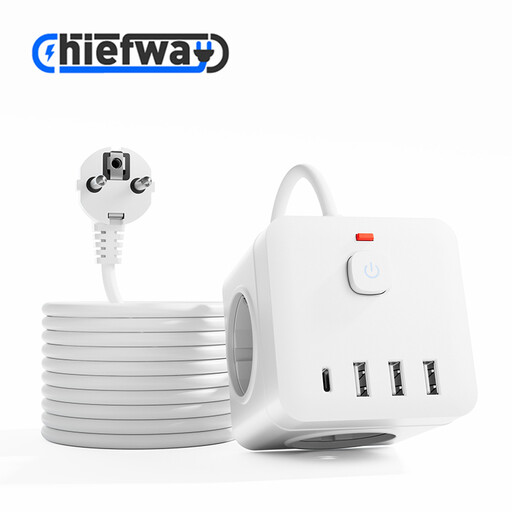 No image available
An option if you need standard sockets as well as USB charging.
Stated maximum: 2500 W; cable: 1.5 m. Don’t connect power strips to each other without careful consideration.
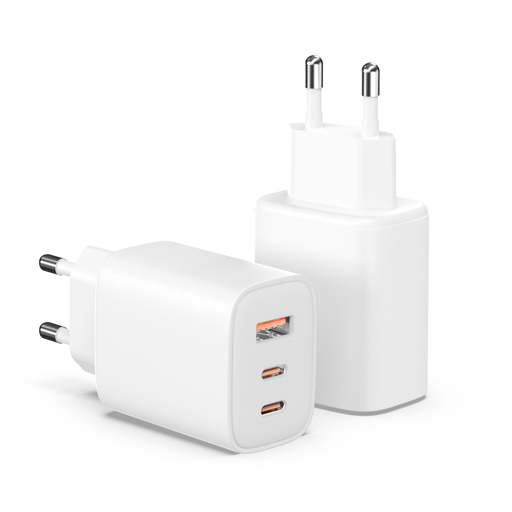 No image available
A multi-port option if you want to connect your speaker and other USB devices to a single wall socket.
The product name lists a maximum of 65 W, two USB-C ports and one USB-A port. Check how much power is available when using several ports at once.
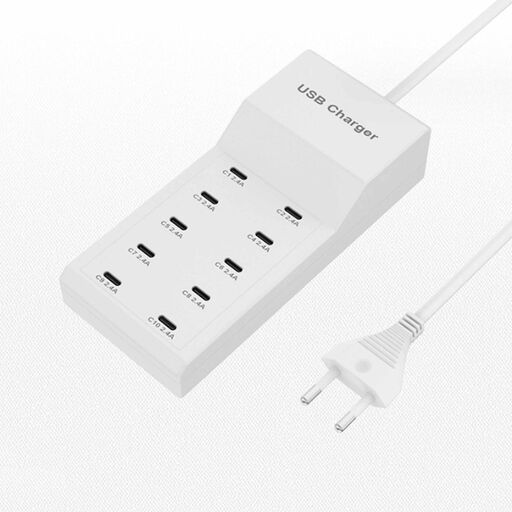 No image available
An option for connecting several USB devices to a single charging point.
The product name lists 10 ports, including USB-C and USB-A.
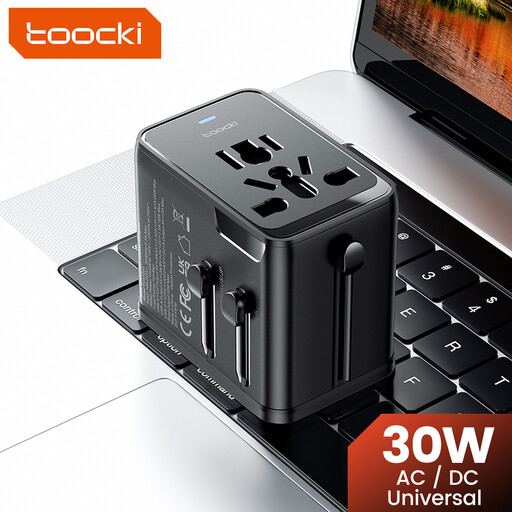 No image available
A travel adapter with several USB ports, designed for those who want to combine an adapter with USB charging.
The product name lists 30 W PD, one USB-A port and two USB-C ports, with plug options for the EU, UK, US and Australia.
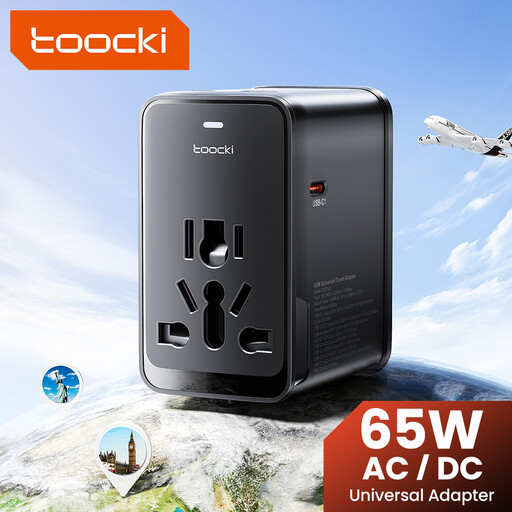 No image available
A travel adapter with several USB ports for anyone looking for an adapter as well as USB charging.
The product name lists a maximum of 65 W PD, one USB-A port and three USB-C ports, with plug options for the EU, UK, US and Australia.
No. Check the connection and charging specifications for your exact speaker model. The EU rules for the specified category of new portable speakers have applied since 28 December 2024, but they don’t automatically tell you which connection an older model has. JBL specifies a Type-C port and a charging time at 5 V/3 A for the Charge 5; those details don’t necessarily apply to other models.
A charger may share its output power between ports. IKEA lists 45 W for the SJÖSS 805.744.38 when using one USB-C connection, and 22 W per connection when using two. IKEA also says that connecting a device may briefly interrupt charging that’s already in progress.
Brandweer Nederland recommends placing a charger in an open space so heat can escape, not charging devices under a pillow or duvet, and avoiding damaged cables or chargers. IKEA says to unplug the SJÖSS charger before cleaning it and wipe it with a dry cloth.
According to ACM ConsuWijzer, your statutory guarantee is separate from any manufacturer’s or seller’s guarantee. If a product doesn’t perform as you could reasonably expect during normal use, the seller is responsible for providing a suitable solution at no cost. In the Netherlands, there isn’t one fixed guarantee period for every product.
The Netherlands Food and Consumer Product Safety Authority states that CE marking is mandatory for electrical products. Check the marking on the specific product; CE isn’t proof that it has passed an independent safety test. The new EU ecodesign requirements for external power supplies will apply from 14 December 2028.