What should you look for in a USB charger?
First, check your phone’s connector and charging requirements. Then decide whether one port is enough and choose a dry spot with plenty of space around it.
| What to consider |
What should you check? |
Who should pay attention? |
| A dry, clear charging spot |
Check the CE marking and product identity. Keep the adapter and cable undamaged, dry and unobstructed. |
If you charge your phone on the worktop, you’ll want to avoid moisture and blocked ventilation. Around 36% of consumers with this charging need put a safe charging spot first. |
| Connector and charging protocol |
Check your phone model, the port on your phone, the cable connectors and the charging specifications for your phone and adapter. |
If you’re looking for a cable and charging technology that suit your phone, you won’t want to pay for features it can’t use. Around 29% of these consumers put compatibility first. |
| The charging speed you want |
Compare the charging protocol and power output of the exact adapter version with your phone’s charging requirements. |
If you mainly want to use your phone’s fast-charging mode, check that your phone, cable and adapter all support it. Around 21% of these consumers put charging time first. |
| A second port |
Check the number of ports and the stated power output per port when using both at the same time. |
If you regularly charge another device as well as your phone, an extra port may be useful. The total power output isn’t automatically the power output per port. Around 14% of these consumers mainly want to charge devices simultaneously. |
CE marking is compulsory for mains adapters covered by the Dutch Commodities Act Decree on Electrical Equipment, according to the Netherlands Food and Consumer Product Safety Authority. A marking on its own doesn’t prove that an individual item offered for sale has been independently tested.
USB chargers at Joybuy
This selection includes USB-C mains adapters for a single phone, as well as multi-port adapters for anyone who wants to charge a second device too.
 No image available
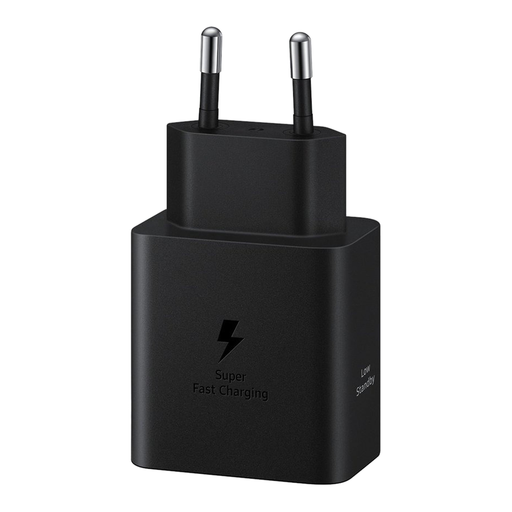
Samsung 45 W USB-C charger (without cable)
An option to compare if your phone is compatible with a USB-C charger; check your device’s charging requirements.
Stated power output: 45 W. USB-C to USB-C. No cable included.
View at Joybuy
 No image available
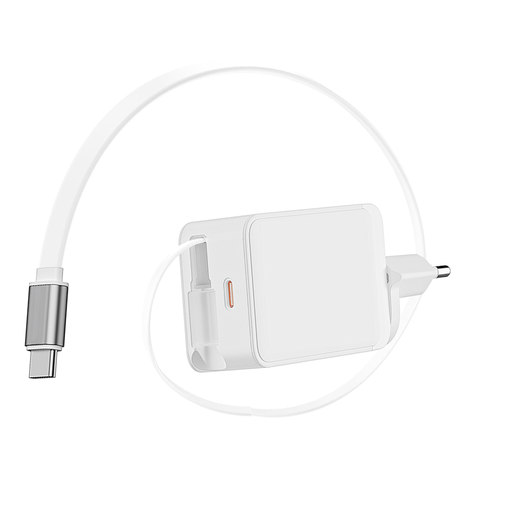
65 W USB-C mains adapter with retractable cable, 2 ports
The two USB-C ports may suit a charging spot where you also want to connect a second USB-C device; check the power output per port.
Stated power output: 65 W. Two USB-C ports. The product name specifies a retractable USB-C cable.
View at Joybuy
 No image available
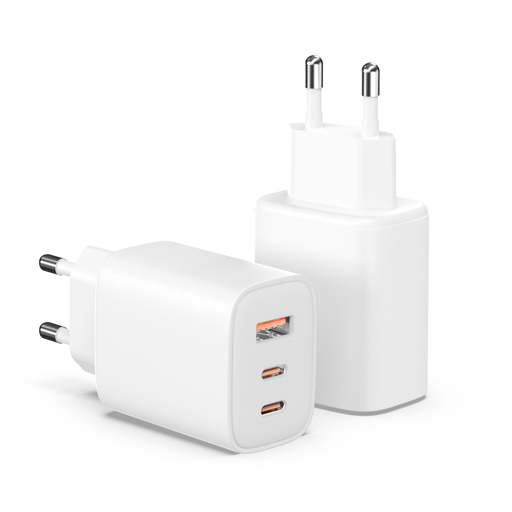
65 W USB mains adapter, 2 USB-C ports and 1 USB-A port
The range of ports may be useful if you want to charge devices with different connectors in one place; check which cables you’ll need.
Stated power output: 65 W. Two USB-C ports and one USB-A port.
View at Joybuy
 No image available
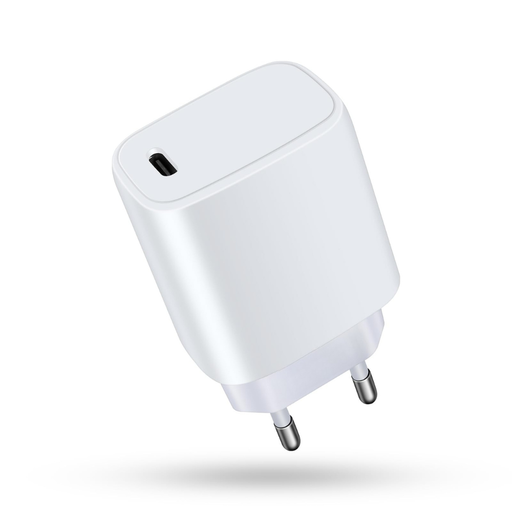
20 W USB-C mains adapter, 1 port
A single-port option to compare if you usually charge one device at a time; check that the power output suits your phone.
Stated power output: 20 W. One USB-C port.
View at Joybuy
 No image available
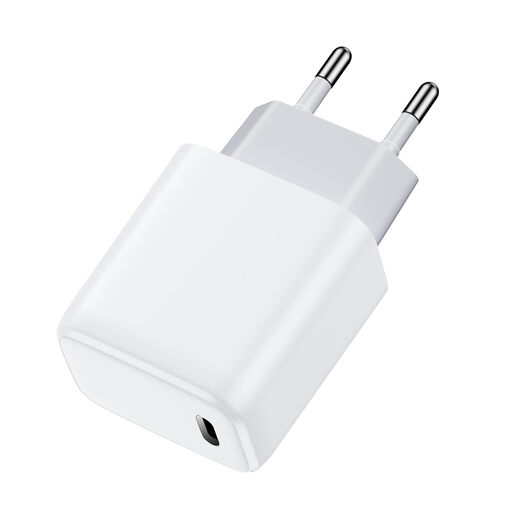
30 W USB-C mains adapter, 1 port
A single-port option to compare if you usually charge one phone at a time; the stated power output doesn’t guarantee a particular charging time.
Stated power output: 30 W. One USB-C port.
View at Joybuy
Frequently asked questions
Can I put the charger on the worktop next to the sink?
Choose a spot where your phone, adapter and connectors will stay dry, and where heat can escape. The Netherlands Fire Service advises placing chargers in a clear space and not using damaged cables.
Do I always need a charger from my phone’s brand for fast charging?
Not always: Apple also lists suitable USB-PD adapters from other brands. For your phone model, check the cable, charging technology and power requirements. Samsung links Super Fast Charging to compatible devices.
Do I need to buy a cable as well?
That depends on the cable you already have and the exact version of the adapter. Samsung states that the EP-T2510NBEGEU doesn’t include a cable and describes the EP-T2510XBEGEU as a version supplied with a USB-C-to-USB-C cable. Also check which connector your phone uses.
Which marking is required for a USB mains adapter in the Netherlands?
CE marking is compulsory for electrical equipment covered by the Dutch Commodities Act Decree on Electrical Equipment, according to the Netherlands Food and Consumer Product Safety Authority. A CE mark doesn’t prove that every individual item offered for sale has been independently tested.
Is the stated wattage the same as my phone’s charging speed?
No. An adapter’s maximum power output doesn’t promise a particular charging time. Your phone, cable and supported charging technology all help determine what your device can make use of.


