
Vandaag of morgen in huis

Kwaliteit gegarandeerd

Welkomstaanbiedingen ontgrendelen: GRATIS bezorging | Tot 80% korting | Gratis 30 dagen JoyPlus-proefperiode
Download de app
Traveling with a bag full of different chargers and cables is a familiar frustration. You arrive at your hotel only to discover you have the wrong plug, or that your charger is too weak to power your laptop and phone simultaneously. A good USB-C travel adapter seems like the solution, but the market is flooded with models that overpromise and underdeliver.
As a Joybuy Product Recommendation Officer, I see the daily struggles travellers face. Before you invest in a new travel companion, it's wise to understand the most common pitfalls.
To avoid ending up with a useless adapter in your suitcase, there are a few specifications you should always check. These are the objective features that distinguish a handy gadget from e-waste.
The most critical specification for a modern traveller is the power output, expressed in Watts (W). To charge a laptop via USB-C, you need a port that supports Power Delivery (PD) and provides at least 45W to 65W.
A 70W travel adapter is a solid choice. This output is sufficient to charge most laptops at full speed, even while you simultaneously power your phone and other gadgets. A lower wattage will result in slow charging or a laptop that drains faster than it charges.
A modern travel adapter with USB ports must be versatile. Look for a model with a combination of:
Such a model functions as an all-in-one travel charger, saving you the need to carry multiple chargers.
No one wants a bulky, heavy brick in their carry-on. A compact travel adapter is essential. Pay attention to smart design choices that make life easier. A great example is a travel adapter with a retractable cable. This prevents a tangle of loose cables and makes packing and unpacking much neater. Also, always check if the adapter is CE marked, which indicates that the product complies with European safety standards.
Not every traveller has the same needs. Below are a few options that suit different use cases, based on their specifications.
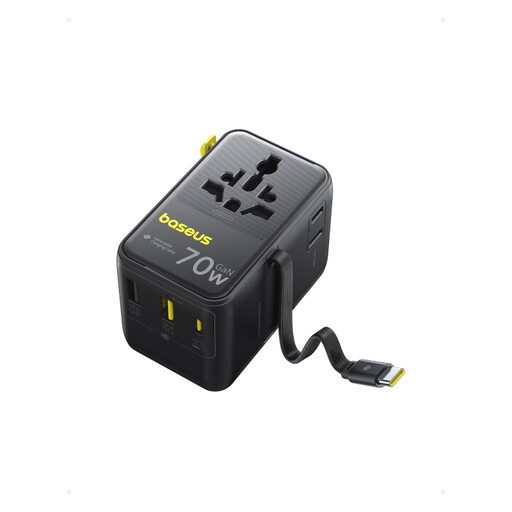
Why This Fits Their Persona: This traveller wants one device that does it all to keep their luggage light. This Baseus travel adapter replaces the chargers for your laptop, phone, earbuds, and more, combining them into a single compact unit.
Unlike weak "universal" adapters, this model delivers a powerful 70W total output, including a fast USB-C port suitable for laptops.
The 6-in-1 design with two AC ports, two USB-A, one USB-C, and an integrated 68 cm retractable cable ensures maximum functionality and a tidy (travel) workspace.
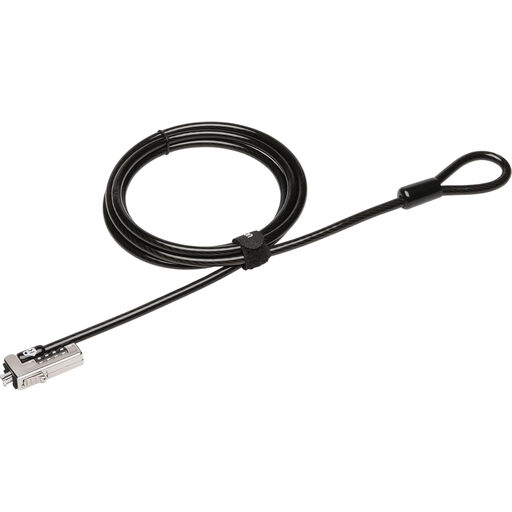
Why This Fits Their Persona: This traveller often works in public spaces like airports, libraries, or co-working spaces. While the travel adapter powers their devices, this lock ensures their valuable laptop stays secure.
This product addresses a different, but equally important, travel pitfall: theft. It provides peace of mind when you need to step away from your workspace.
The 1.8-meter steel cable offers flexibility to anchor your laptop to a fixed object. The keyless combination lock means you don't have to carry an extra key.
We've curated a complete, up-to-date list of products that fully meet these strict selection criteria and Dutch safety regulations.
No, this is a crucial distinction. A travel adapter only ensures that the shape of your plug fits the foreign outlet. It does not change the voltage (expressed in Volts). Most modern chargers for laptops and phones are designed for a wide voltage range (often indicated as 100-240V on the charger itself). Always check this. Devices without such a charger, like some hairdryers or kettles, require a separate, often heavy, voltage converter.
Not necessarily. The key is the power output (wattage) of the USB-C port. For most modern laptops, you need a port that delivers at least 45W to 65W via the Power Delivery (PD) standard. A travel adapter with a 15W or 20W USB-C port will barely charge your laptop, if at all. Therefore, always check the port's specifications.
GaN stands for Gallium Nitride. It is a semiconductor material used in modern chargers as an alternative to traditional silicon. For you as a user, this has practical benefits: GaN chargers are generally more compact, lighter, and more efficient (they convert more electricity into power and less into heat) than older chargers with the same output. The aforementioned Baseus travel adapter, for example, uses this technology.
