
Vandaag of morgen in huis

Kwaliteit gegarandeerd

Welkomstaanbiedingen ontgrendelen: GRATIS bezorging | Tot 80% korting | Gratis 30 dagen JoyPlus-proefperiode
Download de app
A flat smartphone is rarely convenient when you’re out and about. However, a power bank with USB-C is not automatically suitable for every user. A compact model can be handy for everyday use, while a larger power bank may be needed for a tablet or laptop. Terms such as “fast charging”, “wireless” and “universal” only mean something when the technical specifications support them.
The main pitfalls:
Capacity is usually stated in mAh. A 10000 mAh power bank is suitable for everyday emergencies, such as topping up your smartphone during a train journey or working day. A 20000 mAh power bank offers more reserve power for several devices or longer trips, but is generally heavier and larger.
Also consider the dimensions and weight. A compact model weighing around 100 grams fits easily into a jacket pocket, but stores less energy. For a laptop or tablet, the combination of capacity and output power is particularly important.
For air travel, check the airline’s rules. Permitted energy is often expressed in Wh and varies between carriers. Keep a power bank in your hand luggage and follow the airline’s latest instructions.
A fast power bank states its maximum output power in watts. For smartphones, 18 to 30 W is often practical, provided the device supports the relevant charging standard. Tablets and USB-C laptops often require more, such as 45, 65 or 100 W.
Check these three points:
For example, a USB-C power bank rated at 87 W may, according to the product description, deliver a maximum of 65 W to one device, with the remaining power available for other devices. This makes the specification more interesting for a laptop user than for someone who only charges a smartphone.
A USB-C fast charger for the mains is a different product from a power bank. A mains adapter does not charge itself and is therefore not intended for use without a power socket.
A USB-C power bank with a built-in cable means you don’t have to remember to bring a separate cable. However, check whether the cable is long enough and which connector is needed at the other end. A built-in cable can also wear out, so look at its construction and any information about flexibility.
A magnetic power bank is particularly useful if you want to attach a compatible smartphone directly to the back. With a Qi2 power bank, both the phone and the case must be suitable for the magnetic and wireless standard being used. According to Baseus’s product description, the model below supports Qi2 wireless charging up to 15 W and wired charging up to 45 W. The actual speed depends on the device, cable, case and charging protocol.
Also pay attention to heat, ventilation and safety. Use a power bank in a dry environment, keep it away from heat and do not use damaged cables. A CE marking is relevant within the European market, but you should also check the manufacturer’s details, warnings, warranty and returns policy.
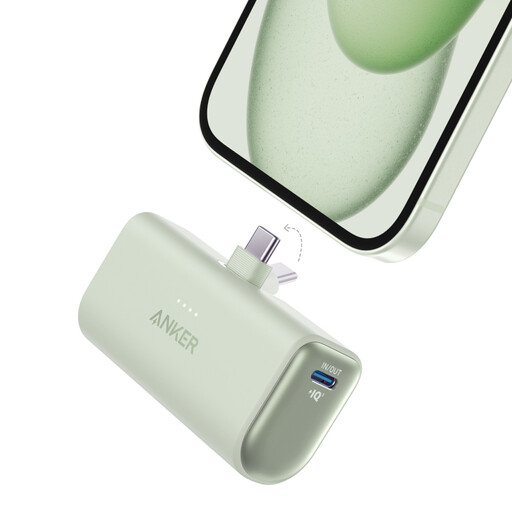
Why it suits this profile: With a capacity of 5,002 mAh and a weight of approximately 99 grams, this model is designed for short trips, students and everyday use. The built-in USB-C connector and two USB-C ports reduce the number of separate accessories you need.
The specifications state both the 22.5 W output and the exact weight and dimensions. This means you don’t have to rely solely on the word “compact”.
99 grams, foldable USB-C connector, two USB-C ports and a stated output power of 22.7 W.
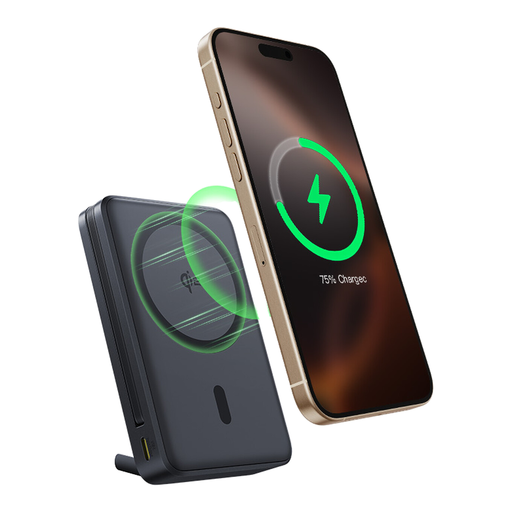
Why it suits this profile: This model combines cable charging, wireless charging and a built-in stand. It’s ideal for users who want to keep viewing their phone during a video call, train journey or work session.
The product description distinguishes between Qi2 wireless charging up to 15 W and charging via the built-in USB-C cable up to 45 W. This clearly separates convenience from speed.
10,000 mAh, built-in USB-C cable, stated wired output of 45 W, Qi2 support and an integrated stand.
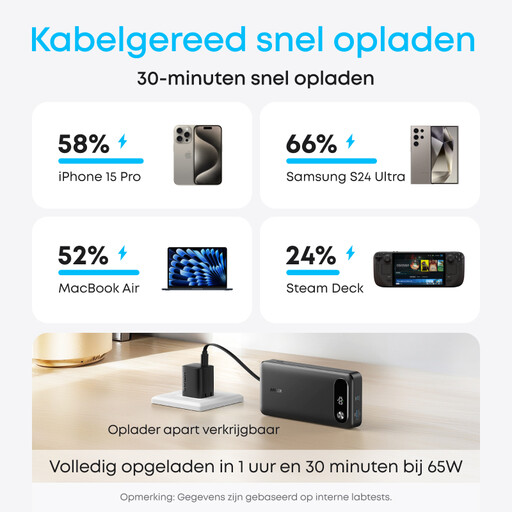
Why it suits this profile: The combination of 20,000 mAh, up to 65 W for one device and charging three devices simultaneously is aimed at professionals, travellers and users of smartphones, tablets and USB-C laptops.
The product specification states both the total output of 87 W and the 65 W limit for one device. This prevents confusion when charging multiple devices.
20,000 mAh, integrated USB-C cable, three simultaneous connections and support for devices with higher charging requirements.
We’ve put together a complete, up-to-date list of products that fully meet these strict selection criteria and the applicable European safety regulations.
That depends on your device’s connector and charging protocol. A Samsung smartphone with USB-C can be connected directly using a USB-C cable. Certain iPhone models require a suitable cable. Also check whether your phone supports USB Power Delivery or another fast-charging protocol.
Its lifespan depends on charging cycles, storage and conditions of use. Store the power bank in a dry place and keep it away from extreme heat. Do not leave it completely empty for extended periods and do not use a damaged cable. The manufacturer’s warranty and statutory guarantee may vary by product and seller.
Wireless charging is mainly about convenience, but based on the stated product specifications, wired charging is often faster and more efficient. With wireless charging, alignment, phone cases and heat generation can affect the speed. So choose a magnetic power bank for convenience, and one with a built-in USB-C cable when charging power is more important.
