
Vandaag of morgen in huis

Kwaliteit gegarandeerd

Welkomstaanbiedingen ontgrendelen: GRATIS bezorging | Tot 80% korting | Gratis 30 dagen JoyPlus-proefperiode
Download de app
A drawer full of chargers, but not a single one that's truly fast or can handle all your devices at once. Sound familiar? The switch to USB-C was supposed to simplify everything, but the reality is often different. Many chargers make lofty promises but let you down with slow speeds, inconvenient sizes, or compatibility issues.
As a Joybuy Product Recommendation Officer, I see the challenges consumers face every day. Before you invest in a new USB-C fast charger, it's crucial to recognize three common pitfalls that can cost you money and patience.
Fortunately, these problems are easy to avoid if you know what to look for.
To avoid a bad purchase, you don't need to dig through a technical manual. Focus on these three concrete specifications.
The total wattage (e.g., 65W or 100W) is the maximum power the charger can deliver across all ports combined. More important is the output specification per port. A good multi-device charger clearly specifies how many watts each port delivers, both individually and when used simultaneously.
Look for a charger that can deliver at least 45W to 65W on a single USB-C port if you want to charge a modern laptop (like a MacBook Air or Dell XPS). A 65W USB-C charger is often a flexible choice that can handle most laptops and other devices.
A fast charger only works optimally if it supports the correct protocol.
Check the product details to see if PD 3.0 and, if necessary, PPS are supported.
If you see the terms GaN charger or Gallium Nitride, pay attention. This isn't a marketing gimmick. GaN is a semiconductor material that replaces traditional silicon. The practical benefits are immediately noticeable:
A compact charger with GaN technology is the modern standard for anyone who values efficiency and portability.
Not every charger is right for everyone. Below are some highlighted options, linked to specific user profiles.
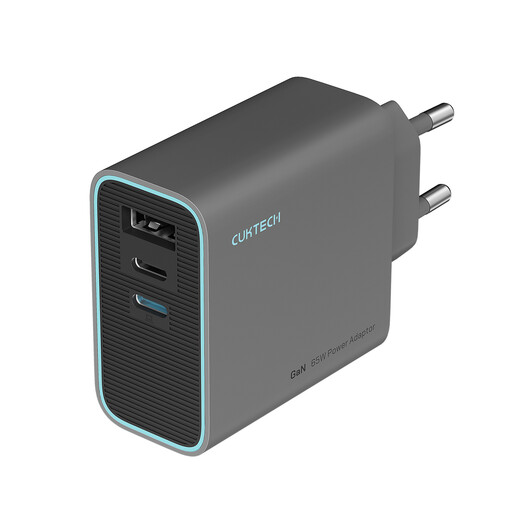
Why This Fits Their Persona: For those constantly on the move between the office, home, and appointments, this is the ideal companion. It's powerful enough for a MacBook Air, tablet, and smartphone, but thanks to its foldable plug and compact GaN design, it fits effortlessly into any bag.
This charger bypasses the outdated technology trap by using GaN. It stays cool and compact. Additionally, by providing a full 65W on a single port, it delivers enough power for a laptop, thus avoiding the 'false wattage' trap.
Three ports (2x USB-C, 1x USB-A) for maximum flexibility. The foldable plug design makes it exceptionally portable.
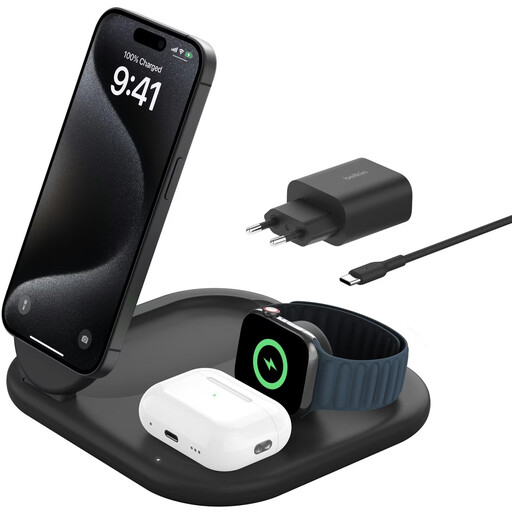
Why This Fits Their Persona: For those living entirely within the Apple ecosystem, this is the ultimate solution for a nightstand or desk. No more fussing with separate cables for your iPhone, Apple Watch, and AirPods. Everything charges wirelessly and neatly in one place.
This charging station solves 'protocol chaos' by being specifically designed for Apple devices, with support for MagSafe and the new Qi2 standard for faster wireless charging. It's an all-in-one solution that just works.
Charges 3 devices at once (iPhone, Watch, AirPods). The foldable design also makes it convenient for travel. The charger and cable are included.
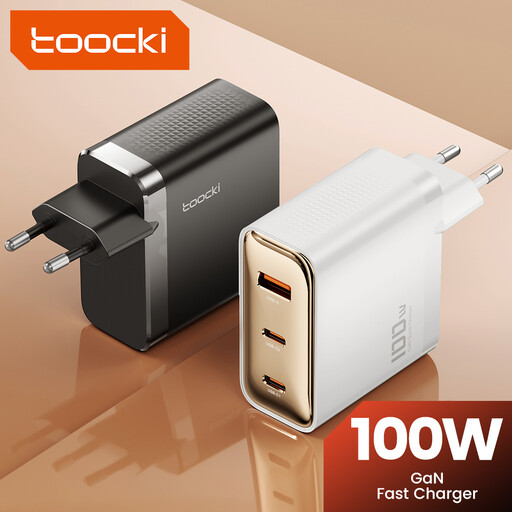
Why This Fits Their Persona: For the user with a powerful work laptop (like a MacBook Pro or Dell XPS), a fast-charging smartphone, and other gadgets. This charger delivers the high power needed to run everything at full speed, without compromise.
This charger tackles the '100W trap' head-on by being able to deliver up to 100W on a single USB-C port. It supports both PD 3.0 and QC 3.0, which resolves the protocol chaos for most devices.
Very high power output of 100W, suitable for the most demanding laptops. The GaN technology keeps the size manageable despite the high output.
We have compiled a complete, up-to-date list of products that fully meet these strict selection criteria and applicable safety standards.
Yes, generally. Because GaN chargers are more efficient, they produce less excess heat. Overheating is one of the biggest risks to the lifespan and safety of electronics. A cooler charger is a safer charger. However, always ensure you buy a charger that complies with local safety standards, such as CE certification.
Absolutely. A modern Power Delivery charger communicates with the connected device to deliver the exact amount of power required. Your phone will never draw more power than it is designed for. Using a higher-wattage charger is therefore completely safe and even future-proof for when you eventually purchase a device with a higher charging capacity.
Check two things. First, look at your laptop's specifications (or on its original charger) to see what wattage it requires. Second, check if your laptop supports charging via USB-C. For example, if your laptop requires 60W, you need a USB-C wall charger that can deliver at least 60W on a single port. In that case, a 65W USB-C charger is an excellent choice.
