
Vandaag of morgen in huis

Kwaliteit gegarandeerd

Welkomstaanbiedingen ontgrendelen: GRATIS bezorging | Tot 80% korting | Gratis 30 dagen JoyPlus-proefperiode
Download de app
An upper-arm blood pressure monitor can be useful if you want to take regular readings at home. However, many models look alike, despite important differences in cuff size, memory, controls and power supply. A low price doesn’t automatically mean a product is easy to use, and extra features don’t necessarily make a device right for your needs.
Look out for these common pitfalls:
The cuff should fit snugly around your upper arm without feeling tight. Measure your arm circumference halfway along your upper arm and compare it with the stated range. A blood pressure monitor with a large cuff may be worth considering if your arm circumference falls outside the standard range.
A range of 22-42 cm fits many adults, but always check it for yourself. The AILE, Treesmile U83H, Treesmile FC-BP100, Treesmile FC-BP102 and YE670A list a wide range. The Braun ExactFit 3 comes with two cuffs: size S up to 21 cm and size L for 33-43 cm. This can be handy in households where people have different arm circumferences.
For measuring your blood pressure at home every day, an automatic digital blood pressure monitor with a single start button is often easy to use. A large LCD screen with clear figures can help if you have difficulty seeing. For older people, a simple menu, clear instructions and, where available, spoken prompts may also be useful.
A colour scale can help you make sense of readings at a glance, but it isn’t a medical diagnosis. Use the results as a record, and discuss readings that remain outside the normal range with a doctor.
If you take readings with a partner, two user profiles can be useful. Check how many readings are stored for each user, too. According to the product description, the AILE stores 99 readings per person. The Treesmile U83H stores 90 readings per user, while the Treesmile FC-BP100 and FC-BP102 each list 120 readings per user.
A blood pressure monitor with heart-rate measurement is a common choice. Some models also offer irregular heartbeat detection. This feature alerts you if an irregular pattern is detected during a reading; it isn’t a diagnosis. According to the product descriptions, this feature is included on the Braun ExactFit 3, Sinocare ARM 30E Plus, Treesmile FC-BP100, Treesmile FC-BP102 and YE670A, among others.
Always take readings according to the instructions: rest for about five minutes, sit with both feet flat on the floor, keep your arm at heart level and don’t talk during the reading. Place the cuff on your bare upper arm.
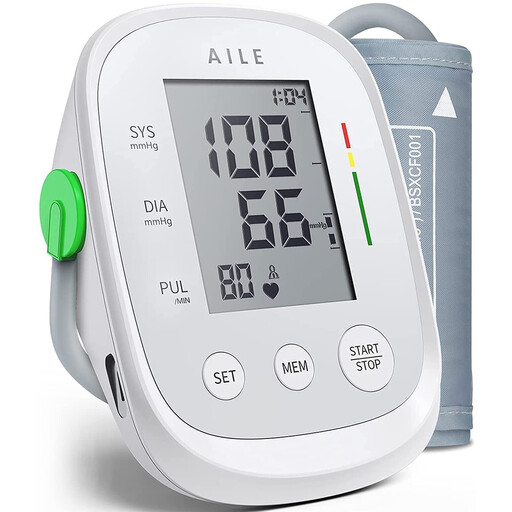
Why it suits this user: A straightforward option if you want to take readings at home on your own and don’t need an extensive app. The large cuff fits arm circumferences of 22-42 cm.
The cuff size is clearly stated, and the monitor has two user profiles with 99 memory slots per person. Please note: a USB cable is included, but batteries and an adapter aren’t.
Wide range of 22-42 cm, automatic readings, memory for two users and an average of the last three readings, according to the product description.
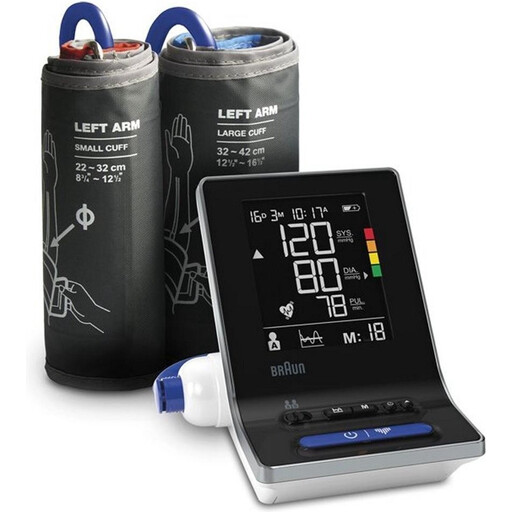
Why it suits this user: A good fit for people who value two cuffs, a large screen and familiar, straightforward controls.
The two cuffs reduce the chance of a single standard size not fitting. The product description also lists two users and 40 memory slots in total.
XL display, an average of three readings and an irregular heartbeat alert, according to the stated product specifications.
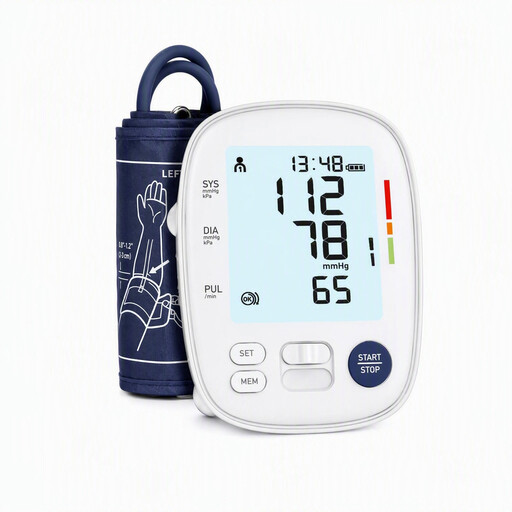
Why it suits this user: A good option for families who take readings often and want to store plenty of data for each user. The large figures are handy for older people.
The model lists a 22-42 cm cuff, two memory banks holding 120 readings each and checks for cuff placement and body movement.
Large LCD screen, battery and Type-C power options, an average of three readings and stated irregular heartbeat detection.
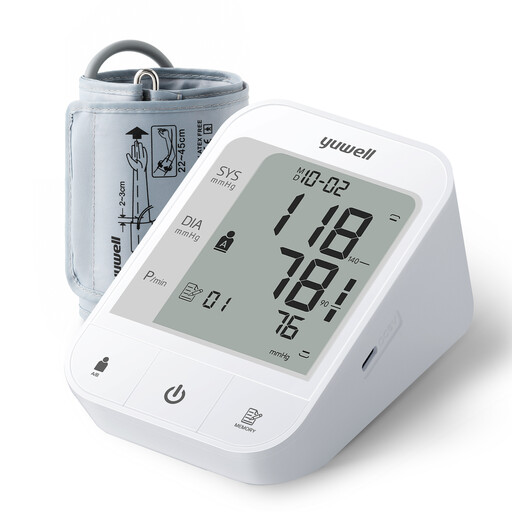
Why it suits this user: The one-button operation, 3.8-inch screen, supplied batteries and storage case make it well suited to regular use at home.
The wide cuff range of 22-45 cm means you don’t have to rely on a standard size. The monitor offers two profiles, each with 99 memory slots.
USB cable, four AA batteries, an average of three readings and a stated measurement range of ±3 mmHg, according to the product description.
A smartwatch can display your heart rate, sleep and other activity data. Product descriptions for several VoxorAI models also mention blood pressure measurement. According to the information provided, these are additional smartwatch features. If you specifically want to measure your blood pressure at home, an upper-arm model with a suitable cuff, a consistent measuring routine and built-in memory is usually a more targeted choice.
Don’t adjust your medication based on a reading alone. If you repeatedly get high readings, receive an irregular heartbeat alert or have any concerns, it’s a good idea to contact a healthcare professional.
We’ve put together a complete, up-to-date list of products that meet these strict selection criteria and the applicable European safety requirements.
First, rest for about five minutes. Sit upright with your feet flat on the floor and place the cuff on your bare upper arm, level with your heart. Keep still and don’t talk during the reading. Always follow the instructions for your chosen device.
Its lifespan depends on how it’s used, the batteries, storage and maintenance. Keep the device dry, avoid dropping it and clean the cuff according to the instructions. Check regularly that the cable, tube and hook-and-loop fastening aren’t damaged.
The ongoing costs are usually for batteries, unless you use a model powered via USB. Check whether an adapter is included, too. If you use the monitor frequently, you may need extra batteries or a replacement cuff later.
