
Vandaag of morgen in huis

Kwaliteit gegarandeerd

Welkomstaanbiedingen ontgrendelen: GRATIS bezorging | Tot 80% korting | Gratis 30 dagen JoyPlus-proefperiode
Download de app
An upper arm blood pressure monitor is a practical way for many households to keep track of readings at home. However, not every model is equally suitable for everyday use. A cuff that is too small, a hard-to-read screen or an unclear memory function can quickly leave a device unused in a drawer.
When comparing models, focus on product specifications you can check. A manufacturer may describe a device as an “accurate blood pressure monitor” or refer to clinical results, but marketing claims like these are not automatically a guarantee for every user. The way you take a reading, how well the cuff fits and your posture can all affect the result.
A standard cuff won’t suit every arm. A cuff that’s too tight or too loose can be uncomfortable and affect the reading. Always check the range in centimetres, rather than relying on the description “for adults”.
An upper arm blood pressure monitor with a wide cuff, for example one covering 22 to 42 cm, will fit a wide range of adults. Measure your upper arm according to the manufacturer’s instructions before ordering.
A compact device can be handy to store, but a small display is less practical for older people or anyone who wants to read the screen without glasses. An upper arm blood pressure monitor with a large display and clear numbers can make the difference between a device you can use independently and one you regularly need help with.
Also check the power options. Some models run on batteries and can also be powered via USB. That’s useful if you keep the monitor in one place, while batteries give you more flexibility.
A memory function is only useful if you can easily find your readings. Check whether the device supports multiple users, how many readings it stores and whether it saves the date and time.
An upper arm blood pressure monitor with irregular heartbeat detection can flag an irregular heartbeat during a reading. This is a warning, not a diagnosis. According to product information from various brands, you should contact a doctor if the warnings recur or readings are unusual. Don’t adjust your medication yourself based on a single reading taken at home.
For a reliable reading, place the cuff on your bare upper arm, about two to three centimetres above your elbow. Rest your arm at heart level, and keep still and quiet while the monitor takes a reading. Sit calmly for a few minutes beforehand.
A range of 22 to 42 cm is practical for many families. The Braun ExactFit 3 comes with two cuffs: a smaller size for arms up to 21 cm and a larger size for arms measuring 33 to 43 cm. This may be useful if several people with noticeably different arm circumferences use the same device.
An automatic blood pressure monitor starts taking a reading at the touch of a button. For older people, large numbers, high contrast and simple menus are often more important than an extensive app.
According to the product description, the Treesmile FC-BP100 and FC-BP102 have a 63 × 81 mm LCD screen with large numbers. The Sinocare ARM 30E Plus has a 3.6-inch LCD screen. Check whether the version you choose actually includes a backlight or voice output, as options can vary between versions.
If you take readings in the morning and evening, an upper arm blood pressure monitor with memory can be useful. A feature that calculates the average of your last three readings helps you avoid focusing on just one result.
Storage capacity varies considerably:
You don’t necessarily need more memory. Choose a model that makes it easy to find your readings and note them down for a follow-up appointment.
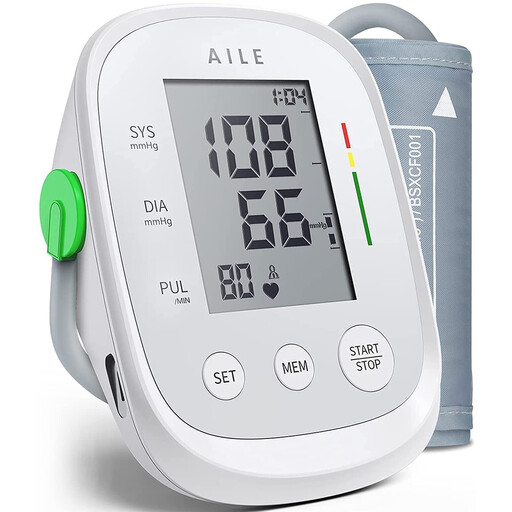
Why it suits this profile: A straightforward choice for home use, with automatic operation, a wide cuff and two user profiles.
According to the product details, the cuff fits arms measuring 22–42 cm. The large digital display makes it easier to read the numbers.
Stores up to 99 readings per user, calculates the average of the last three readings and runs on USB power or four AAA batteries.
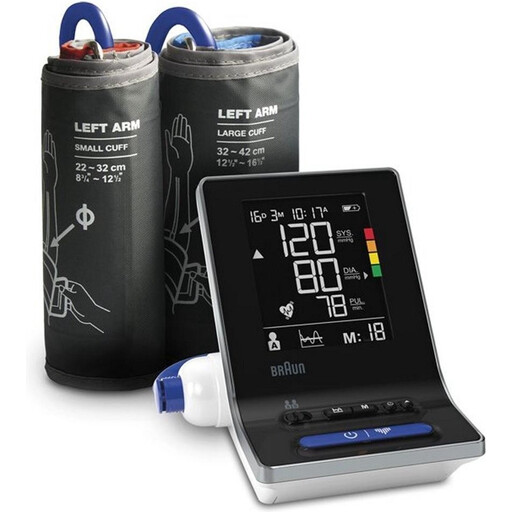
Why it suits this profile: A good option for households that value different cuff sizes, a backlit display and a well-known brand.
The set includes two cuffs, making it less likely that you’ll take a reading with the wrong size. The display has a backlight and colour indicators.
For two users, calculates the average of three readings and flags an irregular heartbeat, according to the product information.
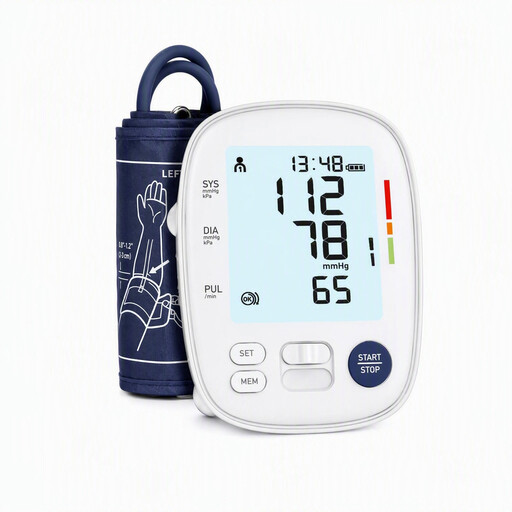
Why it suits this profile: Suits families who take readings regularly and need separate storage for two people.
The wide 22–42 cm cuff, cuff-position check and movement detection help you follow a consistent measuring routine.
Two memory banks, each storing 120 readings; calculates the average of three readings; runs on USB-C or battery power; and warns of an irregular heartbeat.
An irregular heartbeat alert or a persistently high reading is not a diagnosis. Use the results as information to discuss with your GP.
We’ve put together a complete, up-to-date list of products that meet these strict selection criteria and the relevant European safety requirements.
An upper arm model is often chosen for home readings because you can position the cuff at heart level. With a wrist monitor, your posture is more likely to affect the reading. Always follow the instructions and choose a cuff that fits.
How long it lasts depends on use, storage and maintenance. Keep the device dry, avoid sharply bending the tube and check the cuff regularly for wear. See the manual for information about calibration, warranty and replacement.
As well as the purchase price, batteries can be an ongoing expense. A model with USB power may be handy if you keep it in one place. Check whether batteries, an adapter or a storage case are included, as this varies by product.
