
Families dealing with small spills
Want to tackle localised stains on suitable dining chairs and store the appliance without taking up too much space.


First, check whether your chair’s care instructions say its upholstery can be wet-cleaned: a spot cleaner can’t make a water-sensitive fabric suitable for water. For the occasional small spill, compact storage may matter more than a large tank; if you have several chairs to clean, tank capacity, reach and the right attachments become more important. In its US manufacturer guidance, BISSELL advises testing a hidden area for colourfastness first, if wet cleaning is permitted.
Want to tackle localised stains on suitable dining chairs and store the appliance without taking up too much space.
Want to clean several seats or tackle seams too, so they pay attention to tank capacity, reach and the attachments included.
May find a cord awkward to use around chairs and want to know which battery and accessories are included with the model they choose.
First, check whether the chair can be wet-cleaned. Then decide whether you mainly need an appliance for occasional spills or several seats. Going cordless is a separate practical preference, so check the exact model and what’s in the box.
| What to consider | What to look for | Who is this important for? |
|---|---|---|
| Upholstery suitability | Read the furniture manufacturer’s care instructions. If wet cleaning is permitted, test a hidden area for colourfastness. | I want to avoid cleaning a chair that shouldn’t be wet-cleaned. Around 25% of consumers put upholstery suitability first. |
| Small spills and storage | Compare the dimensions, included attachment and clean water tank of the exact model. | For a few spills, I want an appliance that’s easy to grab and put away. Around 31% of consumers with small chair stains make compact storage their top priority. |
| Several chairs and reach | Check the capacity of the clean and dirty water tanks, the cord and hose length, and which attachments are actually included. | If I’m cleaning several chairs in a row, usable capacity and reach matter more than a compact design alone. Around 25% of consumers prioritise cleaning several chairs and having enough reach. |
| Cleaning and maintenance after use | Check how the tanks are emptied and what the manual says about rinsing and cleaning solution. | I want to know how much work is involved in emptying and cleaning the appliance after use. Around 19% of consumers make easy maintenance their top priority. |
A label saying ‘suitable for upholstery’ doesn’t confirm that the fabric on your specific chair can be wet-cleaned.
Check the furniture care instructions before buying or using an appliance. If wet cleaning is permitted, test a hidden area for colourfastness.
The attachment supplied can make a difference when cleaning seams and narrow areas of a chair. Kärcher describes the SE 3 Compact Home N1 as coming with an upholstery nozzle and a crevice nozzle; check what’s included for the exact model code.
Compare the attachments included with the model you’re considering and check that they’re suitable for the areas you want to clean.
According to ACM ConsuWijzer, you always have statutory rights in addition to any guarantee from the retailer or manufacturer.
Check your statutory rights with the retailer first, then consider whether additional cover would be useful for your situation.
BISSELL positions its SpotClean range for a variety of cleaning jobs, with the SpotClean Mini as a compact option.
Kärcher describes the SE 3 Compact Home N1 as suitable for textile surfaces and says this model comes with upholstery and crevice nozzles.
According to Rowenta, the Clean It range includes the Compact IN3010 and the IN5011, with different tank capacities and accessories.
The Joybuy products below are portable spot and upholstery cleaners, including models with different tank specifications and battery options. Only use an appliance on upholstery that the furniture care instructions say can be wet-cleaned.
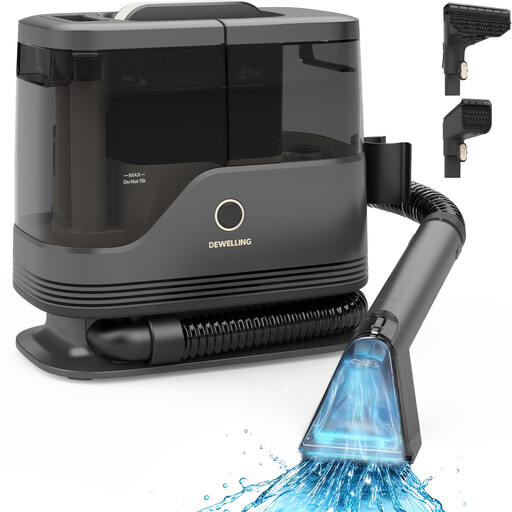 Image unavailable
A portable option for spot-cleaning chair upholstery that can be wet-cleaned.
The product name lists 0.6 l and 1.5 l tanks, a self-cleaning function on the handle, 400 W and 13 kPa.
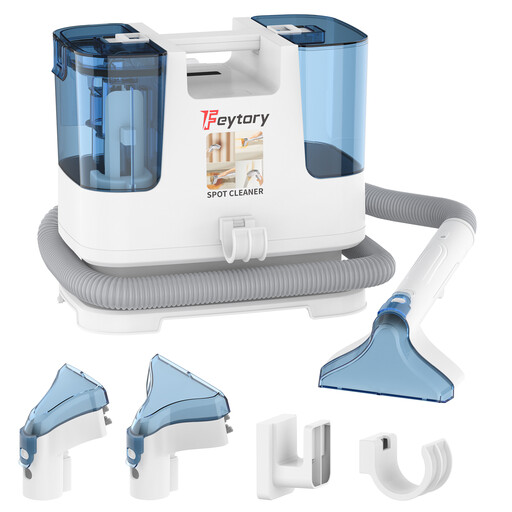 Image unavailable
A handy model for spot-cleaning suitable chair upholstery; the product name also mentions sofas and carpets.
The product name lists 0.6 l and 1.5 l tanks and a suction power of 15 kPa.
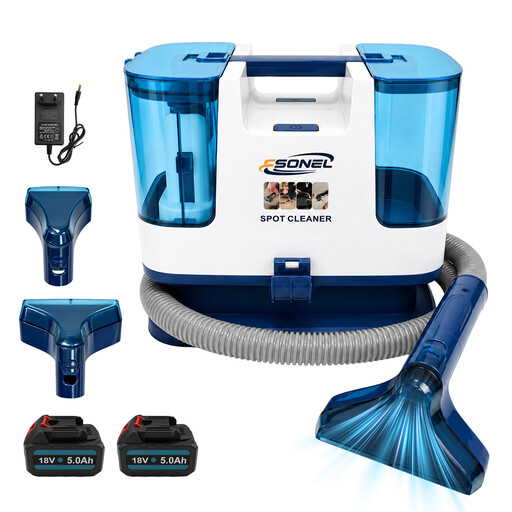 Image unavailable
A battery-powered model for cordless cleaning of suitable upholstered chairs.
The product name lists two batteries, 400 W and 17 kPa; wet fabrics, sofas and car seats are also listed as suitable applications.
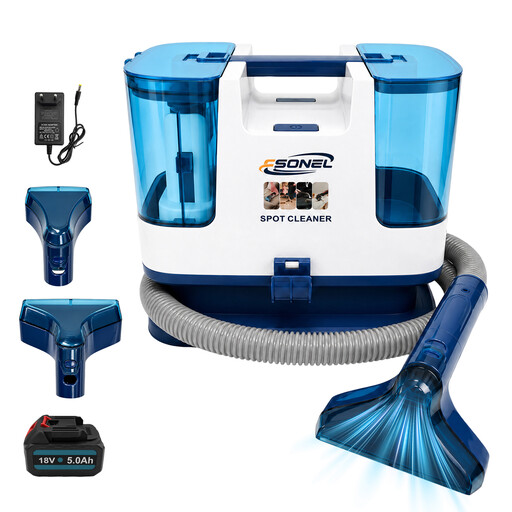 Image unavailable
A battery-powered model for cordless cleaning of suitable upholstered chairs.
The product name lists one battery, 400 W and 17 kPa; wet fabrics, sofas and car seats are also listed as suitable applications.
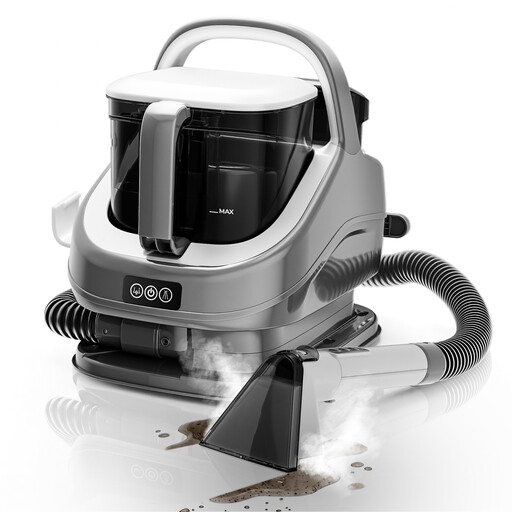 Image unavailable
The product description lists sofas and upholstery as suitable applications. Don’t use the appliance on fabrics that aren’t water-resistant.
The product name lists three modes for cold water, hot water and steam, a suction power of 13 kPa and dual water tanks. The product description lists a 1.1 m hose and a 3 m cord.
No. Follow the care instructions for the specific chair. In its US manufacturer guidance, BISSELL advises against wet cleaning fabrics with code S or X; for code W or WS, it recommends testing a hidden area for colourfastness first. This is manufacturer guidance, not a Dutch legal classification. If the instructions aren’t clear, ask the furniture manufacturer for advice.
Follow the manual for the exact model when emptying and rinsing it. Kärcher describes the SE 3 Compact Home N1 as having an internal rinsing function; Rowenta supplies an Autoclean accessory with the Clean It Compact IN3010. These features don’t automatically replace the maintenance specified in the manual.
No, you don’t need an extended warranty to have statutory rights. According to ACM ConsuWijzer, you always have statutory rights in addition to any guarantee from the retailer or manufacturer; the retailer is responsible if a product used normally doesn’t meet your reasonable expectations. The applicable period isn’t automatically two years for every appliance.
Electrical equipment covered by Dutch low-voltage regulations must meet product requirements. The Netherlands Food and Consumer Product Safety Authority (NVWA) gives the nominal voltage ranges for these regulations as 50 to 1,000 V AC and 75 to 1,500 V DC. The NVWA states that CE marking is compulsory for the relevant category of electrical products. The exact requirements depend on the product; CE marking isn’t an independent assessment of cleaning performance.