
Uniform wearer who wants neat sleeves
You want to smooth cuffs, seams and sleeves with precision, and are looking for a suitably narrow ironing surface. Check your uniform’s ironing instructions too.


If you mainly iron individual uniform sleeves and need to put the appliance away after use, a compact steam iron with a stable sleeve board is often a better fit. If you regularly iron several uniforms in one go, a steam generator with a larger water tank may be useful, but it takes up more space. A garment steamer is another option, particularly if removing creases from hanging clothes matters more to you than pressing sleeves flat.
You want to smooth cuffs, seams and sleeves with precision, and are looking for a suitably narrow ironing surface. Check your uniform’s ironing instructions too.
You set up your ironing equipment when you need it, then put it away afterwards. Size, a stable position and letting it cool down safely are all important to you.
You regularly iron a larger pile and want to refill the water less often, provided there’s room for the generator base and a suitable ironing board.
A good fit if: you do short ironing sessions, have limited storage space and want to support one sleeve at a time. The Consumers’ Association says a steam iron is a suitable choice if you don’t iron much or have little space.
Bear in mind: a sleeve board is an extra item to store, and you may need to refill the water more often during longer ironing sessions than with a generator.
A good fit if: you regularly iron several uniforms in one go and have space for a separate base. The Consumers’ Association recommends a generator as an option for people who iron frequently and in larger quantities.
Bear in mind: the complete set takes up more space and may be harder to move and store.
A good fit if: removing creases from hanging clothes matters more to you than pressing a sleeve flat.
Bear in mind: a garment steamer is a different appliance from an iron that presses fabric; don’t choose one if you need a sharply pressed sleeve crease.
| What to consider | What should you check? | Who is this important to? |
|---|---|---|
| Pressing sleeves and details | Check that the sleeve fits over the board, that the board is stable and that it is suitable for use with steam. | If I want to iron cuffs and seams precisely, I need a narrow surface that supports the sleeve properly. Around 36% of consumers prioritise precision when ironing sleeves. |
| Compact, safe storage | Measure the available working and storage space, and check the instructions for switching off and cooling down the appliance. | When I share the ironing space with others, I want to be able to position the appliance securely and let it cool down safely after use. An estimated 29% of consumers prioritise compact use and safe sharing of the space. |
| Fabric settings and safe ironing | Read the care label and the manual for the exact model, and check which settings and instructions for use apply. | If my uniforms are made from different fabrics that can be ironed, I want to be able to adjust the temperature and how I use the iron for each garment. Around 21% of consumers prioritise suitable fabric settings and careful use. |
| Ironing several uniforms | Compare the tank capacity with the size of the complete set, and check that your ironing board is suitable. | When ironing several uniforms in a row, I want to refill the water less often, as long as the generator base fits in my working and storage space. Around 14% of consumers prioritise longer ironing sessions. |
A steam specification alone doesn’t tell you how suitable an iron is for detailed work around cuffs and seams. The ironing surface, how well the sleeve fits and the garment’s ironing instructions all matter too.
Choose based on how often you iron, how much space you have and how you support the sleeve. Compare continuous steam output and steam boost as separate specifications.
A hot soleplate and a shared workspace call for careful use. An automatic shut-off feature doesn’t replace supervision.
Stay with the appliance while it’s in use, unplug it when you’ve finished and leave the iron somewhere safe to cool down.
Product-specific information isn’t the same as an explanation of your statutory rights in the Netherlands. The Dutch government states that there is no fixed statutory guarantee period in the Netherlands; what you can reasonably expect from a product is taken into account.
For questions about your statutory rights, consult Dutch government information and consider any additional guarantee separately.
Tefal’s range includes conventional steam irons such as the Ultragliss Plus FV6810 and Smart Protect Plus FV6870.
Braun offers both a conventional iron, the TexStyle 7 Pro SI 7181, and a generator, the CareStyle 1 IS 1012 BL.
The Philips 7000 Series includes steam irons. The features below apply specifically to the DST7040/80R0.
Brabantia makes a sleeve board as an additional ironing surface to use alongside a standard iron or steam iron.
Below are steam irons and a compact handheld iron for different ironing needs. Check the care label and the manual for the exact model. According to the Netherlands Food and Consumer Product Safety Authority, CE marking is mandatory for electrical products sold on the Dutch market; check the marking on the specific item.
 No image available
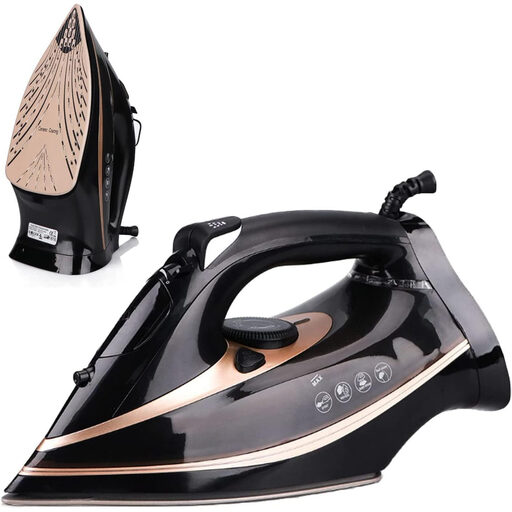
An option if you’re looking for a standard steam iron for ironing uniform sleeves; first check that the sleeve and your ironing surface are a good match.
The product name lists 70 g/min steam output, a 120 g steam boost, a 300 ml water tank and a self-cleaning function.
 No image available
A conventional steam iron to consider if you want to iron uniform sleeves on a suitable, stable surface.
Check the care label and the model manual for the correct settings.
 No image available
A compact iron to consider if easy storage in a shared space is important; check that this type of appliance suits the way you iron sleeves.
The product name lists Compact, Lightweight and Dual Voltage.
 No image available
A steam iron to consider for targeted ironing, with the sleeve supported on a suitable surface.
Before use, check the care label and the instructions for the exact model.
 No image available
A conventional steam iron to consider if you want to iron uniform sleeves precisely; check the manual for instructions on using this model and its settings.
Not for every uniform, but a stable sleeve board can help support one sleeve flat at a time. Check that the sleeve fits and that the board is suitable for steam if you’re using a steam iron.
Don’t leave a hot iron unattended. Unplug it after use and let it cool down before putting it away. Automatic shut-off doesn’t replace these steps.
Follow the descaling instructions for the exact model. Philips, for example, describes different procedures, so check which one applies to your iron.
No. According to the Dutch government, there is no fixed statutory guarantee period in the Netherlands; you can expect a product to last for a reasonable period. Contact the seller if a product is faulty. A manufacturer’s guarantee or additional guarantee is separate from this.
According to the Netherlands Food and Consumer Product Safety Authority, CE marking is mandatory for electrical products. Check the marking on the specific item; the general requirement doesn’t confirm that every individual product has been checked.