
Renter with limited floor space
You want to hang underwear indoors but be able to put the airer away after use. So compare both its footprint when open and its folded size.


Start by considering how much space the airer takes up when in use and where you can store it. Then decide between heated rails and a standard airer. A heated airer may suit you if you regularly want extra help with drying, but it uses electricity and doesn’t replace ventilation. Compare drying times or electricity costs only when you have data for the specific model and your own usage.
You want to hang underwear indoors but be able to put the airer away after use. So compare both its footprint when open and its folded size.
You often dry a few items of underwear and are considering heated rails. Check the available hanging space and the stated wattage, without assuming there will be a set drying time.
You need a suitable place to dry your clothes and a way to remove moist air. Heating an airer doesn’t replace ventilation.
Suitable if: you have floor space while drying and can store the airer flat afterwards.
Bear in mind: electricity consumption and the need to ventilate the room.
Suitable if: a smaller number of rails works for your small loads of washing.
Bear in mind: whether individual items will have enough space and what the instructions say about positioning.
Suitable if: you want to dry your washing without extra heat or don’t want to use electricity for the airer.
Bear in mind: ventilation is still important with this option.
| Consideration | What should you check? | Who is this important for? |
|---|---|---|
| Space and storage | Measure the available space when the airer is in use and compare its open and folded dimensions. | I want to use the airer without blocking a walkway, then store it away afterwards. Around 26% of consumers are most concerned about space when the airer is in use and in storage. |
| Extra help with drying | Check which rails heat up and whether there are enough separate hanging spaces. | If I regularly do small loads of washing, I want to know whether heated rails suit the way I hang my washing. Around 21% of consumers prioritise extra help with drying for these loads. |
| Underwear and contact with heat | Read the care label and the instructions for the airer you’ve chosen. | I want to dry my underwear according to the care label, rather than assuming that direct contact with heated rails is always suitable. Around 21% of consumers focus mainly on finding a suitable way to dry underwear. |
| Damp in the home | Before setting it up, check how air can flow into and out of the room. | I want to use the airer somewhere that allows moist air to be removed. Around 16% of consumers make managing damp in the drying area their top priority. |
| Electricity consumption | Compare the stated wattage with how long you’ll use it; wattage alone doesn’t tell you how much a drying session will cost. | I want to take electricity use into account before choosing a heated airer. Around 16% of consumers make electricity consumption their top priority. |
An airer that folds flat may still take up a lot of floor space while you’re drying clothes.
Measure both the space available when it’s in use and the place where you plan to store it.
The time it takes for the tubes to warm up doesn’t tell you how long underwear will take to dry. This depends on factors including the fabric, how wet the washing is, room temperature and humidity.
Look for drying data for the exact model, and don’t treat a stated warm-up time as a guarantee of drying time.
Drying washing adds moisture to the indoor air. Milieu Centraal recommends letting fresh air in and removing moist air to help prevent damp problems.
Choose a drying spot where air can flow in and out, even when using a heated airer.
CE marking is compulsory for electrical products covered by the relevant regulations. The Netherlands Food and Consumer Product Safety Authority states that testing isn’t compulsory for this product group, so a mark doesn’t prove that the product has undergone an independent drying test.
Check the marking, the instructions and the identity of the exact model. Treat stated features separately from measured results.
A heated, folding airer is worth comparing if adjustability is important to you.
A freestanding heated towel rail may be worth considering if you’re looking for a compact set-up that doesn’t need to be fixed to a wall.
Unheated, freestanding airers are an alternative if you don’t want heated rails.
Drying towers and folding airers offer different designs to compare against the space you have available.
The Joybuy products below include folding heated and unheated airers, drying towers and wall-mounted airers. Compare the space required, how each one can be stored and whether heating is specifically mentioned.
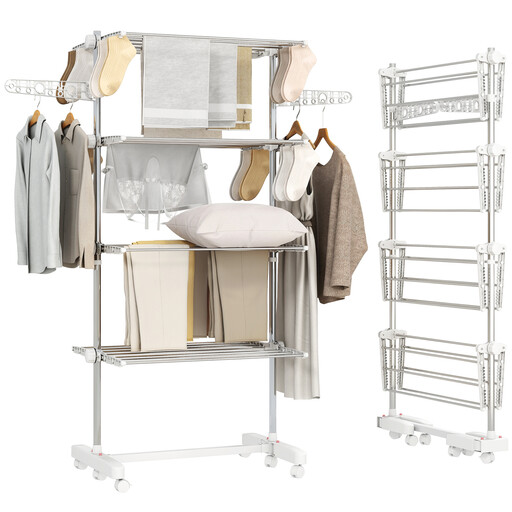 No image available
Suitable if you want to hang several items of clothing at once and be able to move the airer around.
The description lists three adjustable drying racks, two side wings and four wheels.
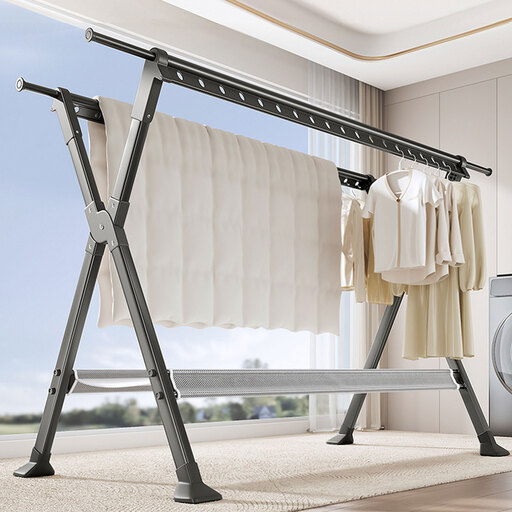 No image available
An option to compare if you want to lay out small or delicate items separately.
The description lists 42 slots for clothes and a mesh drying shelf for small, delicate items. The airer folds away.
 No image available
Suitable if you want a heated airer that folds away after use.
The product name lists 230 W and dimensions of 144 × 53 × 91 cm. Use it indoors on a stable, level surface, with adequate ventilation and at least 31 cm clearance from walls.
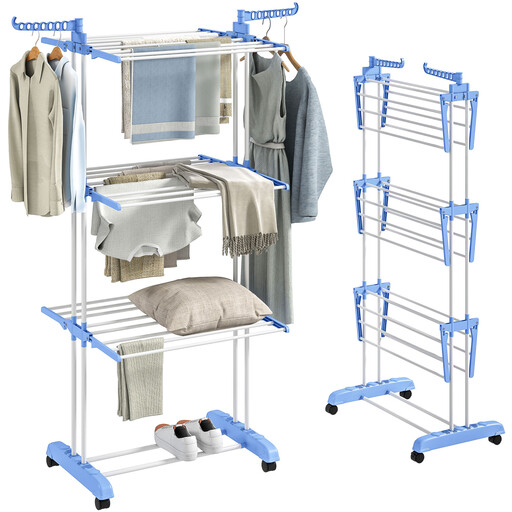 No image available
Suitable if you want plenty of hanging space and need to move the airer around your home.
The description lists three adjustable drying racks, side wings and four wheels, two of which can be locked.
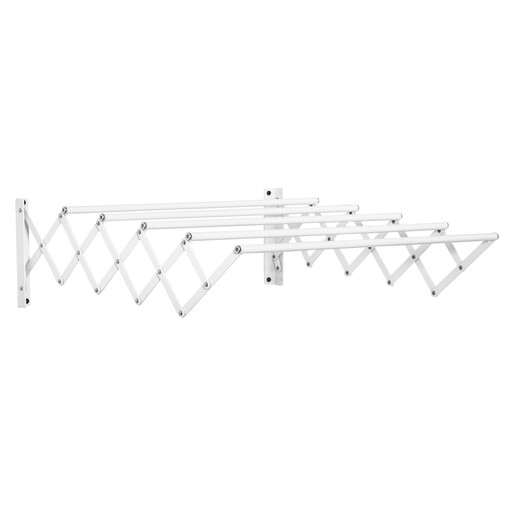 No image available
Suitable if you want the airer to take up little space when not in use and are looking for a fixed wall-mounted option.
The product name lists dimensions of 63,5 × 60 × 20 cm and five rails. It needs to be wall-mounted, so it can’t be folded away as a freestanding model.
Yes. Milieu Centraal identifies drying washing as a source of moisture in indoor air and recommends letting fresh air in and removing moist air to help prevent damp problems.
Multiply the wattage by the number of hours you use the airer, then divide by 1,000 to find the number of kWh if it runs continuously at that wattage. Actual consumption depends on the appliance and how long you use it; the cost also depends on your electricity tariff.
No, that doesn’t automatically follow from the care label. Read the care symbols and the instructions for the airer you’ve chosen; if you’re unsure, don’t assume that direct contact with heated rails is suitable.
CE marking is compulsory for electrical products covered by the relevant regulations. The Netherlands Food and Consumer Product Safety Authority states that testing isn’t compulsory for this product group, so don’t present the mark as proof of an independent test.
No. Don’t assume it’s suitable just because it’s electric or because information about another model says so. Follow the instructions for the exact product and check the positioning guidance for the place you have in mind.