
PC space explorer
You mainly want a wide view of the game world on a single monitor, so check whether the game supports 21:9. Nixxes describes ultrawide support for Death Stranding 2 on PC; check the aspect ratio for each game.


Choose 21:9 ultrawide if your PC and the game you want to play support that aspect ratio, and a wide view on a single screen is your priority. A 16:9 monitor may be a better fit if support is uncertain or a more compact screen suits your desk better. Also compare resolution and refresh rate for each connection, and factor in panel care if you choose OLED and a HUD stays on screen for long periods. A 21:9 monitor alone does not guarantee that a game will show more of the world.
You mainly want a wide view of the game world on a single monitor, so check whether the game supports 21:9. Nixxes describes ultrawide support for Death Stranding 2 on PC; check the aspect ratio for each game.
You prioritise how dark environments look and, with OLED, consider how long fixed HUD elements remain on screen. Samsung describes static game elements as a possible cause of image retention on OLED monitors.
You want the screen size, connection and refresh rate to suit your desk and device. ASUS lists different refresh rate ranges via HDMI and DisplayPort for the VG27AQ3A.
A good fit if: you want a wide view on a single screen and your game supports 21:9.
Also consider: support varies between games, and an LCD does not automatically avoid every other panel-related trade-off.
A good fit if: a wide view and dark scenes matter to you.
Also consider: panel care is worth bearing in mind if a static HUD stays on screen for a long time; follow the instructions for the exact model.
A good fit if: you want a more compact screen or have yet to confirm 21:9 support.
Also consider: you won't get the physical width of an ultrawide; aspect ratio alone does not determine how much of the game you'll see.
When comparing a single gaming monitor for space exploration, first check the game and your device's connection, then consider panel type, screen size and placement.
| Consideration | What to look for when buying | Who this matters to |
|---|---|---|
| Wide view on a single screen | Check 21:9 support for each game and measure the available space, including the monitor stand. | If I want a wide view while exploring space, I'll first check that my game supports it; around 31% of consumers name a wide view as their top buying priority. |
| Dark scenes | Compare panel type and stated HDR certification; with OLED, also consider fixed HUD elements that remain visible for a long time. | For dark game environments, I want to weigh image quality against using a fixed HUD; around 25% of consumers give dark scenes top priority. |
| Smooth motion | Check the resolution and Hz for each input. ASUS lists up to 180 Hz via DisplayPort and an HDMI range of up to 144 Hz for the VG27AQ3A. | If I want moving images to look smooth, I'll check which display mode my connection can handle; around 19% of consumers prioritise smooth motion. |
| Game and device compatibility | Check the aspect ratio supported by the specific game, as well as the resolution and refresh rate supported by your device and connection. | If I'm not sure whether my game and device support the same display mode, I want to check that combination in advance; around 13% of consumers name compatibility as their top consideration. |
| Placement and energy consumption | Measure the available space, including the stand, and compare the EU energy label for the exact model. The European Commission lists a scale from A to G for electronic displays. | If my desk is short on space and I want to factor in energy consumption, I'll check the dimensions and label for the version I'm considering; around 12% of consumers prioritise placement and energy consumption. |
A screen's aspect ratio and the widescreen options in a specific game are not the same thing. Nixxes describes 21:9 support for Death Stranding 2 on PC; that information does not automatically apply to other games.
Before treating the extra screen width as a deciding advantage, check the aspect ratio and widescreen settings for the game you want to play.
The stated refresh rate ranges for HDMI and DisplayPort differ on the ASUS TUF Gaming VG27AQ3A.
Check the resolution, Hz, connection and compatible cable together for the exact model.
Samsung describes static game elements as a possible cause of image retention on OLED monitors.
Read the care instructions and warranty terms for the exact model, and compare this trade-off with an LCD option.
The G34WQi is an example of an ultrawide LCD for anyone looking for 21:9 on a single screen.
The UltraGear 34GX900A-B is a 21:9 OLED model for anyone looking for a wide picture with OLED display quality.
The AW3426DW is a 34-inch QD-OLED example for a high-performance ultrawide setup.
The TUF Gaming VG27AQ3A is a more compact 27-inch 16:9 QHD option.
The 32-inch Odyssey G5 G55C is a larger 16:9 QHD LCD alternative without an ultrawide format.
These Joybuy products are ultrawide gaming monitors for anyone looking for a wide view on a single screen. Check whether each game supports 21:9, and match the resolution and refresh rate to your device and connection.
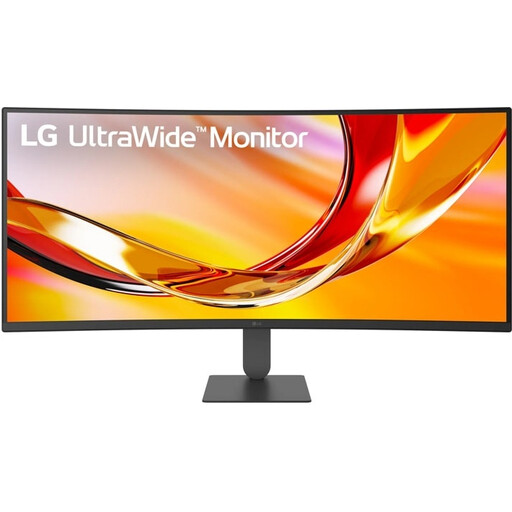 No image available
An option to compare if you're looking for a curved ultrawide for a single-screen setup.
The product title lists a 34-inch screen, WQHD resolution, a VA panel and 144 Hz.
 No image available
An ultrawide option to consider if you want to match the stated display mode to each connection.
The product title lists a 34-inch screen, Fast VA and 3440 × 1440 resolution. The stated refresh rate is up to 180 Hz via DisplayPort and 100 Hz via HDMI.
 No image available
An LCD option to include in your comparison if you're looking for a 34-inch widescreen monitor.
The product title lists a 34-inch screen, LCD and 3440 × 1440 resolution.
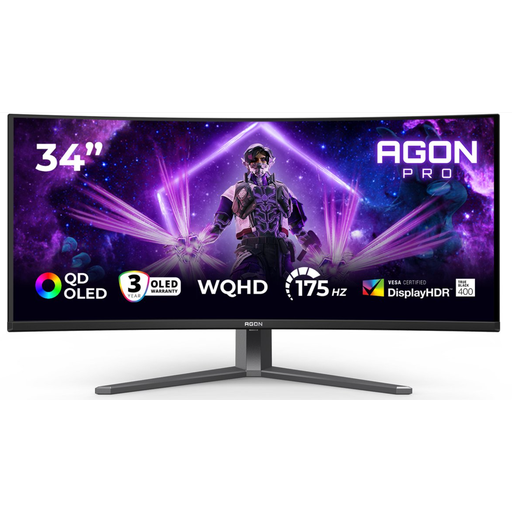 No image available
A model to compare if you're looking for a wide screen and a stand with several adjustment options.
The product title lists a 34-inch screen, 3440 × 1440 resolution and a stand with height, swivel and tilt adjustment. The stated refresh rate is up to 175 Hz via DisplayPort and 100 Hz via HDMI.
 No image available
A QD-OLED option to consider if you're looking for a wide screen with OLED display quality.
The product title lists a 34-inch screen, QD-OLED and 3440 × 1440 resolution.
No, you can't assume that from the monitor alone. Check whether the specific game has a suitable widescreen mode; Nixxes describes 21:9 support for Death Stranding 2 on PC, not for all games.
Check which resolution and Hz combination the input you're using supports, and set that display mode on your device too. ASUS lists up to 180 Hz via DisplayPort and an HDMI range of up to 144 Hz for the VG27AQ3A.
Bear in mind that static interface elements may stay visible for a long time, and follow the care instructions for the exact model. Samsung describes image retention and Pixel Refresh for its OLED monitors; check whether the advice applies to your model before following it.
Compare the energy label and model information for the version you're considering. The European Commission lists a scale from A to G for electronic displays.
According to the Dutch government, when you buy online from a business, you generally have 14 days to change your mind. You also have statutory protection if a product is faulty; the Netherlands does not have a fixed statutory warranty period, and the retailer is your point of contact if there's a problem.