
Comparing drawings
You regularly compare two versions or floor plans side by side and want to assess dimension lines and other details at your usual zoom level.


Your choice mainly depends on the space two drawing windows need at your usual text scale. A 49-inch monitor with a resolution of 5120 × 1440 pixels offers plenty of horizontal space, while a monitor of around 40 inches with 5120 × 2160 pixels has more vertical pixels. A 34-inch model may suit you if desk width is limited. With any model, also check its positioning, height adjustment and your computer’s video output.
You regularly compare two versions or floor plans side by side and want to assess dimension lines and other details at your usual zoom level.
You mainly read dimension lines, legends and annotations, so screen height and text scale matter more to you than maximum width.
You switch between sitting and standing, or between computers, so you’re looking at screen adjustment, available desk space and connections.
May suit: a workspace where desk width is a consideration and you want to try using two drawing windows. LG and BenQ list a resolution of 3440 × 1440 pixels for the 34-inch models discussed here.
Bear in mind: two full drawings won’t necessarily be readable side by side. Check dimension lines and legends at your own text scale.
May suit: anyone looking for vertical space for drawing sheets, toolbars and annotations as well as two windows. Dell and LG list a resolution of 5120 × 2160 pixels for the 40-inch models discussed here.
Bear in mind: compare the footprint and viewing distance, and check the connection. Your computer must support the chosen resolution through the video output you’re using.
May suit: anyone who wants to put two wide drawing windows side by side and has plenty of space on and in front of their desk. Lenovo lists a resolution of 5120 × 1440 pixels for the ThinkVision P49w-30.
Bear in mind: the 49-inch option reviewed has 1440 vertical pixels, compared with 2160 for the 40-inch 5K2K models discussed here. Also check whether you can read the outer parts of the screen comfortably.
| What to consider | What should you check? | Who is this important for? |
|---|---|---|
| Two drawings side by side | Compare the aspect ratio, resolution and physical width with two of your own drawings at your usual text scale. | I want to assess two versions side by side without constantly switching between them or zooming in. Around 36% of consumers prioritise wide drawing windows. |
| Details and document height | Check the vertical resolution and read your own dimension lines, legends and annotations at your preferred scaling setting. | I mainly read dimensions and notes, and want to be able to assess them clearly alongside toolbars. Around 29% of consumers prioritise vertical space for detail. |
| Positioning when sitting and standing | Measure the desk space and check the height adjustment. If you’re using a monitor arm, also check its mounting compatibility and weight capacity. | I switch between sitting and standing and want to position the screen comfortably for both. Around 21% of consumers prioritise an adjustable workspace. |
| Connection and charging | Compare your computer’s video output and charging requirements with the connections and power specifications of the exact monitor model. | I connect a computer or switch between computers and want to know whether the display and any power delivery will work with my setup. Around 14% of consumers prioritise simple computer connectivity. |
The Lenovo ThinkVision P49w-30 discussed here has 1440 vertical pixels; the 40-inch 5K2K models mentioned have 2160. Screen size alone doesn’t tell you how much vertical resolution you’ll get.
Compare the full resolution and check your dimension lines at the text scale you use, rather than comparing screen sizes alone.
The models reviewed list different connections and power outputs. Whether they meet your display and power needs also depends on your computer’s capabilities.
Check your computer’s video output, the cable you’ll use, and the connection and charging specifications for the exact monitor variant.
With a sit-stand desk, the stand, desk depth and adjustability matter too. A screen that fits at one height may be less convenient at another working height.
Measure the space available and check the height adjustment. If you’re using an arm, also compare its mounting dimensions and weight capacity with the monitor.
The UltraSharp U4025QW is a 39.7-inch 5K2K model discussed here, for anyone considering extra document height and an integrated hub.
The UltraWide models discussed include both a 34-inch version with a resolution of 3440 × 1440 pixels and the 40WP95CP-W with a resolution of 5120 × 2160 pixels.
The ThinkVision P49w-30 is a 49-inch 32:9 option discussed here, for anyone who wants to view two wide windows side by side.
The PD3420Q is a 34-inch DesignVue model discussed here, for anyone considering a smaller workstation and a CAD/CAM display mode.
The Business Monitor 40B1U6903CH/00 is a 39.7-inch 5K2K model discussed here, for a workspace where docking is also a consideration.
This selection includes ultrawide monitors for wide drawing windows and a 34-inch alternative with a different screen layout.
 No image available
The wide 32:9 format is worth considering if you want to place two drawing windows side by side. Check that dimension lines remain readable at your text scale.
5120 × 1440 pixels; 165 Hz; VA panel; height-adjustable stand.
 No image available
The specified 49-inch screen size and resolution are worth considering if you want to compare a wide layout for two drawing windows. Check readability and positioning in your own workspace.
5120 × 1440 pixels.
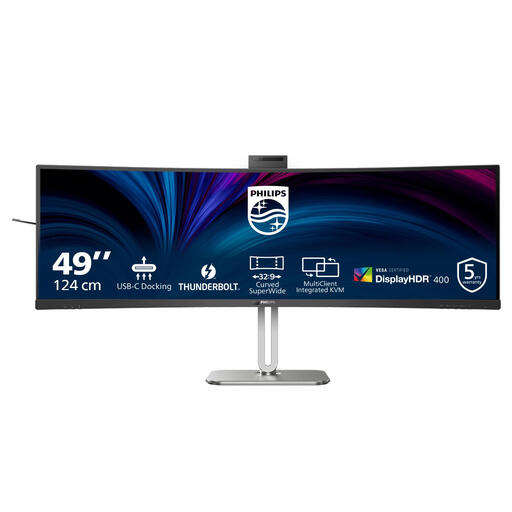 No image available
This 49-inch monitor is worth considering if you want to place two wide drawing windows side by side. Check that its physical dimensions fit your desk.
5120 × 1440 pixels.
 No image available
This ultrawide monitor is worth considering if you want to arrange two drawing windows across a wide screen. Check the resolution and how readable your own drawings are.
KVM switch; USB-C dock; RJ45 (LAN); height-adjustable stand.
 No image available
A 34-inch model is worth considering if desk width is a factor. Test whether both drawing windows are readable at your usual scale.
34 inches; WQHD; VA panel; curved design with 1800R curvature; 120 Hz.
In Windows 10 or 11, you can use Snap to drag windows to the left and right edges of the screen and adjust their width. Then check that everything is readable at your usual drawing scale; arranging the windows doesn’t increase the available resolution. Microsoft explains this feature in Windows support.
Only if the arm’s mount and weight capacity are suitable for the exact monitor and the relevant mounting components. BenQ lists VESA 100 × 100 mm and a weight of 6.9 kg without the stand for the PD3420Q; LG also lists VESA 100 × 100 mm and a weight of 10.2 kg without the stand for the 40WP95CP-W. This information does not confirm that any specific monitor arm is suitable.
For employers, Arboportaal sets out requirements for screen-based workstations. For employees who work at a screen for more than 2 hours a day, the screen must, among other things, be height-adjustable and non-reflective. Arboportaal also explains the circumstances in which an employer may depart from these requirements. This is not a general purchasing rule for every private individual or self-employed user.
The European Commission lists an energy label for electronic displays, including computer monitors. Compare the labels and product information for the models you’re considering. The Dutch government explains that private individuals can return an old, similar appliance free of charge when buying a new one, including when buying online. According to the Dutch government, the old-for-new scheme does not apply to businesses.