
Anyone assessing letterforms
You work with small text and fine details, and want to assess resolution, viewing distance and display scaling together. Microsoft Support explains how to adjust display resolution and scaling in Windows.


Start by checking how legible your own type specimens are at your preferred viewing distance and scale. The extra screen width is most useful when you want to view examples and references side by side. Then check that you can position the monitor comfortably when sitting and standing, and that its ports and any USB-C power delivery are compatible with your laptop. Manufacturer specifications can help guide your choice, but they can’t predict how your type specimens will look on screen.
You work with small text and fine details, and want to assess resolution, viewing distance and display scaling together. Microsoft Support explains how to adjust display resolution and scaling in Windows.
You want to keep type specimens, design files or examples visible at the same time, so you need enough horizontal workspace. LG lists a 21:9 aspect ratio and a resolution of 3440 × 1440 pixels for the 34U650A-B.
You change your working height and want to position the screen comfortably in both positions; connecting it to your laptop may also be a factor. Arboportaal offers guidance on setting up a workstation for screen-based work, including screen positioning.
| What to consider | What should you check? | Who should prioritise this? |
|---|---|---|
| Legibility of fine details | View your own type specimen from your intended viewing distance and check your computer’s resolution and scaling settings. | If fine letter details matter to you, see how your specimen looks at the scale you use. Around 36% of consumers prioritise legible typographic details. |
| Room for windows | Measure the available desk space and check that the windows you want to use will fit side by side. | If you want to keep a type specimen and reference open at the same time, workspace is a major consideration. Around 29% of consumers give simultaneous windows top priority. |
| Positioning when sitting and standing | Check the height, tilt, footprint and any mounting compatibility for both working positions. | If you alternate between sitting and standing during the working day, the monitor needs to work at both heights. Around 21% of consumers look at screen positioning first. |
| Connecting to your laptop | Compare your laptop’s video output and charging requirements with the ports and power specifications of the exact monitor model. | If you want to connect your laptop to the monitor and possibly charge it, check that they support the features you need. Around 14% of consumers make laptop connectivity their top priority. |
A wide screen gives you more workspace, but it doesn’t guarantee that small text will be comfortable to read at your chosen scale.
Test one of your own type specimens and check the resolution, viewing distance and scaling before making screen width the deciding factor.
Monitors can have different ports and features. The presence of USB-C alone doesn’t tell you which features your laptop can use.
Compare the full port and power specifications with your laptop and cable.
Depending on the combination, you may need a different cable or connection solution.
Whether a screen is positioned comfortably also depends on the height of your desk and how you sit and stand.
Measure your setup and check the adjustment range of the stand or monitor arm before ordering.
You may need a mount that’s compatible with your desk.
BenQ describes the PD3420Q as a flat ultrawide monitor for design workflows where you want to compare type specimens and colour modes.
Dell describes the UltraSharp U3425WE as a curved ultrawide hub monitor for anyone who values connectivity at their workstation.
LG describes the 34U650A-B as a curved IPS ultrawide screen for working with multiple windows.
Philips describes the B Line 346B1C/00 as a curved ultrawide monitor with USB-C and an ergonomic stand.
These monitors are suited to typography and working with multiple windows. Check the adjustability you need and compatibility with your laptop for each model.
 No image available
The 21:9 aspect ratio and 3440 × 1440-pixel resolution are worth considering if you want to view multiple windows side by side.
1800R curved screen; 120 Hz; 34 inches.
 No image available
This monitor is an option if you want to combine an ultrawide workspace with laptop connectivity.
3440 × 1440 pixels; 21:9; USB-C with up to 90 W Power Delivery; 100 Hz. The product description states that the stand is height-adjustable and supports tilt and swivel. USB-C charging requires a compatible laptop that supports USB Power Delivery and DisplayPort Alt Mode.
 No image available
The 21:9 workspace and built-in webcam are useful if you want to combine multiple windows with video calls from the same workstation.
IPS; 3440 × 1440 pixels; 100 Hz; USB-C with up to 90 W Power Delivery. Charging capability depends on the connected laptop.
 No image available
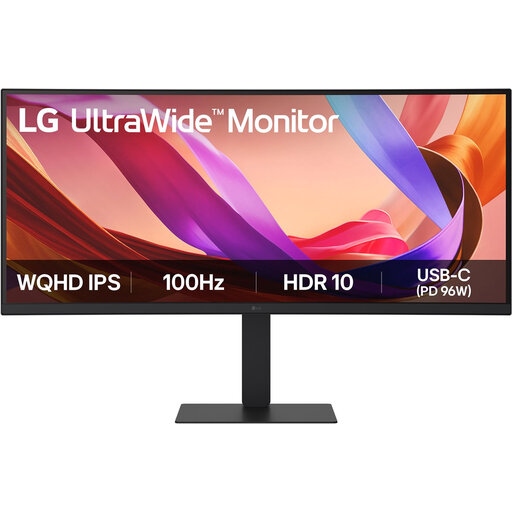
The stated aspect ratio and resolution are suited to working with multiple windows side by side.
IPS; 21:9; 3440 × 1440 pixels; 99% sRGB according to the product description. USB-C with up to 96 W Power Delivery; the stand supports height, tilt and swivel adjustment.
 No image available
The 32:9 screen and stated resolution are worth considering if you want to display multiple windows at once.
5120 × 1440 pixels; 165 Hz; VA panel; 1500R; 120% sRGB according to the product description. The title specifies a height-adjustable version. The safety information recommends using a desk or mount that can support at least 15 kg and having two people install it.
View one of your own specimens at your usual viewing distance and the scale you work at. Microsoft Support explains how to set display resolution and scaling in Windows; the stated pixel resolution alone can’t predict how your specimen will look.
Check the screen position at both desk heights. Arboportaal recommends placing the top of the screen slightly below eye level; check that your stand or mount allows this with your setup.
According to the Dutch government, you’re entitled to a product that works properly when you buy it; a commercial guarantee may provide additional cover. For distance purchases, a 14-day cooling-off period applies in many cases, with some exceptions. Check the terms that apply to your purchase.
According to Arboportaal, rules on setting up the workstation, including screen adjustability, apply to employees doing screen-based work. This isn’t automatically the same legal requirement for every personal monitor purchase; first check whether these workplace rules apply to your situation.