
People who compare drawings
You want to view revisions and reference drawings side by side, and prioritise a clear layout and readability over extra multimedia features.


Start by checking whether two drawings will fit side by side at the scale you need to review them. A 34-inch screen with a resolution of 3440 × 1440 gives you plenty of horizontal workspace, but that doesn’t guarantee that dimensions will be easy to read. Then compare the panel and connectivity options with your laptop and workspace. The listed model specifications don’t tell you how much noise a monitor makes, so don’t assume it will be quiet; check this separately.
You want to view revisions and reference drawings side by side, and prioritise a clear layout and readability over extra multimedia features.
You read lots of small labels and want to position the screen to suit your chair, desk and lighting. Arboportaal highlights small symbols, contrast and glare as things to consider when working with a screen.
You switch between drawing work and other tasks, and want to know whether a single connection can handle the display, peripherals and enough power for your laptop.
| What to consider | What should you check? | Who is this important to? |
|---|---|---|
| Comparing drawings | Test the window layout and scale in your drawing software, and check that the screen and stand fit on your desk. | When I compare revisions, I want to see both drawings at a usable scale. Around 33% of consumers prioritise comparing drawings as their main purchase need. |
| Reading small details | View one of your own drawings from your intended viewing distance, and check the screen height, reflections and lighting. | Anyone who reads lots of small dimensions wants to assess details without constantly adjusting the screen position. Around 27% of consumers prioritise reading comfort and a suitable screen position. |
| Connecting a laptop and peripherals | Check whether your laptop supports video over USB-C, and whether the power output and available ports suit the way you use it. | When I switch between drawing work and other tasks on a laptop, I want to know whether one cable can connect my devices. Around 20% of consumers say laptop and peripheral connectivity is their main purchase need. |
| A quiet study | Ask for information about the noise level of the specific model, or assess the monitor under the conditions in which you’ll use it. | Anyone working in a quiet study doesn’t want to be distracted by audible electronics or a noisy power supply. Around 20% of consumers prioritise quiet operation. |
Two windows may fit side by side, while dimensions can still be hard to read at your chosen scale.
Test the layout and zoom level you need using your own drawings and software.
A USB-C port with Power Delivery doesn’t automatically mean that every laptop can output video through it or receive enough power.
Compare your laptop’s USB-C video and charging capabilities with those of the exact monitor model. You may also need a suitable connection or power supply.
Rijksoverheid explains that there is no fixed statutory guarantee period in the Netherlands; if a product develops a fault, the retailer is your point of contact.
Check what protection an additional agreement actually provides.
The Pro 34 Plus P3425WE is a 34.1-inch IPS ultrawide with a USB-C hub.
The 34U650A-B is a 34-inch IPS ultrawide designed for a wide window layout.
Philips says the E Line 346E2CUAE/00 combines a 34-inch ultrawide with USB-C and MultiView.
The Modern MD342CQP is a 34-inch VA ultrawide with features for using multiple devices or sources.
The ProLite XCB3494WQSU-B1 is a VA alternative with an adjustable stand.
These models offer plenty of workspace for drawings and side-by-side windows, with differences in panel type, connectivity and available modes.
 No image available
Suited to anyone who wants to view drawings side by side and is looking for a USB-C hub; the product name specifies a 34-inch monitor.
 No image available
A curved 34-inch dual-mode monitor to consider if you’re weighing up the available display modes for your drawing work. The detail mode is listed as 5120 × 2160 at 120 Hz; the other mode is 2560 × 1080 at 240 Hz.
 No image available
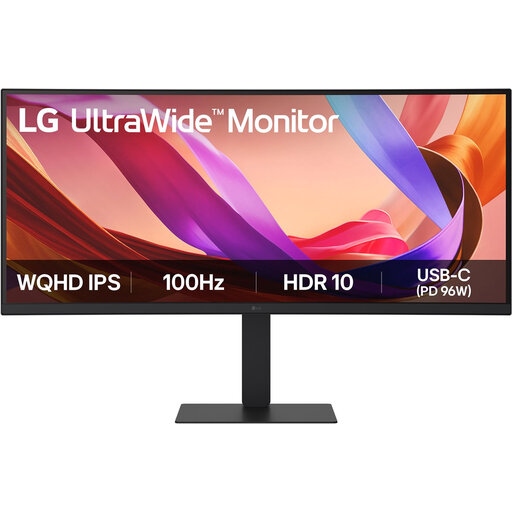
Suited to anyone looking for a 34-inch IPS ultrawide to view drawings side by side. LG lists a resolution of 3440 × 1440, a 100 Hz refresh rate, typically 99% sRGB and 3800R curvature.
 No image available
A 34-inch ultrawide to consider if you want to arrange several work windows on one screen. The product name specifies a resolution of 3440 × 1440.
 No image available
Suited to anyone considering a 34-inch ultrawide with PBP for multiple windows or sources. The product name specifies a resolution of 3440 × 1440; check that the PBP layout works with your sources.
This resolution gives you plenty of horizontal screen space, but it doesn’t guarantee that every dimension will be easy to read. Test the scale and window layout you need in your own software; small symbols and low contrast can make things harder to read.
Adjust the screen height, lighting and reflections to suit your workspace, and break up long periods of screen work. Employers also have obligations relating to screen work; these don’t automatically amount to a personal buying requirement for every reader.
Compare the energy information for the specific models on their EU energy labels, and factor in how long you’ll use them. The European Commission states that electronic displays, including computer monitors, have an energy label graded from A to G.
Online consumer purchases often come with a 14-day cooling-off period, as explained by Rijksoverheid. There is no fixed two-year statutory guarantee period in the Netherlands: what you can reasonably expect from the product is what matters, and the retailer is your point of contact if it develops a fault.
The product specifications listed don’t support any claims about the noise level of a specific model. Ask for model-specific acoustic information or assess the monitor under the conditions in which you plan to use it.