Start by choosing a screen that suits the colour space of your final output, and make sure your monitor profile fits your workflow. Extra screen width won’t make colours more reliable on its own. Then compare the space available for images and editing panels, the adjustment options for your sit-stand desk, and how the monitor connects to your computer.
Who is this for?
Colour-critical image editor
If you compare images for a specific output colour space, you’ll want to manage your monitor profile as well as check the manufacturer’s specifications. Adobe notes that factors such as calibration status and ambient lighting can affect the colours you see.
Editor who works with lots of comparison windows
If you want to view original and edited images side by side with your editing panels, you’ll need to consider both physical screen space and resolution. ASUS, BenQ and LG specify different resolutions for their models.
Flexible sit-stand worker
If you regularly change your working position, it helps to have a screen position that works at both desk heights. The Dutch Working Conditions Portal outlines the risks of static working postures when using a computer screen.
What should you look for?
ASUS and BenQ list colour spaces for specific models, while Adobe points out that colour management also depends on factors such as your monitor profile and ambient light. So start by assessing your output workflow, then consider workspace, desk setup and laptop connectivity.
| What to consider |
What should you look for? |
Who is this important for? |
| Colour comparison |
Check whether the stated colour space suits your final output and whether you can manage the monitor profile. |
If I compare images for the web or Rec.709, I want to know whether the screen suits that colour space and how to manage its profile. Around 36% of consumers put colour reliability first. |
| Space for comparisons |
Consider resolution and physical screen width alongside your usual window layout and software scaling. |
I want to see edited and original images alongside my panels. For around 29% of consumers, this space for comparisons is the top priority when choosing. |
| Desk setup |
Check the adjustment range, the depth of your desk and, if you’re using an arm, the VESA mount. |
When I switch between sitting and standing, I want to position the screen comfortably without changing my working posture. Around 21% of consumers prioritise their workstation setup. |
| Laptop connectivity |
Compare the video support of the monitor and laptop, and check that the stated power delivery suits your laptop. |
If I want to connect my laptop with a single cable, both the video signal and power delivery need to work. Around 14% of consumers make laptop connectivity their top buying priority. |
Common pitfalls
-
Confusing a wide colour gamut with lasting colour accuracy
A stated gamut percentage doesn’t, on its own, tell you whether your colour workflow is set up correctly. Adobe also notes that profile status and ambient lighting can affect how you judge colour.
Choose a screen to suit the colour space of your final output, and check how you’ll manage its monitor profile.
Profiling the screen and checking it again later can take extra time.
-
Choosing based on screen size alone
A larger screen doesn’t automatically mean more pixels. Resolution and software scaling also affect how much image detail and how many panels you can see at once.
Compare resolution, physical dimensions and your usual window layout together.
-
Assuming every USB-C port supports everything over a single cable
Power delivery varies by model, and your laptop must support the required video output.
Check the video support and power delivery of both your laptop and monitor. Depending on the combination, you may need a separate power adapter.
Brands to consider
ASUS
The ProArt PA34VCNV is a 34.1-inch option to consider for working in sRGB or Rec.709.
- ASUS specifies 100% sRGB, factory calibration with ΔE < 2 and USB-C power delivery of up to 96 W for this model.
- These are model specifications and manufacturer claims, not an independent measurement of your individual screen. ASUS states a maximum refresh rate of 60 Hz.
BenQ
The Creative Pro PD3420Q is a 34-inch IPS ultrawide with stated sRGB and P3 coverage.
- BenQ specifies 100% sRGB, 98% P3 and 65 W USB-C power delivery for this model.
- P3 coverage doesn’t prove that your screen has been profiled correctly. BenQ states a refresh rate of 60 Hz.
Dell
The UltraSharp U3425WE is a 34.1-inch IPS Black model with Thunderbolt hub features, making laptop connectivity a key consideration.
- Dell lists a resolution of 3440 × 1440 pixels, a 120 Hz refresh rate, height adjustment and 90 W power delivery for this model.
- Check the exact model specifications and connection options for your computer before making a choice.
LG
The 34WK95U is a 34-inch option for those considering a stated resolution of 5120 × 2160 pixels.
- LG lists 98% DCI-P3, Thunderbolt 3 with 85 W power delivery and 110 mm of height adjustment for this model.
- Check that your computer can output the desired resolution through the connection you intend to use.
Samsung
The ViewFinity S65VC is an ultrawide model worth considering as an all-round option.
- Tweakers lists KVM and 90 W USB-C for this model.
- Tweakers also notes its pronounced 1000R curvature. An all-round review doesn’t show whether this model suits your colour workflow.
Ultrawide monitors at Joybuy
This selection of Joybuy products focuses on ultrawide monitors for comparing edits, with screen space, colour work and positioning at a sit-stand desk in mind.
 No image available
Dell Pro P3426WEV 34.1-inch curved WQHD IPS monitor
A good fit if you’re looking for a wide workspace with laptop connectivity. The product name lists a webcam, USB-C hub, 100 Hz refresh rate and 90 W Power Delivery; Joybuy’s product information also mentions a height-adjustable stand.
View at Joybuy
 No image available
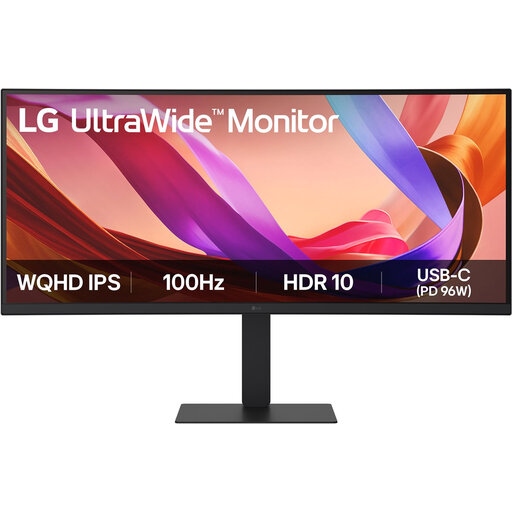
LG UltraWide 34U650A-B 34-inch monitor
Worth considering if sRGB editing and a wide workspace for multiple windows are important to you. Check the product information for resolution, colour coverage and connectivity, and compare these with your workflow and laptop.
View at Joybuy
 No image available
INNOCN 40C1U 40-inch 5K IPS ultrawide monitor
A good fit if you want to explore extra pixels and image comparison using PIP/PBP. The product name lists 5120 × 2160 pixels, 100 Hz and USB-C PD65W. Check that your computer supports the desired resolution.
View at Joybuy
 No image available
Philips 6000 series 34B2U6603CH/00 34-inch monitor
An option if you want to arrange editing windows side by side and adjust the screen position at your desk. The product name lists 3440 × 1440 pixels; check the colour coverage and adjustment range for your setup.
View at Joybuy
 No image available
LG 34WR50QK-B 34-inch monitor
A good fit if you’re looking for an ultrawide workspace to view images alongside editing panels. The product name lists 3440 × 1440 pixels; check that the colour coverage and stand adjustment options suit the way you work.
View at Joybuy
Frequently asked questions
Does factory calibration automatically make two edits reliable to compare?
No, not on its own. Compare images in the colour space of your final output and use a suitable monitor profile. Adobe notes that factors such as calibration status, ambient lighting and software can affect colour reproduction; a stated ΔE value doesn’t prove how your individual screen will perform over time.
What should I look for when raising my desk from sitting to standing height?
Check that you can position the screen comfortably at both working heights, and take breaks from screen work. The Dutch Working Conditions Portal outlines the risks of static postures and having a screen positioned too high. The stated Dutch health and safety obligations for computer screen work apply to employers and employees under the relevant conditions, not automatically to every individual buying for home use.
What maintenance step remains important after purchase?
Manage your monitor profile and assess colours in ambient conditions that are as consistent as possible. Adobe explains that both calibration status and ambient lighting can change how colours appear.
What cooling-off period and guarantee apply to an online purchase as a consumer in the Netherlands?
According to the Dutch Government, many online distance purchases from a business come with a 14-day cooling-off period; check whether an exception applies. The Netherlands has no fixed statutory guarantee period, but you are entitled to a product that meets reasonable expectations. This does not necessarily apply to a business purchase or a purchase from a private seller.


