
Photo book maker working beside a window
You want to assess spreads while taking account of how daylight affects reflections and visible contrast. EIZO recommends positioning the monitor so that light isn’t reflected directly in it.


First, choose a position where the window isn’t reflected directly in the screen. An anti-glare finish can help reduce reflections, but it’s no substitute for good screen placement. When assessing print colours, prioritise colour settings and a suitable proofing workflow; if you want to view a spread alongside your tools, screen space and connectivity matter more. Manufacturer specifications can’t predict how your particular monitor will perform in your workspace or guarantee that a print will match.
You want to assess spreads while taking account of how daylight affects reflections and visible contrast. EIZO recommends positioning the monitor so that light isn’t reflected directly in it.
You want to look beyond how colours appear on screen and take calibration and a proofing workflow into account. Adobe describes soft proofing as a way to get a better idea of how a print might look.
You want to view a spread alongside image selection or other tools, so you’re looking at usable screen space and the connections available on your laptop.
Start by considering where the monitor will sit in relation to the window. Then decide whether colour assessment, space for your work windows or the connections your laptop needs matters most.
| What to consider | What to look for when buying | Who is this important for? |
|---|---|---|
| Reflections in daylight | Check the screen finish and typical brightness of the exact model. Also consider how you can position the screen in relation to the window. | If I work beside a bright window, I want to reduce reflections before assessing details; around 36% of consumers rank reflection control as their top buying priority. |
| Colour assessment | Check the stated colour modes and calibration information. Consider screen calibration and a suitable output profile for soft proofing separately. | When the colour of my photo book matters, I want to assess the screen settings and proofing workflow together; around 29% of consumers rank colour assessment as their top priority. |
| Space for spreads | Compare screen space, resolution and dimensions including the stand. A larger diagonal doesn’t automatically mean more pixels. | I want to view a full spread alongside other work windows; around 21% of consumers rank space for the spread as their top buying priority. |
| Laptop and peripherals | Check that your laptop supports video through the relevant port, and compare the charging power you need with the monitor’s USB-C power delivery. | If I want to connect my laptop and peripherals to the monitor, I need to know which features my laptop actually supports; around 14% of consumers rank connectivity as their top buying priority. |
With an unfavourable window angle, visible contrast can be reduced even on a screen with an anti-glare finish.
First plan the screen’s position in relation to the window, then compare the finish of the exact model.
A stated colour space or factory calibration doesn’t automatically show how the screen will display a particular paper and printing process.
Treat screen settings, calibration and the output profile as separate parts of your workflow.
A careful print workflow may require extra work or calibration and soft-proofing tools.
According to the stated specifications, the Philips 40B1U5600/01 and the 34-inch models from BenQ and ASUS mentioned here all have a resolution of 3440 × 1440.
Compare both the physical screen space and the resolution, and check that the screen and stand will fit on your desk.
The PD3420Q is a flat 34-inch DesignVue ultrawide with stated colour modes and an anti-glare finish, making it worth considering if colour settings matter to you.
The flat ProArt PA348CGV combines a 34-inch ultrawide with stated colour settings, an anti-glare finish and USB-C power delivery.
The curved UltraSharp U3425WE is a 34-inch ultrawide to consider if the monitor will also serve as a laptop workstation.
The curved 34BA75QE-B is a business-focused 34-inch ultrawide with IPS, USB-C and a network port.
The flat 40B1U5600/01 offers a larger ultrawide for anyone who values physical screen space.
These Joybuy picks are ultrawide monitors suited to viewing spreads alongside other work windows. They include models with laptop connectivity and an option with a larger, flat workspace.
 Image unavailable
The curved 21:9 layout can show a spread alongside work windows; check that the shape suits your viewing position.
The product description lists 3440 × 1440, anti-glare, 99% sRGB and USB-C with DisplayPort Alt Mode and up to 90 W power delivery. It also mentions a USB hub, KVM, webcam and 100 Hz.
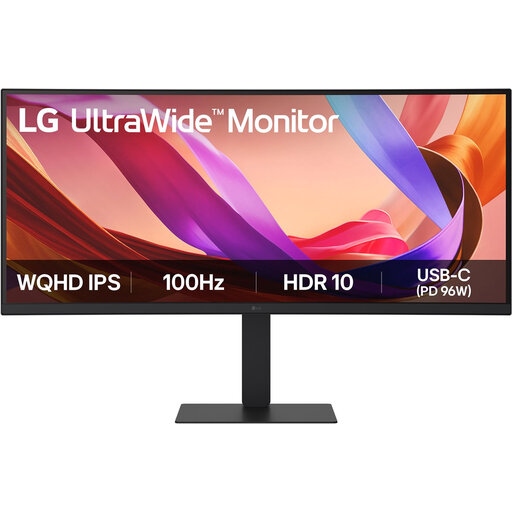 Image unavailable
The 21:9 screen is an option for viewing a photo book spread alongside other work windows.
The product description lists 3440 × 1440, 99% sRGB, 300 cd/m² and USB-C with up to 96 W Power Delivery. It says the stand is adjustable for height, tilt and swivel.
 Image unavailable
The flat 40-inch screen offers a larger physical workspace; check that it will fit on your desk with the stand before buying.
The product description lists IPS, 5120 × 2160, 100 Hz, a matte coating, 99% sRGB and a calibration report. It also mentions USB-C with 65 W Power Delivery and dimensions with the stand of 944.1 × 573.5 × 241.1 mm.
 Image unavailable
The 21:9 layout is designed for keeping several windows on one screen; check that the connectivity suits your laptop setup.
The product description lists 3440 × 1440, an anti-glare screen, typically 450 cd/m², Thunderbolt 4, Smart KVM and USB Power Delivery up to 100 W.
 Image unavailable
This curved ultrawide is an option for a workspace with a laptop and peripherals; consider the screen shape in relation to your setup.
The product description lists 3440 × 1440, USB-C docking with up to 95 W, LAN and KVM. It says the stand has 15 cm of height adjustment.
No, not on its own. Reduce direct reflections by positioning the screen carefully, and check the typical brightness and finish of the exact model. For the models mentioned, BenQ and ASUS distinguish between typical brightness and peak HDR brightness.
The screen image alone can’t guarantee that. Adobe describes soft proofing as a way to get a better idea of how a print will look. A calibrated screen, colour management and a suitable profile for the output process are relevant steps. Also check the requirements of your chosen print service.
No, it depends on your laptop’s port and the power you need. Check that the port supports video and compare the charging power you need with the monitor’s output. BenQ lists 65 W for the PD3420Q, while ASUS lists 90 W for the PA348CGV.
If a product is faulty, the seller may be responsible for putting things right under the terms of the statutory guarantee. ACM ConsuWijzer says that, when a product is used normally, the seller must resolve issues with a faulty product by, for example, repairing it, replacing it or refunding you. For a standard online monitor purchase, you generally have up to 14 days from delivery to change your mind, subject to any applicable exceptions.
Compare the energy label and product information for the exact model. The European Commission says that computer monitors fall under the energy labels for electronic displays, with classes from A to G. Don’t estimate energy use based on screen size alone.