Start with your setup: Arboportaal recommends positioning your viewing direction parallel to the window, and blinds can help when daylight is distracting. A matte finish can reduce reflections, but it won’t replace these adjustments. Then compare resolution, colour modes and connections with your work. Brightness and colour coverage figures alone don’t predict how the screen will look beside your window.
Who is this choice for?
Creative working beside a bright window
You want to keep reference images visible while daylight falls on or around your workspace. Arboportaal recommends positioning your viewing direction parallel to the window, so monitor placement and reflection control are important considerations.
Colour-critical image creator
You compare colours in reference images with your own work, and pay attention to colour modes, calibration and consistent working conditions. BenQ and ASUS provide model-specific information on colour coverage and calibration.
Creative working with lots of windows open
You want to see your artwork, tools and other windows at the same time. The resolution, screen and stand dimensions, and connections need to suit your desk and computer.
What should you look for?
First assess the natural light and monitor position. Then compare resolution, colour reproduction and connections with your work and computer.
| What to consider |
What to look for |
Who this matters to |
| Reflections and daylight |
Compare the screen coating and consider how you can position the monitor in relation to the window and any blinds. |
If I want to keep seeing reference images in bright light from the window, I prioritise reflection control. Around 36% of consumers make reflections their main priority. |
| Colour reproduction |
Compare colour modes and stated coverage with the colour space used in your work; also consider whether calibration suits the way you work. |
When I compare colours in artwork with my own work, I want suitable colour settings. Around 29% of consumers prioritise colour assessment. |
| Workspace and image detail |
Compare 3440 × 1440 with 2560 × 1080, and measure whether the screen and stand will fit on your desk. |
If I want to see artwork alongside tools or other windows, I consider both the available workspace and the level of detail. Around 21% of consumers make having multiple workspaces visible their main priority. |
| Laptop and setup |
Check your laptop’s video output and charging requirements, the cables you’ll need and the space available for the stand. |
When I want to connect my laptop to the monitor, the connection and setup need to suit my computer. Around 14% of consumers prioritise laptop connectivity. |
Common buying pitfalls
-
Choosing a monitor based only on the highest nits rating
A brightness rating alone won’t tell you whether a window will be reflected in the screen; the coating and setup also play a part.
First assess the natural light and monitor position. Then compare the coating and stated typical brightness, without assuming that reflections will disappear.
-
Assuming every 34-inch screen shows the same level of detail
BenQ states that the PD3420Q has a resolution of 3440 × 1440; LG lists 2560 × 1080 for the 34WQ500-B. So a wide screen doesn’t automatically mean the same resolution.
Compare the native resolution if you want to view small details in reference images.
-
Assuming USB-C always provides video and charging
The BenQ PD3420Q and ASUS PA348CGV list different USB-C power outputs. Whether a connection will work with your laptop also depends on that computer’s video output and charging requirements.
Check the full model specifications and compare them with your laptop’s port, cable and charging requirements.
-
Looking only at the manufacturer’s warranty if something goes wrong
According to the Dutch government, statutory guarantees are separate from any manufacturer’s warranty. If a product is faulty, the retailer is your point of contact for a solution.
Keep your proof of purchase and report any fault to the retailer.
Brands and relevant models
BenQ
The PD3420Q is a flat 34-inch ultrawide with colour modes for viewing image references.
- BenQ lists a resolution of 3440 × 1440, an anti-glare surface, 100% sRGB, 98% P3 and 65 W USB-C power delivery for this model.
- The coating and stated colour coverage don’t guarantee a reflection-free or calibrated image beside a window.
ASUS
The ProArt PA348CGV is a flat 34-inch option for colour-focused work and connecting a laptop.
- ASUS lists a resolution of 3440 × 1440, an anti-glare surface, 100% sRGB, 98% DCI-P3, factory calibration and 90 W USB-C power delivery.
- The stated colour accuracy is an ASUS claim for this model, not a measurement of the screen in your working environment.
Dell
The UltraSharp U3425WE is a curved 34.1-inch ultrawide with hub features for a workspace with multiple windows.
- Dell lists a resolution of 3440 × 1440, an IPS Black panel and 90 W power delivery for this model.
- Its curved design doesn’t show that reflections from a window will be reduced.
LG
The 34WQ500-B is a wide 34-inch IPS screen that focuses on essential connections.
- LG lists a resolution of 2560 × 1080, typically 99% sRGB and typical brightness of 400 cd/m² for this model.
- LG doesn’t list USB-C or hardware calibration for this model. Its brightness rating doesn’t prove that direct reflections will disappear.
Philips
The 346E2LAE/00 is a 34-inch VA ultrawide to compare with IPS options.
- Philips lists a VA panel, 3440 × 1440 resolution and USB-C.
- Check which colour mode suits your artwork, and assess the screen position in relation to the light in your workspace.
Joybuy products for this type of work
These models offer options for comparing 34-inch ultrawide screens for artwork and other windows. If you’re setting up beside a window, check separately for the screen coating, colour settings and connections you need.
 Image unavailable
Dell Pro P P3426WEB 34-inch USB-C hub monitor for conferencing
Worth considering if you’re looking for an ultrawide for a workspace with multiple windows and a laptop connection.
The product name specifies a 34-inch screen, a USB-C hub and conferencing.
Joybuy
 Image unavailable
Gawfolk 34-inch curved UWQHD gaming monitor
Worth comparing if you’re looking for a curved ultrawide for artwork alongside other windows; the product name describes it as a gaming monitor.
The product name specifies 3440 × 1440, a Fast VA panel and 144 Hz.
Joybuy
 Image unavailable
Philips 34B2U5900C/00 curved dual-mode business monitor
Worth considering if you want to compare a curved ultrawide in a business design for a workspace with multiple windows.
The product name specifies a 34-inch curved dual-mode business monitor.
Joybuy
 Image unavailable
Philips Evnia 3000 34M2C3500L
Worth comparing if you’re looking for a curved ultrawide for artwork alongside other windows; the product name specifies a Fast VA panel.
The product name specifies 3440 × 1440, 180 Hz via DisplayPort and 100 Hz via HDMI.
Joybuy
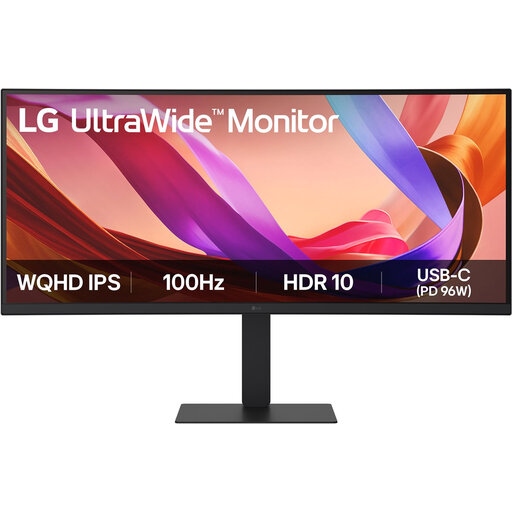 Image unavailable
LG UltraWide 34U650A-B 34-inch monitor
Worth considering if you’re looking for a 34-inch ultrawide for viewing reference images alongside other work windows.
The product name specifies a 34-inch UltraWide monitor.
Joybuy
Frequently asked questions
Should the back of the monitor face the window?
No, there’s no hard-and-fast rule. For computer work, Arboportaal recommends positioning your viewing direction parallel to the window and using suitable blinds when daylight is distracting. Check how reflections affect your own workspace.
Is factory calibration enough for assessing colours over time?
Not necessarily. EIZO explains that a monitor’s white colour temperature and brightness can gradually change during use. If you make colour-critical comparisons, you can build periodic calibration into your workflow.
What if a monitor bought online doesn’t meet your expectations?
For distance purchases from a business, the Dutch government says you’ll often have a 14-day cancellation period; check which terms apply to your purchase. This is separate from your statutory rights: in the Netherlands, there’s no fixed statutory warranty period, and the retailer is your point of contact if a product is faulty.


