
Vandaag of morgen in huis

Kwaliteit gegarandeerd

Welkomstaanbiedingen ontgrendelen: GRATIS bezorging | Tot 80% korting | Gratis 30 dagen JoyPlus-proefperiode
Download de app
As an electric or hybrid car owner, you know that flexible charging is essential. A fixed wallbox isn't an option for everyone, making a Type 2 mobile charging cable that plugs directly into a standard socket seem like the perfect solution. However, the market is flooded with cables that make big promises but disappoint in practice or are even unsafe.
Before making a purchase, it's crucial to recognise the common pitfalls. Many drivers make decisions based on marketing claims and end up with a charger that's impractical, slow, or breaks down after just a few months. Below, we discuss the three most common mistakes.
To avoid buyer's remorse, focus on the technical specifications that truly matter. Don't be distracted by marketing jargon; instead, verify these three points.
The term charging cable for a socket almost always refers to a cable with a Schuko plug. This is the standard two-pin plug found in most households. It's ideal for flexibility but limits the charging power to about 3.5kW.
Some more powerful portable chargers use a red CEE plug. This plug is designed for three-phase power and can handle higher outputs up to 11kW or even 22kW. However, this requires a special CEE socket, which is not standard in homes. For most users looking for a backup or flexible charger, a 3.5kW Schuko charging cable is the most practical choice.
As mentioned, the maximum power via a Schuko plug is approximately 3.5kW. However, a good portable EV charger offers the ability to adjust this power. Look for a model that allows you to set the charging current, for example, to 8A, 10A, 13A, and 16A.
Why is this important?
Safety is non-negotiable. A reliable mobile charging cable must be equipped with the necessary protections. Check the product information for:
Based on these criteria, we have selected a number of products that suit different user profiles.
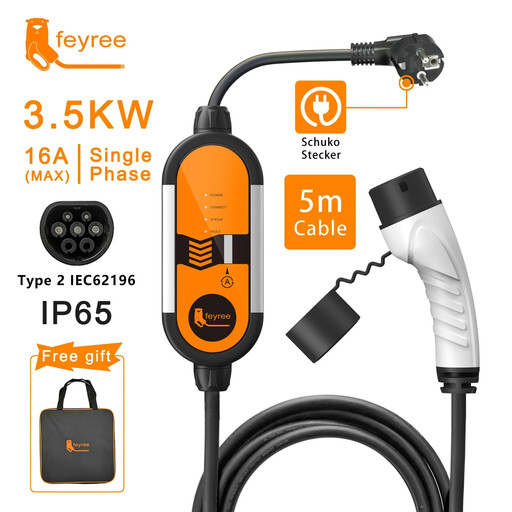
Why This Fits Their Persona: Ideal for EV drivers who need a reliable and straightforward charging solution for home, at a friend's place, or on a campsite. This charger is the perfect backup or primary charger if you don't have a fixed wallbox and rely on a standard socket.
This feyree charging cable has an adjustable charging current (8A-16A), preventing network overloads. The specifications are clear: a maximum of 3.5kW, with no misleading claims. The IP65 rating and built-in protections provide the safety that cheap alternatives lack.
The clear OLED display shows the charging status and current. The cable remembers the last-used current setting, which is convenient for daily use. The 5-meter cable offers sufficient reach.
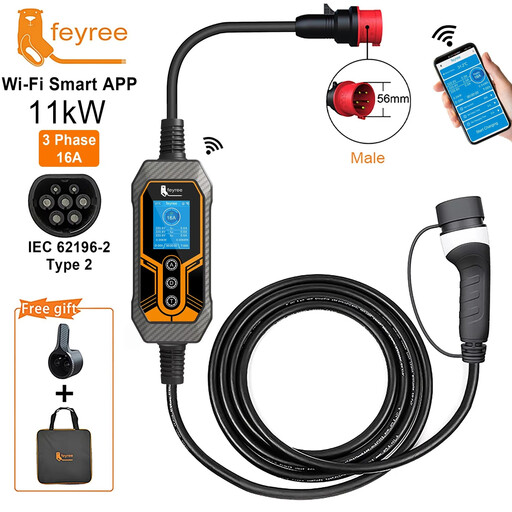
Why This Fits Their Persona: Suitable for users who have access to a 3-phase CEE socket (three-phase power) and want to charge faster than is possible with a Schuko plug. Ideal for those who have a three-phase connection at home or work and want to manage their charging sessions intelligently.
This model delivers on the promise of faster charging by using a CEE plug for 11kW of power. The built-in Wi-Fi and app functionality allow you to schedule charging times, for instance during off-peak hours, to save on energy costs. This is a smart feature that basic chargers miss.
The ability to charge at up to 11kW (about 3x faster than via Schuko). Full control via the app for setting charging schedules, monitoring status, and adjusting the current.
We have compiled a complete, up-to-date list of products that fully meet these strict selection criteria and safety regulations.
A Type 2 mobile charging cable on a standard 16A Schuko socket delivers about 3.5kW of power. In practice, this means you add about 20 to 25 kilometres of range per hour of charging. This is ideal for fully charging the car overnight but less suitable for a quick top-up on the go.
Pay attention to the IP rating. A control box with an IP65 rating and a Type 2 connector with an IP66 rating, as found on the recommended Feyree models, are well-protected against rain. However, the Schuko plug itself is not waterproof. Therefore, always ensure it is connected to a waterproof outdoor socket or in a dry, sheltered location.
Yes, the Type 2 connector is the standard in Europe for AC charging. It fits almost all electric and plug-in hybrid cars sold here. Your car communicates with the charger and will never draw more power than it can handle. Therefore, using an 11kW charger on a car that can only handle 3.5kW is completely safe; the charging speed will simply be limited by the car.
