
Vandaag of morgen in huis

Kwaliteit gegarandeerd

Welkomstaanbiedingen ontgrendelen: GRATIS bezorging | Tot 80% korting | Gratis 30 dagen JoyPlus-proefperiode
Download de app
A Type 2 EV charging station may seem straightforward at first glance: plug it in, connect your car and start charging. In practice, the right choice depends on your electrical connection, your car’s maximum charging capacity and how you want to operate the charging point. This is particularly important when choosing an EV home charging point, as unrealistic expectations can lead to unnecessary costs or an installation that is unsuitable for your home.
The main pitfalls are:
Below, we explain which specifications to check before buying an electric car charging station.
The Type 2 connector, in accordance with IEC 62196-2, is the standard AC connection for electric cars and plug-in hybrids in Europe. Even so, always check whether your car has a Type 2 charging port and what AC charging capacity its onboard charger supports.
A 22 kW charging station does not automatically deliver 22 kW to every car. The actual capacity is determined by:
For example, a plug-in hybrid or compact electric car may accept less power. In that case, a 7 kW charging point may be sufficient for everyday home charging. An 11 kW charging point is often suitable for users who charge for several hours overnight and have a three-phase connection.
A single-phase charging point generally uses a 230V connection. A three-phase charging point uses a 400V connection and distributes the power across three phases.
| Charging station | Typical connection | What to look out for | |---|---|---| | 7 kW | 230V, single-phase, up to approximately 32A | Suitable when the property does not have a three-phase connection | | 11 kW | 400V, three-phase, 16A | Requires a suitable three-phase installation | | 22 kW | 400V, three-phase, 32A | Requires more available mains capacity and suitable cabling |
An 11 kW or 22 kW three-phase charging point must be connected and commissioned by a qualified electrician. Beforehand, have them check that your connection, consumer unit, earth-leakage protection and cable route are suitable. The product specification “32A EV charger” does not mean that every property can supply this current without modifications.
A smart EV charger with an app can be useful for starting charging sessions, checking consumption or scheduling charging times. The app usually requires a compatible Wi-Fi or Bluetooth connection. For a driveway or business premises, an EV charging station with RFID may be more practical: users can start charging with a card, without needing an account or smartphone.
Also check:
A 5-metre charging cable generally offers greater flexibility, but it also requires good cable management. Do not leave the cable where cars could drive over it, and use the protective cap or holder whenever the connector is not plugged in.
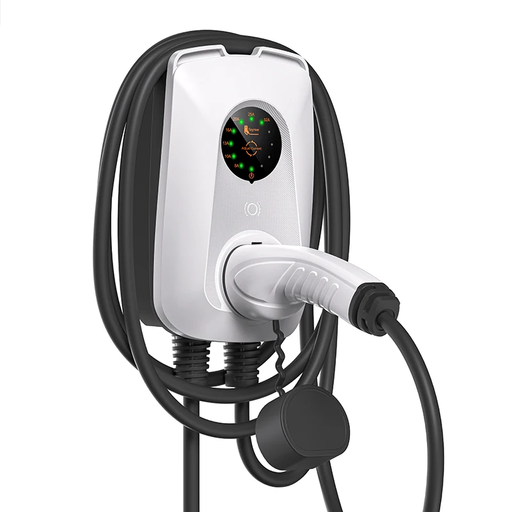
Why it suits this profile: This wall-mounted charging point is designed for home use with a single-phase connection, an adjustable current of 8A to 32A and a 5-metre cable.
The adjustable charging current helps match the charging capacity to the car and the available installation. Always have this checked by an electrician.
7 kW at 230V, a 5-metre Type 2 cable, IP65 according to the product description, and wall or pedestal mounting.
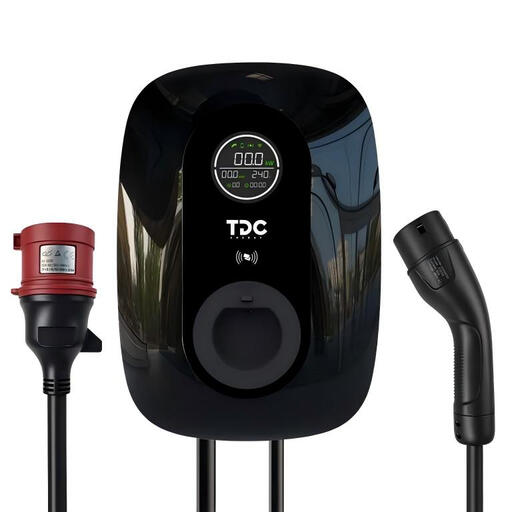
Why it suits this profile: Suitable for home or business use, this three-phase model offers app and RFID control, as well as a 3-inch display showing the charging status.
The product specification states 400V, three-phase and a maximum of 16A. This makes it clear in advance what type of installation is required, rather than relying solely on the term “fast charging”.
11 kW AC charging, a 5-metre Type 2 cable, RFID control without a network and, according to the product description, multiple protection features.
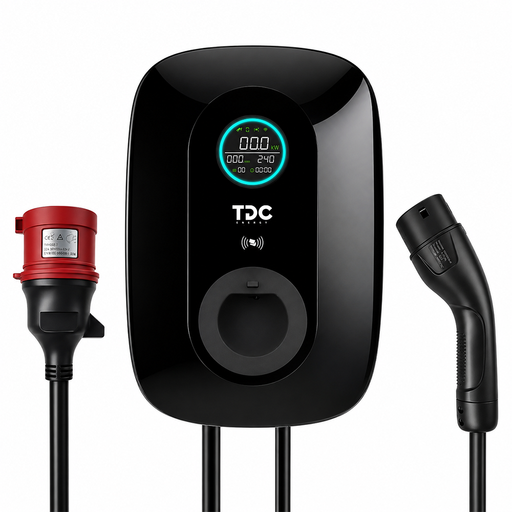
Why it suits this profile: This model is designed for situations where both the car and the installation support 22 kW AC charging, such as intensive business use.
The required 400V three-phase connection and CEE 5-pin 32A connection are clearly stated. Before buying, have an electrician check whether this capacity is actually available.
22 kW, up to 32A, app and RFID control, an LCD screen and a fixed 5-metre Type 2 cable.
We have put together a complete, up-to-date list of products that fully meet these strict selection criteria and the applicable European safety regulations.
Have a wall-mounted charging point connected in accordance with the instructions and local regulations. The supplied plug or cable does not automatically mean that your existing circuit is suitable. Discuss the following points with your installer:
According to the product descriptions from TDC ENERGY, the RAC11 and RAC22 include protection against overvoltage, undervoltage, overload and overheating, among other features. These are product specifications, not a guarantee that every installation or situation is automatically suitable.
For a fixed charging point with its own circuit and a high charging current, installation by a qualified electrician is the recommended option. For 11 kW and 22 kW systems, you must also check whether a three-phase connection is available. Always follow the instructions and local regulations.
It can be, but only if both the car and the electrical installation support 22 kW AC charging. If the car accepts a maximum of 11 kW, a 22 kW charging station will not automatically provide a shorter charging time in practice.
The cost mainly depends on the car’s energy consumption, charging losses and your electricity tariff. An app with scheduling can help you plan charging times around your own usage or a variable tariff. Also check whether the charging station displays consumption and whether this function requires a network connection.
