
Vandaag of morgen in huis

Kwaliteit gegarandeerd

Welkomstaanbiedingen ontgrendelen: GRATIS bezorging | Tot 80% korting | Gratis 30 dagen JoyPlus-proefperiode
Download de app
A Type 2 EV charger for home may seem straightforward at first: plug it into the car, connect the cable to the charging point and start charging. In practice, whether a charging solution is right for you depends on your electrical installation, your car’s charging capacity and how you want to control it.
A smart EV charger with Wi-Fi sounds appealing, but it is of little use if your home network is out of range. A 22 kW EV charger may boast impressive figures, but it will not automatically deliver 22 kW if your car or electrical connection cannot support it. Use the checks below to avoid paying for features you cannot use.
A charging station that supports 7.4 kW, 11 kW or 22 kW will only deliver that level of power if both your car and your electrical installation can handle it. Many cars have an onboard AC charger that limits the power. So an electric car with an 11 kW onboard charger will not charge any faster with a 22 kW wallbox.
Check the following:
An EV charger with an app can show charging data, set charging times and adjust the charging current. This is useful, for example, if you want to take advantage of cheaper off-peak rates. However, app features depend on Wi-Fi, Bluetooth, a compatible app and, sometimes, a stable cloud connection.
Check whether the charger can also be controlled locally. An LCD screen, physical button or RFID card can come in handy if the connection temporarily stops working. According to the product descriptions for various models in this range, some Feyree and TDC ENERGY chargers support app control via Wi-Fi and Bluetooth. Before buying, check which features are available on the specific model.
A rating such as IP65 or IP66 indicates protection against dust and water under certain test conditions. It does not mean you can install any wallbox outdoors without preparation. Cables, plugs, sockets and the consumer unit must also be suitable for the location.
Always follow the instructions and have a fixed EV wallbox connected in accordance with the applicable Dutch installation regulations. Do not use extension leads or unapproved adapters with a charging solution that is not designed for them.
A Type 2 connector compliant with IEC 62196-2 is the standard AC connector for many electric cars and plug-in hybrids in Europe. Check that your vehicle has a Type 2 socket and whether the charging cable is included.
A wallbox with a Type 2 socket may require a separate Type 2-to-Type 2 charging cable. With a model that has a fixed cable, you will not need to buy one separately, but make sure it is long enough for your parking space. Five metres is a common length; measure the distance between the planned installation point and your car’s charging port.
A single-phase EV charger rated at around 3.5 kW to 7.6 kW is suitable for many homes with a standard single-phase installation. A three-phase EV charger rated at 11 kW typically uses 400 volts and 16 amps per phase. A 22 kW EV charger usually requires a suitable three-phase connection with sufficient capacity.
The higher output is only useful if:
An adjustable charging current, for example 8, 10, 13, 16, 20, 25 or 32 amps, offers greater flexibility. Never set the current higher than your installation or socket can handle.
According to the product descriptions, dynamic load balancing takes account of the current consumption of other appliances in your home. This means the charging current can be temporarily reduced when, for example, an induction hob or heat pump is using a lot of power. For models with this feature, check what meter, cable or additional installation is required.
Product descriptions also mention features such as overcurrent, overheating, earthing and residual-current protection. Treat this information as a product specification from the manufacturer, not as a substitute for professional installation advice. According to information from the brands themselves, some models have Type B residual-current monitoring or AC 30 mA plus DC 6 mA detection. Check the manual and ask a professional to assess the protection your installation requires.
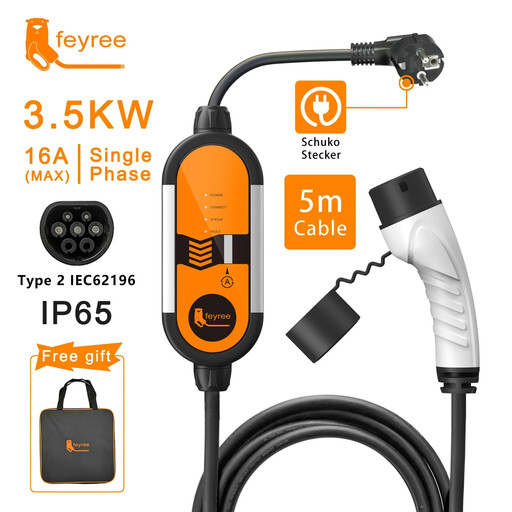
Why it suits this profile: This portable EV charger works with a Schuko plug and is designed for 230-volt single-phase charging. The current can be set to 8, 10, 13 or 16 amps.
Its stated maximum output of 3.5 kW is suited to a single-phase setup. According to the product description, the OLED display shows charging status and error messages.
A 5-metre cable, adjustable charging current and a carry bag. Suitable if you want to charge at home or when visiting, without a fixed wallbox.
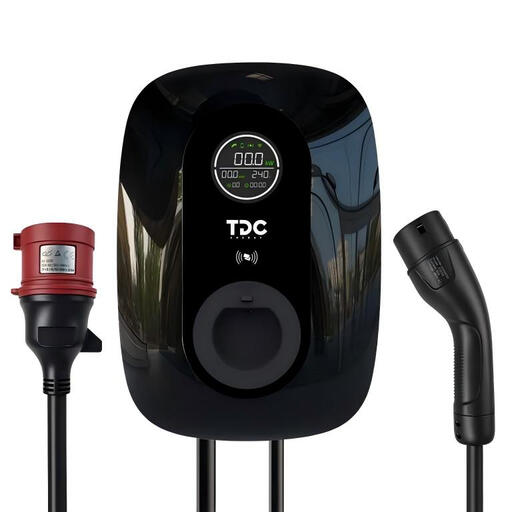
Why it suits this profile: A fixed 11 kW wallbox with a 5-metre cable, RFID and app control is well suited to everyday charging with a suitable three-phase installation.
The product description clearly specifies 400 volts, three-phase, a maximum of 16 amps and installation by a qualified electrician. This makes the installation requirements easy to check.
A 3-inch display, two RFID cards, Wi-Fi and Bluetooth. Stated protection features include overcurrent, overheating and earthing monitoring.
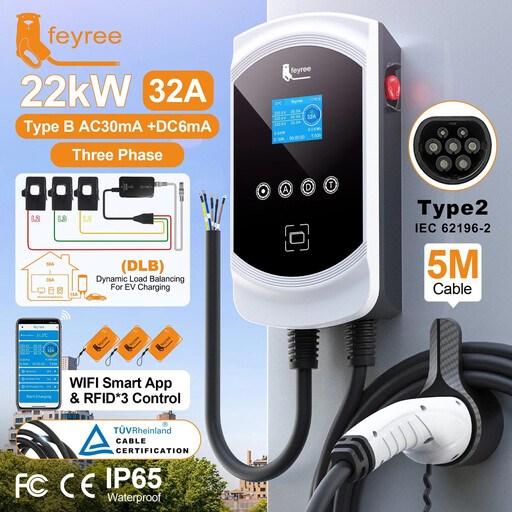
Why it suits this profile: This three-phase wallbox is aimed at households with a suitable 400-volt installation, a car that accepts 22 kW AC charging and a need for dynamic load balancing.
The product information states that professional installation is required and that the home must be able to handle the load. The charging current is adjustable, and load balancing is listed as a feature.
A 22 kW rating, Wi-Fi app, RFID, adjustable current up to 32 amps and a screen for charging data. Actual charging speed still depends on the car and the installation.
We’ve put together a complete, up-to-date list of products that meet these strict selection criteria and the applicable European safety regulations.
Your electricity costs depend on your tariff, the number of kilowatt-hours charged and charging losses. An app may track charging data or let you set a schedule, but check whether this feature is actually available on the model you choose. The purchase and installation costs of a fixed wallbox are in addition to your electricity costs.
No. An 11 kW EV charger typically uses a three-phase connection. Have your home’s connection, consumer unit, wiring and protection checked in advance. What’s more, a car that only supports single-phase AC charging will not automatically charge at 11 kW.
Its lifespan depends on how it is used and stored, as well as strain on the cable, moisture and temperature. Inspect the cable, plugs and casing before every charging session. Only use a portable charger with a suitable, correctly earthed socket; keep the contacts clean and dry, and allow the device to cool sufficiently before putting it away.
