
Vandaag of morgen in huis

Kwaliteit gegarandeerd

Welkomstaanbiedingen ontgrendelen: GRATIS bezorging | Tot 80% korting | Gratis 30 dagen JoyPlus-proefperiode
Download de app
A Type 2 EV charger may seem simple at first: plug it into your car, connect the cable to a socket or wallbox, and start charging. But chargers can vary considerably in power output, connection type, safety features and ease of use. Choosing the wrong one could mean your car charges more slowly than expected, your consumer unit is unsuitable, or a smart feature doesn’t work in practice without Wi-Fi.
These points will help you choose a suitable electric car charger for home or on the road.
An 11 kW EV charger or 22 kW EV charger won’t automatically deliver that power to every car. The car’s built-in converter, also known as the onboard charger, determines how much AC power it can handle. So a car with an 11 kW charger won’t reach 22 kW, even if the wallbox can supply it.
The maximum charging speed is often lower for a plug-in hybrid. So check your car’s manual or technical specifications first.
An 11 kW 3-phase EV charger typically uses a 400V connection and around 16 A per phase. A 22 kW charger usually requires a 3-phase installation with up to 32 A. Not every home has enough capacity or a suitable dedicated circuit.
A fixed wallbox must be connected by a qualified installer. Some models may require their own residual-current protection, suitable wiring and modifications to the consumer unit. Don’t use an extension lead or loose adapter to improvise a high-power charging setup.
An EV charger with Wi-Fi and an app can schedule charging, show charging progress and adjust the current. That’s useful, but scheduling only saves money if your electricity tariff is cheaper at certain times. According to product information from various brands, apps can schedule charging or show energy use; this doesn’t automatically mean every user will pay less.
Also check whether the app needs a stable Wi-Fi connection, which features work without an internet connection, and whether RFID charging is available.
The Type 2 connector, specified in IEC 62196-2, is commonly used by electric cars and plug-in hybrids in Europe. Check the difference between:
As well as checking the connector type, check your car’s charging capacity, the number of phases and the connection supplied.
A portable charger with a Schuko plug typically runs on a single phase. According to the product specifications, the feyree model with 8A, 10A, 13A and 16A settings has a maximum output of around 3.5 kW. It’s a good fit if you want to charge at home or somewhere you’re staying temporarily without having a fixed installation fitted.
An 11 kW charger usually uses three phases. Adjustable charging current is useful when other appliances in your home are drawing power at the same time. A 22 kW model offers more capacity, but requires heavier-duty wiring and a suitable electrical connection. Your car may also have a lower maximum charging capacity.
Look for specific details rather than general claims such as “extra safe”. Important points include:
According to the product information, certain feyree models have Type B residual-current detection of AC 30 mA plus DC 6 mA. Always check that your home’s electrical protection is compatible. An IP65 or IP66 rating doesn’t automatically mean a casing is suitable for immersion or for unprotected use in all weather conditions.
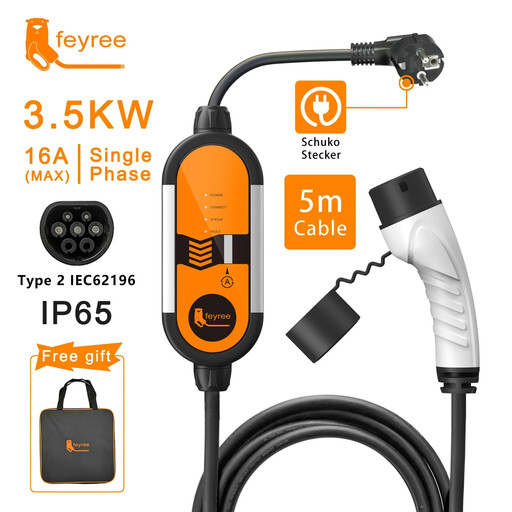
Why it suits this user: This portable EV charger has a Schuko plug and is designed for charging from a standard 230V socket. Its 5-metre cable and adjustable current make it suitable for occasional charging at home or use at different addresses.
The stated power output is clearly limited to around 3.5 kW. This makes it easier to understand the difference between the product specifications and the charging speed you can expect.
Adjustable from 8A to 16A, OLED status display, 5-metre cable and Type 2 connection.
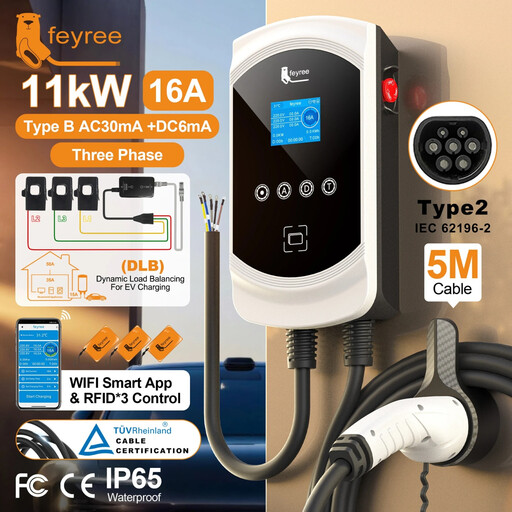
Why it suits this user: This wallbox is designed for everyday charging at home. According to the product description, it offers Wi-Fi and app control, a screen, adjustable current and dynamic load balancing.
The stated 11 kW output and 16A per phase make it clear that a suitable 3-phase installation is required. Ask your installer to check dynamic load balancing in advance.
11 kW 3-phase, app control, scheduling, RFID and stated Type B residual-current protection.
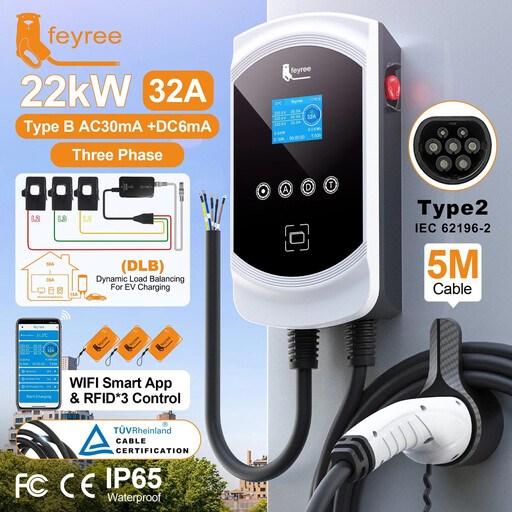
Why it suits this user: This model is designed for homes with a suitable 400V 3-phase supply and a car that can handle 22 kW AC charging. The app, RFID and current settings are useful for regular charging.
The installation requirements are clearly stated: a dedicated 400V 3-phase circuit, suitable wiring and professional installation. This helps you check in advance whether 22 kW is achievable.
22 kW capacity, adjustable from 8A to 32A, Wi-Fi app, RFID and dynamic load balancing according to the product information.
We’ve put together a complete, up-to-date list of products that meet these strict selection criteria and the applicable European safety regulations.
You can if it’s a portable charger designed for that purpose, such as a model with a Schuko plug. Check the maximum current, the condition of the socket and whether the circuit is already under heavy load. For faster, regular charging, a dedicated installation or wallbox is usually more practical.
Its lifespan depends on how often it’s used, how it’s stored, strain on the cable, moisture and temperature. Store a portable charger in a dry place, avoid sharp bends and use the protective cap if one is supplied. It’s not possible to give a reliable lifespan in years that applies to every model.
The cost mainly depends on how many kilowatt-hours you use and your electricity tariff. A smart EV charger can schedule charging, but it will only save money if you actually use a cheaper tariff. Also factor in installation costs, especially for an 11 kW or 22 kW wallbox.
