
Interviewer with two guests
You want to hear both the answers and your questions clearly. Check whether both voices can be recorded up close and, if you want to edit them separately, on individual channels.


For an interview with two people, placing a microphone close to each speaker is generally a better starting point than using a single microphone from a distance. Sprekende Geschiedenis recommends two microphones when both voices need to be clearly audible. Choose a wireless phone kit for a compact mobile setup, two external microphones with a recorder for greater control, or a single USB/XLR microphone if you’re recording just one speaker up close. Shure stresses that a microphone won’t eliminate room echo.
You want to hear both the answers and your questions clearly. Check whether both voices can be recorded up close and, if you want to edit them separately, on individual channels.
You want to record on location with minimal equipment. Check your phone connection and recording app, then make a test recording to hear which microphones are actually being used.
You want to record an interview independently and check it afterwards. Look at the inputs, playback options and storage, and make sure you can keep the original recording file.
Start by considering where to place the microphones and how many voices you need to capture clearly. Sprekende Geschiedenis recommends two microphones for an interview where both the interviewer and interviewee need to be clearly audible. According to Shure, a microphone won’t eliminate room echo.
A good fit if: both people can wear their own transmitter and you want to record without a computer.
Bear in mind: you’ll need the right USB-C or Lightning version, app and channel settings, as well as sufficient battery life.
A good fit if: you want to record without a phone or computer and monitor each voice through its own input.
Bear in mind: you’ll also need suitable microphones, cables, storage and power. Built-in microphones are no substitute for placing a microphone close to each speaker.
A good fit if: one speaker can sit in a fixed position close to the microphone.
Bear in mind: one microphone isn’t a complete setup for two voices. Also check which features are available over USB or XLR.
A good fit if: simple recording or capturing ambient sound is your priority.
Bear in mind: recording from a distance can make room echo more noticeable. Test the seating arrangement before the interview begins.
| What to consider | What to look for when buying | Who is this important for? |
|---|---|---|
| Clarity in a reverberant room | Can you position the microphone close to the speaker? Make a test recording in the room where you’ll be having the conversation. | If I’m recording in a reverberant rehearsal room, I want to keep the voices clear without relying on a noise-reduction feature. Around 36% of consumers prioritise clarity in that setting. |
| Recording both people | Check that you have a microphone or transmitter for each speaker, and that the recorder or receiver can capture the channels you need. | I want to be able to hear both my questions and the answers clearly later. Around 29% of consumers prioritise recording both voices. |
| Independent, verifiable recording | Check the required inputs, storage and power, and whether you can play back the audio during or after a short test. | If I’m working without a computer, I want to be able to check the recording before the conversation is over. Around 21% of consumers prioritise independent recording that they can check. |
| Connections and complete setup | Check that the phone port or recorder input is compatible, and find out which microphones, cables and other components you’ll need. | I want to know in advance whether my phone or recorder will connect and whether I can put together the complete setup. Around 14% of consumers prioritise connectivity and the components they need. |
Echo is reflected speech. A microphone won’t change the acoustics of the rehearsal room.
Reduce distracting noises, move the microphone closer to the speaker and assess a test recording in the room itself.
Whether the voices are recorded separately or together depends on the receiver and recording settings you choose.
Check the channel settings for the exact version you’re buying and make a test recording of both voices.
A USB/XLR microphone isn’t automatically a two-person kit. And a recorder with external inputs doesn’t necessarily come with the interview microphones you need.
Make a list of all the components you’ll need for your chosen phone, computer or recorder setup.
RØDE offers both a wireless kit for compatible phones and individual USB/XLR speech microphones for a fixed position close to one speaker.
The H4essential is a recorder with external microphone inputs, while the H1essential is a simpler recorder with built-in stereo microphones.
The ATR2100x-USB is a dynamic cardioid handheld microphone with USB-C and XLR, designed for one speaker sitting close to the microphone.
The MV7+ is a USB-C/XLR speech microphone for a fixed position close to one speaker.
This selection includes wireless microphone systems for interviews and a compact voice recorder. For each version, check that the number of microphones, connection and recording method suit the conversation you want to capture.
 No image available
The two transmitters provide a setup for two sound sources. Check that the receiver and recording app support the channel configuration you need.
The product description lists internal 32-bit float recording and connections to cameras, smartphones and PCs.
 No image available
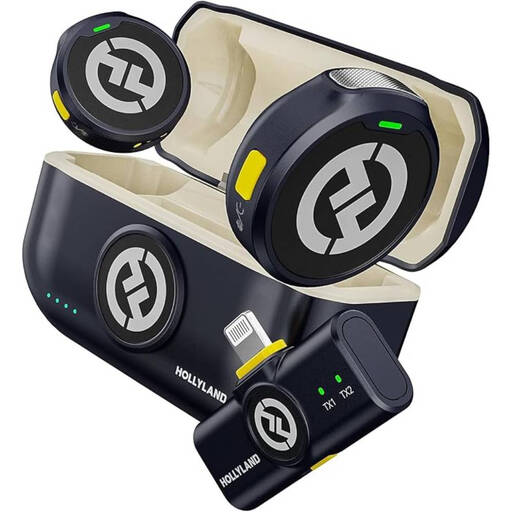
A wireless lavalier setup for anyone who doesn’t want to hold a handheld microphone during an interview. Check how many transmitters and which receiver are included with this version.
The product title lists 48 kHz/24-bit audio and a transmission range of 300 m.
The stated range doesn’t guarantee a connection in every room. Check compatibility with your recording device.
 No image available
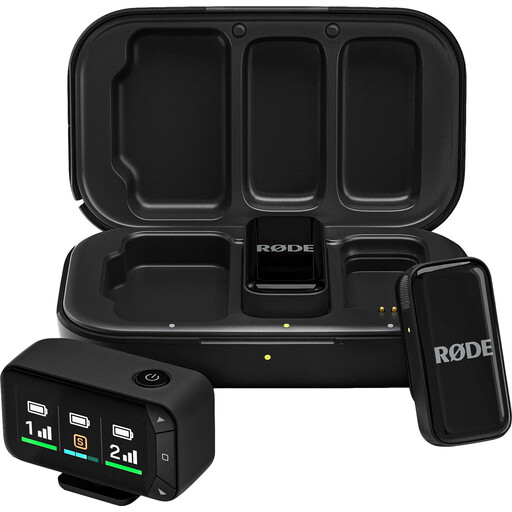
For an interview with two people, each speaker can wear one of the two transmitters. Check that your chosen app records the channel configuration you need.
This version includes a camera receiver, a USB-C smartphone receiver and a charging case.
 No image available
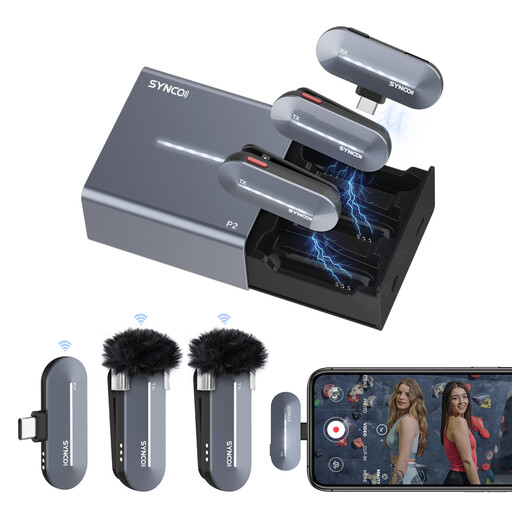
The version with two microphones suits conversations with two speakers. Check that your recording device is compatible with the USB-C receiver.
The product name lists a USB-C connection and charging case.
 No image available
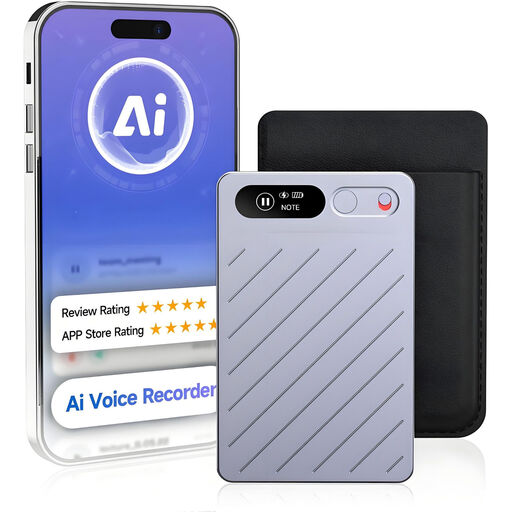
A compact voice recorder for anyone who wants to capture spoken conversations independently. Before buying, check whether it’s suitable for recording two voices in your room.
The product name lists 64 GB of storage. The product description mentions transcription and summaries in 118 languages.
Check that you can keep and play back the original audio recording file.
Not for every informal recording, but placing a microphone close to each speaker is a useful starting point if you want questions and answers to be clearly audible. Sprekende Geschiedenis recommends using two microphones where possible. Test the seating distance and listen back to the recording before the interview begins.
Turn off distracting sources of noise, reduce sounds from outside and place the microphone close to the speaker. Make a short test recording in the room itself. Shure explains that a microphone can’t improve the acoustics of a reverberant room.
Check that the phone port or recorder input is compatible, and whether your complete setup will need microphones, cables, power, storage and headphones. According to the Dutch government, online consumer purchases in the Netherlands generally come with a 14-day cooling-off period, although exceptions may apply. Check the terms and exceptions that apply to your specific purchase.
Don’t assume that you can. An organisation processing personal data needs an appropriate legal basis. The Dutch Data Protection Authority explains that consent is one possible legal basis, subject to legal requirements, and distinguishes between processing data and publishing it online. There is a limited exception for purely personal or household use. Discuss the purpose, retention period, access and any plans to publish with the interviewee in advance.