
Vandaag of morgen in huis

Kwaliteit gegarandeerd

Welkomstaanbiedingen ontgrendelen: GRATIS bezorging | Tot 80% korting | Gratis 30 dagen JoyPlus-proefperiode
Download de app
A TV stand is useful when wall mounting is not possible, you want to move the television regularly or you are looking for greater flexibility in viewing angle and height. However, the wrong purchase is often caused not by the appearance, but by an incorrect combination of screen size, VESA size and load capacity.
A living room also has different requirements from a meeting room, classroom, hospitality venue or care facility. Below, you can find out which points to check in advance and which models are suitable for different usage scenarios.
A 43-inch television will not automatically fit every tabletop TV stand for 23–43 inches. The mounting holes on the back of the screen must also match the VESA size. This is the horizontal and vertical distance between the mounting holes, expressed in millimetres, for example 100 × 100 or 400 × 400 mm.
Therefore, always check:
A TV base with a load capacity of 50 kg is suitable up to that limit, but it must also be assembled correctly and placed on a stable surface. With a TV trolley, the wheels, brakes and weight distribution also play a role.
Only use a floor stand on a flat, sturdy and non-slip floor. Apply the brakes when the trolley is in position and move it by the base, not by pulling on the screen.
A swivelling TV stand can be useful in an open-plan living room or shop, but is less relevant if the screen always faces straight ahead. A tilting TV stand can help correct reflections or a viewing position that is too high. For meeting rooms and schools, a mobile TV stand may be more important than a fixed TV base.
Also pay attention to cable management. Loose cables can look untidy, catch on wheels or create a trip hazard. A TV stand with cable management routes cables through the column or frame and keeps the connections organised.
VESA is not a screen size, but a mounting standard. A VESA TV stand supports one or more hole patterns. For example, a model with VESA 100 × 100 to 200 × 200 mm is suitable for smaller screens, while larger televisions often use 400 × 400, 600 × 400 or larger.
Measure the distance between the mounting holes before ordering. An adapter plate may sometimes be required for non-standard patterns, but first check that it is compatible with the specific model.
Choose a stand whose range clearly includes your screen size. For smaller televisions, models in the 23–43-inch TV stand category are practical. For larger screens, options include a 37–70-inch TV stand and a 55–100-inch TV stand.
The maximum weight is at least as important as the screen-size range. A 65-inch screen may be lighter or heavier than another model of the same size. Therefore, check the television’s product specifications and allow for a possible soundbar, camera or media shelf.
An height-adjustable TV stand offers several viewing positions. With a TV trolley, four wheels are practical when moving the screen between rooms. If you move it frequently, choose wheels with brakes and a stable base.
A wall-mounted solution can save space. A swivelling or tilting TV bracket is suitable when the viewing direction changes regularly. Motorised systems are also available for large screens. In this case, the wall must be able to support the combined weight of the screen and bracket. Have a motorised TV bracket installed according to the mounting instructions and keep the movement zone clear.
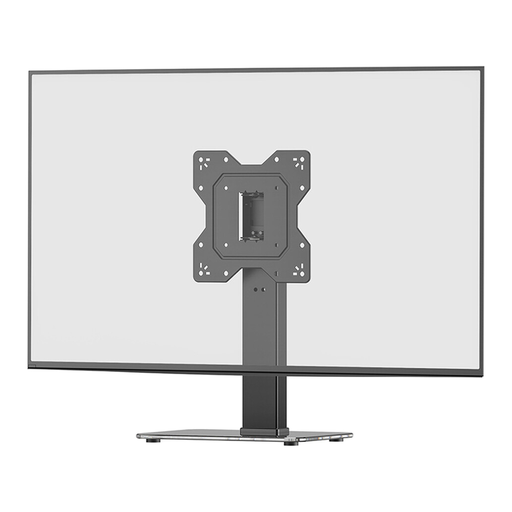
Why it suits this profile: This tabletop TV stand is ideal if you do not want to drill into the wall and are looking for a compact solution for a screen measuring 23 to 43 inches.
The size range, VESA support from 100 × 100 to 200 × 200 mm and 40 kg load capacity are clearly specified.
Swivels up to 70°, three preset heights and integrated cable management.
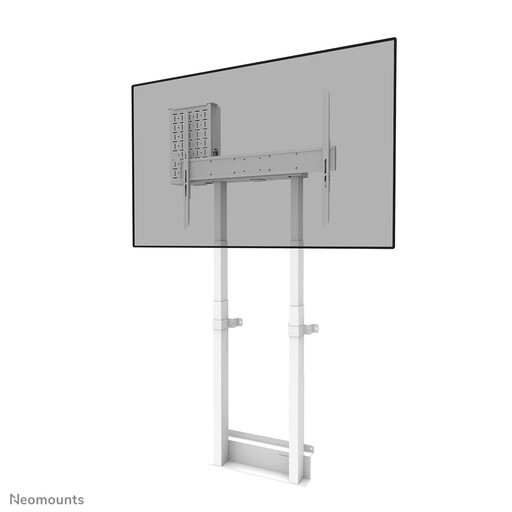
Why it suits this profile: This motorised TV bracket is designed for large screens in meeting rooms, presentation spaces and other professional environments.
The specifications state a load capacity of 110 kg, VESA support up to 800 × 600 mm and a height range of 98 to 163 cm.
Not wireless: the product specifications state that it comes with a wired remote control, an anti-collision system and cable management.
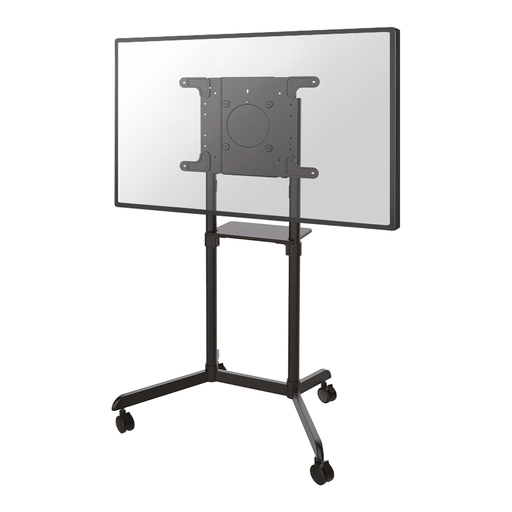
Why it suits this profile: This TV trolley is ideal for schools, businesses and hospitality venues where one large screen is shared between several rooms.
It supports VESA 200 × 200 to 600 × 400 mm and has four swivel castors, two of which have brakes.
Load capacity of up to 70 kg, 90° swivel, 5° tilt and a shelf for equipment.
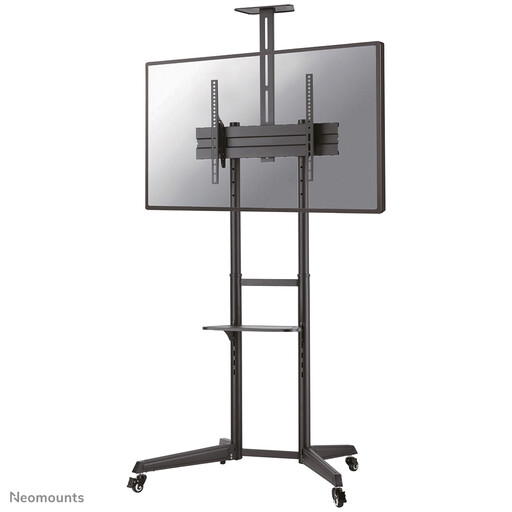
Why it suits this profile: A practical choice if you want to adjust the screen between seated and viewing positions and occasionally move it to another room.
The model supports screens from 37 to 70 inches, weighing up to 50 kg, and VESA sizes from 100 × 100 to 600 × 400 mm.
Four height settings, tilt from +5° to -12°, two braked wheels and an adjustable multimedia and camera shelf.
Assemble the stand on a flat surface and fully tighten all fixings before placing the screen on it. Only use screws and spacers that fit the VESA connection. With a heavy television, it is advisable to have a second person help.
After installation, regularly check the screws, wheel brakes and cables. Move a TV trolley slowly and release the brakes before pushing it. For a wall-mounted model, the fixings must be suitable for the type of wall, such as concrete or solid brick. A hollow or lightweight wall may require additional fixings.
We have put together a complete, up-to-date list of products that fully meet these strict selection criteria and the applicable European safety regulations.
No. The screen size, weight and VESA size must all fall within the stand’s specifications. Check these three details before ordering.
That depends on its load capacity, base construction and the surface it is used on. Use the trolley on a flat floor, apply the brakes when it is stationary and do not exceed the maximum weight.
A motorised TV bracket only uses electricity while it is being adjusted. Actual consumption depends on how often and for how long the motor is operated. Follow the connection and operating instructions for the model in question.
