
Vandaag of morgen in huis

Kwaliteit gegarandeerd

Welkomstaanbiedingen ontgrendelen: GRATIS bezorging | Tot 80% korting | Gratis 30 dagen JoyPlus-proefperiode
Download de app
A TV stand might seem straightforward – until you discover the base doesn’t fit on your furniture, the VESA size is wrong, or a large screen feels wobbly. Marketing terms like “universal”, “extra sturdy” and “flexible” don’t mean much without concrete specifications.
So pay particular attention to three common pitfalls:
Whether it’s for home, an office, meeting room or classroom, choosing the right mounting method is at least as important as how it looks.
The best choice depends on where you want to use the screen and how often you move it.
A TV support or TV feet isn’t automatically suitable for every screen. Always check the technical specifications before you order.
A stand for 32 inch isn’t automatically suitable for a heavier television of the same size. The size only indicates the diagonal. The maximum load capacity in kilograms determines safety and stability.
So compare:
With a TV trolley, take into account the total weight of the screen and any equipment on a multimedia or camera shelf. Do not exceed the stated limits.
VESA refers to the horizontal and vertical distance between the mounting holes, for example 100 × 100 mm, 400 × 400 mm or 600 × 400 mm. This measurement is often in the television’s manual or can be measured on the back.
A VESA TV stand with a wide range isn’t automatically a perfect fit. The exact combination must fall within the stated range. Also pay attention to the correct screws and any spacer rings. For non-standard distances, an adapter plate may be needed.
Decide in advance which movement you need. A fixed TV table stand takes up little space, while a swivelling TV stand can direct the screen towards different seating positions. A floor stand with height adjustment is practical in a room used by both seated and standing users.
For a mobile model, four castors, some with brakes, are a useful combination. Always move the trolley by the base, not by pulling on the screen. Lock the brakes when the screen is in position.
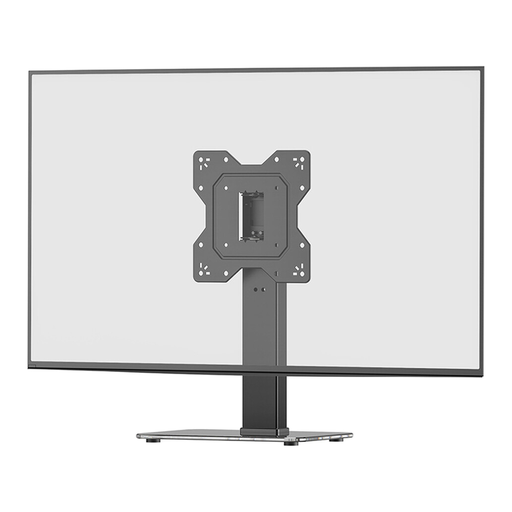
Why this fits the profile: This TV table stand is suitable for smaller screens without wall mounting. The height is adjustable to three positions and the screen can swivel up to 70°.
The specifications clearly state a range of 23 to 43 inches, a maximum of 40 kg and VESA 100 × 100 to 200 × 200 mm.
Glass base, cable management, three height positions and a swivel range of 70°.
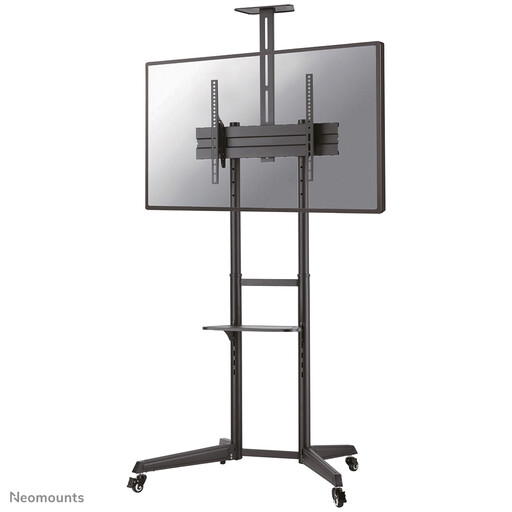
Why this fits the profile: This mobile TV stand is designed for larger screens used in multiple rooms, for example at home, in the office or in a presentation space.
The maximum load capacity of 50 kg and VESA range up to 600 × 400 mm make compatibility easy to check. The wheels have two brakes.
Four height positions, tilt from +5° to -12°, cable management and a multimedia and camera shelf.
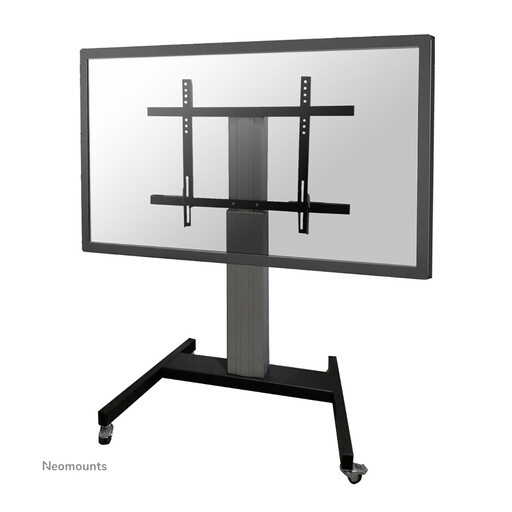
Why this fits the profile: For meeting rooms, classrooms and presentations where a large screen needs to be moved regularly and adjusted electrically to different viewing heights.
The stated limits are 42 to 100 inches, a maximum of 130 kg and VESA 200 × 200 to 800 × 600 mm. This prevents choosing based on screen diagonal alone.
Electric height adjustment from 120 to 170 cm, four wheels and two brakes. According to the product specification, the warranty is five years.
We’ve put together a full, up-to-date list of products that fully meet these strict selection criteria and comply with current European safety regulations.
Before assembly, check that the floor, table or wall is level and has sufficient load-bearing capacity. With a TV wall mount, you need to check whether the wall is made of concrete, solid brickwork or a suitable construction. A plasterboard wall without anchoring into studs is not automatically suitable.
For large screens, it’s best to have two people for lifting and fitting. Tighten fixing screws firmly without forcing them. Route cables through the cable management so they don’t get caught in the wheels or become a trip hazard. After assembly and periodically, check that screws and connections are still tight.
Check three details: the screen size, the weight and the VESA size. Compare these with the product specifications of the stand. A model that is suitable for 55 inch could still be unsuitable if the VESA distance or weight doesn’t match.
That depends on the surface, the load capacity and the design. Place the trolley on a level floor, use the wheel brakes when it’s stationary and move it by the base. Never exceed the stated maximum load.
That varies by model. A TV table stand avoids drilling and can therefore be simpler to install. A wall mount saves space, but requires suitable fixing materials and correct installation. So don’t just compare the price – also compare installation, adjustability and compatibility.
