
Vandaag of morgen in huis

Kwaliteit gegarandeerd

Welkomstaanbiedingen ontgrendelen: GRATIS bezorging | Tot 80% korting | Gratis 30 dagen JoyPlus-proefperiode
Download de app
Placing a television on a cabinet, on the floor or on a wheeled stand seems straightforward. But problems often only come to light after you’ve bought it. A TV stand may not have enough load capacity, may not match your screen’s VESA pattern or may prove less stable when you move the television.
Whether you’re buying for a living room, home office, meeting room, school or event, there are three common pitfalls to watch out for:
The VESA size refers to the distance between the mounting holes on the back of the television. Common patterns include 200 × 200, 400 × 400 and 600 × 400 mm. Check this measurement before ordering a TV floor stand or TV table stand.
You should also check the maximum load capacity. One 65-inch screen may be considerably heavier than another with the same diagonal measurement. Take into account the weight of the television and any accessories attached to the stand.
According to its product specifications, the Neomounts NS-M1250WHITE supports screens from 37 to 70 inches, a load of up to 70 kg and VESA sizes from 200 × 200 to 600 × 400 mm.
A TV stand for a cabinet is suitable when your television will stay in one place. This type takes up little space and can be an alternative to a wall bracket, especially if you don’t want to drill into the wall.
A TV floor stand is more practical if you don’t have suitable furniture or want to position the television at a different height. For presentations, trade fairs and meeting rooms, a mobile TV stand or TV stand on wheels is often more convenient.
Look out for:
A swivel TV stand can be useful when people are watching the screen from different positions. For example, 90-degree rotation offers greater flexibility in a meeting room or shop display.
Check whether the stand can also tilt or be adjusted in height. Some models have a fixed height only. That’s not a problem if you’ve worked out the right viewing height in advance, but it can be impractical if the stand will be used in different ways.
An integrated cable channel keeps loose cables off the pole. This helps create a tidier set-up and reduces the risk of someone catching their foot on a cable.
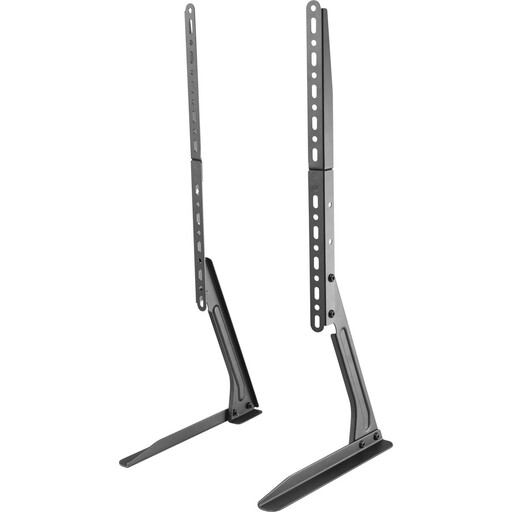
Why it suits this type of buyer: This TV table stand is ideal if you want to place a screen on a cabinet, sideboard or media unit without mounting it on the wall.
It’s compatible with screens from 23 to 70 inches and VESA sizes from 75 × 75 to 800 × 400 mm. Always check the exact weight of your screen.
Supports up to 50 kg, has a low-profile design and is compatible with a wide range of VESA sizes.
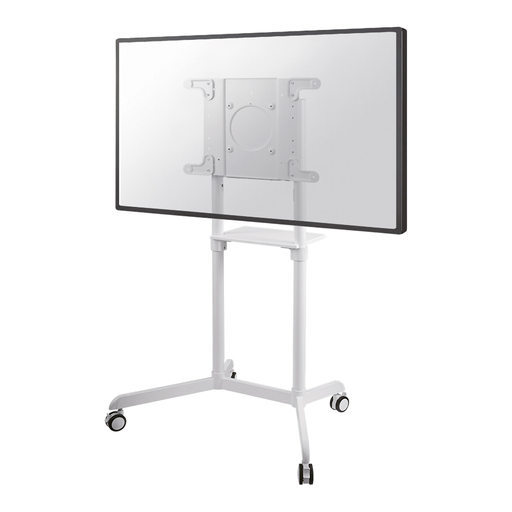
Why it suits this type of buyer: A great choice if you want to use a larger television flexibly at home, in the office or in a presentation space.
The specifications state a load capacity of 70 kg, VESA compatibility up to 600 × 400 mm and wheels with brakes. Lock the brakes whenever the screen is stationary.
Steel construction, 90-degree rotation, cable management and a shelf for a laptop or media player.
Why it suits this type of buyer: Its mobile design makes this model suitable for meeting rooms, schools, shops and other places where a display needs to be moved regularly.
Four castors make it easy to move, and two of them have brakes. Move it slowly and check the mounting screws regularly.
Compatible with Microsoft Surface Hub 2S(X), with concealed cable management and a fixed height of 137 cm.
Before installation, check that all parts are included and use the supplied fixings as instructed in the manual. Keep the following points in mind:
The product information for the Neomounts model states that it comes with a 5-year manufacturer’s warranty. Your statutory consumer rights in the EU also apply; the statutory guarantee is at least 2 years, with any additional rights depending on national regulations.
We’ve put together a complete, up-to-date list of products that meet these strict selection criteria and the applicable European safety regulations.
No. Screen size is only one factor. Always check the VESA pattern, the weight of the television and the stand’s maximum load capacity. For example, a 37–70-inch TV stand may not be suitable for every screen within that range.
That depends on its construction, wheels and the surface it’s used on. Choose a model with sturdy castors and brakes. Move the screen carefully, keep the cables clear and apply the brakes once the trolley is in position.
It depends on the model. A table stand can remove the need for wall mounting, making it a practical choice if you don’t want to drill. Before focusing on price alone, compare the load capacity, VESA compatibility and viewing height you need.
