
Housemates who sit in different places
If you watch together from a sofa and separate chairs, check how the picture looks from the seats at the sides too. The Consumers' Association notes that viewing angles vary between TVs.


Start by measuring the distance from the seats to the screen. This helps you choose a size and viewing angle that suit your shared room. The Consumers' Association recommends using around 2.4 times the screen’s diagonal measurement as a starting point for viewing distance. Then compare OLED and LCD/QLED based on daylight, reflections, the apps you want and the energy consumption of each specific model.
If you watch together from a sofa and separate chairs, check how the picture looks from the seats at the sides too. The Consumers' Association notes that viewing angles vary between TVs.
When space is limited, the screen size, viewing distance and room for the stand or bracket all need to work together. The Consumers' Association describes viewing distance as a practical starting point when choosing a screen size.
If you watch travel programmes through streaming services, check in advance that the apps you use are available on the TV platform. The Consumers' Association points out that not every app is available on every smart TV.
Worth comparing if: housemates often watch from an angle, particularly in a room that isn’t very bright. The Consumers' Association says OLED generally offers a wider viewing angle and deeper blacks.
Bear in mind: an LCD or QLED TV may offer greater brightness. Compare reflections and energy consumption for each model.
Worth comparing if: the room gets a lot of daylight. According to the Consumers' Association, LCD TVs can often be bright, while QLED can offer higher brightness.
Bear in mind: the screen technology alone won’t tell you how wide the viewing angle is or how reflective a specific model will be.
| What to consider | What to look for when buying | Who is this important for? |
|---|---|---|
| Viewing angle and daylight | Assess the model from all the seats and in similar lighting conditions to your room; pay attention to viewing angle and reflections. | If housemates often sit at an angle, I want the picture to be comfortable to watch from the side too. Around 33% of consumers prioritise viewing angle and visibility from seats at the sides. |
| Size and positioning | Measure the viewing distance and available space, including the stand. The Consumers' Association recommends using around 2.4 times the screen’s diagonal measurement as a starting point for viewing distance. | In a small seating area, I want a screen that suits the viewing distance and available space. Around 27% of consumers prioritise size and positioning. |
| Apps and connections | Check that the apps you want are available on the specific TV platform, and count the HDMI ports you’ll need for your devices. | If I watch travel programmes through the services I use regularly, I want to know whether they work on the TV. Around 20% of consumers prioritise access to programmes and apps. |
| Shared costs | Compare the models’ energy consumption on the same basis and agree who will pay for the TV and its running costs. | When housemates share expenses, I want to know the upfront cost and electricity use in advance. Around 20% of consumers put shared costs first. |
Viewing angles vary between TVs, and housemates often watch from the side too. A picture that looks good when you’re sitting directly in front of the screen won’t tell you how it looks from other seats.
View the model you’re considering from the places where housemates usually sit, and look out for reflections too.
The extra resolution is only useful if the programme is available and broadcast in 4K. The Consumers' Association highlights this condition.
Check the picture quality of the programmes you actually watch, and consider size, viewing angle and reflections too.
Not every app is available on every TV platform, and support can change. This means a service you use may no longer be available directly through the TV in future.
Check that the apps you want are available on the specific platform, and see whether there’s an HDMI port for a media player if needed.
Energy consumption depends on factors including screen size and settings. The Consumers' Association also notes that settings can affect energy use.
Compare the model information on the same basis and agree with your housemates how you’ll share the purchase and running costs.
The OLED55C54LA is a specific 55-inch OLED model to compare if housemates often watch from different seats.
The 55-inch QLED P71K is a specific LCD/QLED model to compare, for example if you’re also considering a TV for a bright room.
The 55PUS8510/12 is a 55-inch QLED model with Ambilight and Titan OS, worth considering if you want to include these features in your comparison.
Samsung is a brand to compare if you’d also like to look at a different smart TV platform.
This selection includes 43- and 55-inch TVs with OLED and LCD/QLED technology. Compare the viewing distance, seating positions, apps you want and connections for each model.
 No image available
An OLED model to compare if housemates watch from different seats. The Consumers' Association says OLED generally offers a wider viewing angle, but check the picture from your own seating positions too.
55 inches, 4K, OLED evo and webOS 26. The product name lists 120Hz Native and VRR up to 165Hz.
 No image available
A 55-inch smart TV to consider if you want the streaming apps and connections you use to suit your viewing set-up. Check in advance that your services are available.
55 inches, 4K, Titan OS, three HDMI ports and three-sided Ambilight. The product information also lists a light sensor.
 No image available
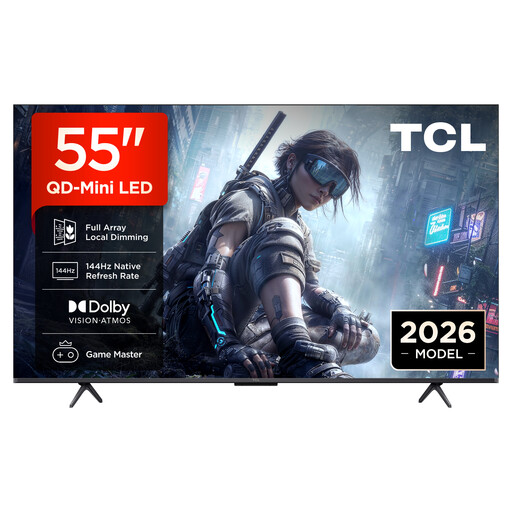
An LCD model to assess alongside OLED. If reflections are a concern in your shared room, check that the screen and seating positions work well together.
QD-Mini LED, 4K and Google TV. The product information lists a matt screen, an ambient light sensor and 144Hz VRR.
 No image available
A 55-inch smart TV to compare if you want to consider Google TV and the listed casting features. Check that the size suits the space and viewing distance where you plan to put it.
QD-Mini LED, 4K, Google TV, Google Cast and AirPlay 2. The product name lists 144Hz.
 No image available
A more compact size to compare if your viewing distance or available space is limited. Check the viewing angle from your housemates’ seats too.
43 inches, 4K UHD and VIDAA. The product information lists a 178° viewing angle and three HDMI 2.1 ports.
Measure from the eyes of the people sitting in their usual seats to where you plan to put the screen. The Consumers' Association recommends using around 2.4 times the screen’s diagonal measurement as a starting point. Compare nearby sizes and check the overall dimensions, including the stand.
Not necessarily, but check before buying that the service you use is available on the specific TV platform. Apps can change; if an app isn’t available, a separate media player connected via HDMI may be an alternative.
Start with the home picture mode rather than the shop mode, and assess a familiar scene in the lighting you usually watch in. The Consumers' Association notes that picture settings can also affect energy consumption.
According to the Dutch government, you don’t need your landlord’s permission for a minor change that can be reversed without too much cost, such as filling in small holes. Permission is needed for more substantial changes or renovations. Before drilling, check the proposed mounting method and the terms of your tenancy; this general rule doesn’t confirm that every wall is suitable.
In the Netherlands, the take-back scheme for household appliances means that when you buy a similar new appliance, the retailer must take your old TV free of charge. This also applies to online purchases, although the drop-off or later collection arrangements may vary.