Start by considering where people sit and how far they are from the screen. Then check that spoken explanations are easy to hear at a comfortable volume, and that using headphones fits your evening routine. An OLED TV is worth comparing if housemates sit at an angle or you care about dark scenes. In a bright room, a suitable LCD or QLED TV may be a good choice, but viewing angles, reflections, sound and apps vary by model.
Who will be watching?
Housemates sitting in different places
You watch with housemates from the sofa, as well as from a seat at an angle to the screen. Viewing angles, reflections and clear dialogue all matter. The Consumers’ Association discusses viewing angles and viewing distance as factors to consider when choosing.
Anyone who likes to watch quietly in the evening
Sometimes you watch on your own while others are asleep or working. A suitable headphone connection and clear spoken explanations may be more important than filling the room with loud sound. The Consumers’ Association describes Bluetooth as one way to connect headphones.
Housemates sharing limited space or costs
You share a smaller living space or split the electricity bill. Measure the viewing distance and available space, then compare the stated energy consumption of TVs in suitable screen sizes. Milieu Centraal recommends using the energy label to compare consumption.
What should you look for when choosing?
First, measure the distance from the seating area and check where the windows and lights are. Then compare the picture from your usual seats, check dialogue clarity and headphone connections, and finally look at the apps and energy consumption.
| Factor to consider |
What to look for |
Who it matters most to |
| Viewing from different seats |
Watch the same scene from the seats furthest from the centre and look out for windows and lights. According to the Consumers’ Association, OLED TVs generally have a wider viewing angle than LCD TVs; check reflections on the model itself. |
If I watch from different seats with my housemates, I want everyone to be able to follow the picture clearly; around 26% of consumers prioritise being able to see the screen from multiple seats. |
| Clear dialogue without disturbing others |
Listen to spoken explanations at a quiet evening volume and check which headphone connection the exact model has. The Consumers’ Association describes Bluetooth as an option for headphones. |
If I watch late, I want to follow the dialogue without waking my housemates; around 21% of consumers prioritise quiet, individual viewing. |
| Bright and dark scenes |
Compare bright and dark images, and check whether the documentary source is in 4K. According to the Consumers’ Association, the extra detail in 4K depends on the source material. |
If I watch nature footage and dark scenes, I want to make out the details in both; around 21% of consumers prioritise picture quality for documentaries. |
| Screen size and available space |
Measure the viewing distance and the space available for the TV, including its stand. The Consumers’ Association suggests dividing the viewing distance by 2.4 as a starting point for the screen diagonal in centimetres. |
If I’m choosing a TV for a shared room, I want the screen to be comfortable to watch and fit the space; around 16% of consumers prioritise a good fit for their room. |
| Energy consumption and app access |
Compare kWh per 1,000 hours on the energy labels of suitable models, and check that they have the apps you want. The Consumers’ Association notes that apps may disappear over time. |
If I share the cost of the TV with housemates, I want to take energy consumption and access to documentaries into account; around 16% of consumers prioritise shared running costs and access. |
How to avoid common buying mistakes
-
Only watching from directly in front of the screen
In a shared room, housemates may sit at an angle to the TV or have to deal with reflections.
Compare the same scene from the seats furthest from the centre, and pay attention to the light in the room.
-
Assuming 4K or speaker power guarantees a good viewing experience
4K detail depends on the source. A speaker’s stated power rating alone doesn’t tell you whether spoken explanations will be easy to follow at a low volume.
Check the resolution of the documentary source and listen to dialogue at the volume you use in the evening.
-
Assuming a built-in app will always be available
According to the Consumers’ Association, apps may disappear from a smart TV over time. A separate media player connected via HDMI could be a useful alternative.
Check that the app you want is available and that there’s a spare HDMI connection.
A separate media player means an extra device and connection.
-
Looking only at the energy label rating
The label shows stated energy consumption on a comparable basis. Settings and any decoder you use also affect household energy consumption.
Compare kWh per 1,000 hours for models in a suitable screen size, and discuss how you’ll split the electricity costs.
Brands to compare
LG
LG is worth comparing if you’re looking at OLED; its Dutch support site specifically mentions the OLED55C51LA.
- The Consumers’ Association says OLED TVs generally offer a wide viewing angle and deep blacks.
- Check reflections and the features of the model you’re considering; panel technology alone doesn’t tell you how easy spoken dialogue will be to hear.
Samsung
Samsung describes the QE55QN80HAUXXN as a 55-inch Neo QLED model.
- Samsung lists mini-LED as a feature of this model.
- This manufacturer’s specification alone doesn’t tell you how viewing angles or dialogue clarity will work in your room; assess each model individually.
Philips
Philips describes the 55PUS8001/12 as a 55-inch 4K LED TV with Ambilight and Titan OS.
- Ambilight and the operating system are features Philips lists for this model.
- Check that the apps you want are available; the Consumers’ Association notes that apps may disappear from smart TVs over time. Assess picture and sound separately from the features listed.
TCL
The Consumers’ Association describes the 55P89K as a 55-inch LCD/QLED model with Google TV.
- The Consumers’ Association lists Bluetooth headphone connectivity and an optical digital audio output for the 55P89K.
- These specifications don’t represent an overall quality rating for TCL; check the connections and features of the exact model.
TVs on Joybuy for your viewing needs
These TV options range from 43 to 86 inches and include Philips and Metz models. Measure the viewing distance and available space before choosing a screen size. Also check that the apps and connections you want suit your viewing routine.
 No image available
Philips 55PUS8001/12, 55 inches
A 55-inch option to compare if you’re looking for a headphone output and 4K picture.
4K UHD, HDR10+/HLG, headphone output, Bluetooth 5.2 and Night Mode.
Joybuy
 No image available
Philips 43PUS8001/12, 43 inches
A 43-inch option to compare if you’re taking the available space and viewing distance into account.
LED LCD, 4K UHD, HDR10+/HLG, Ambilight and Titan OS.
Joybuy
 No image available
Metz 86MQE8000Z, 86 inches
With its 86-inch screen, this model is only an option if the viewing distance and available space suit this size.
QLED, 4K, HDR10+, 144 Hz and Google TV.
Joybuy
 No image available
Metz 43MQF7500Z, 43 inches
A 43-inch QLED option to compare, while also checking the streaming options you want and the space available.
4K UHD, HDR10+, Dolby Vision, Dolby Atmos and Google TV.
Joybuy
 No image available
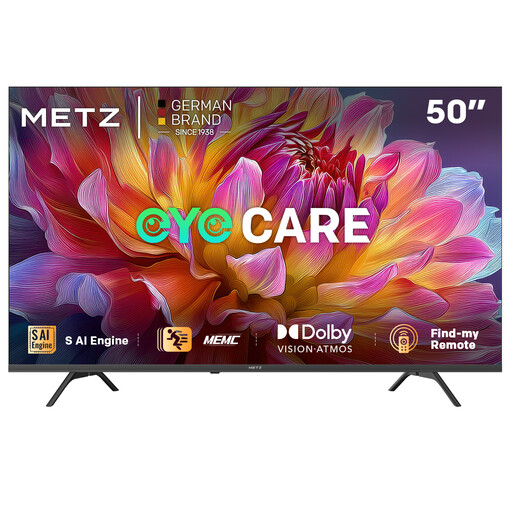
Metz 50MUF7000Z, 50 inches
A 50-inch option to compare if this size suits the viewing distance and the space in your room.
4K UHD, HDR10, Dolby Vision, Dolby Atmos and Google TV.
Joybuy
Frequently asked questions
How do I work out which TV size suits my room?
Measure the distance from your eyes in your usual seats to where the screen will go. The Consumers’ Association suggests dividing the viewing distance by 2.4 as a starting point for the diagonal in centimetres. Then compare nearby screen sizes and check the dimensions, including the stand.
Can I watch with headphones in the evening?
That depends on the connections and features of the exact TV model and your headphones. The Consumers’ Association describes Bluetooth as one way to connect headphones; check which connection your chosen combination uses.
Will the apps on a smart TV stay available?
Not necessarily: according to the Consumers’ Association, apps may disappear from a smart TV over time. Check that the documentary app you want is available, and see whether you have a spare HDMI connection for a separate media player.
How do I compare the energy consumption of TVs?
Compare the stated kWh per 1,000 hours on the energy labels of models in a suitable screen size. The label also includes information about HDR; settings and using a decoder, if applicable, affect actual household energy consumption.


