
Quiz group with seats spread around the room
Wants everyone to be able to follow the questions and answers from the sofa and other seats. Measure your viewing distance and check the picture from the seats at the edges of the room too.


For quiz nights with housemates, screen size, viewing angle and the right connections matter more than a high refresh rate. First, choose a size that suits your seating and check that everyone can read the text, including those sitting to the side. Extra gaming features are mainly relevant if you also play games that make use of them.
Wants everyone to be able to follow the questions and answers from the sofa and other seats. Measure your viewing distance and check the picture from the seats at the edges of the room too.
Switch between a laptop, console and other devices, for example, and want a practical way to show the game on the shared screen.
Often plays during the day and needs to consider windows, reflections and where the TV is placed, without overlooking the viewing angle and power consumption.
The Dutch Consumers’ Association suggests dividing the viewing distance by 2.4 as a starting point for the screen diagonal in centimetres, not as a fixed rule. So measure from the seats you actually use and check that the chosen size suits the room.
| What to consider | What should you check? | Who is this for? |
|---|---|---|
| Readability for the group | Measure the viewing distance and check the viewing angle and reflections from the seats at the edges of the room. | If I want everyone on the sofa and to the side to be able to read the questions, I’ll focus on screen size and visibility from different angles. Around 36% of consumers put visibility first. |
| Playing games and connecting devices | Check how the game you’ve chosen sends its picture to the TV, and count how many HDMI inputs you need for shared devices. | When we switch between a laptop, console and other devices, I want to know how to start the game and connect it. Around 29% of consumers prioritise these connections. |
| Visibility in daylight | Check where the windows and lights are and look out for reflections; consider brightness alongside the TV’s position. | In a bright living room, I want to be able to see the screen clearly during a daytime quiz without losing sight of where everyone is sitting. Around 21% of consumers prioritise visibility in daylight. |
| Power consumption when shared | Compare the energy use per 1,000 hours on the energy labels of models with a suitable screen size. | If different housemates use the TV frequently, I also want to consider its energy use and avoid choosing a bigger screen than the room needs. Around 14% of consumers say shared power consumption is their main concern. |
A high Hz specification doesn’t tell you whether your housemates can see the questions from different seats or how to connect the game.
First, decide which other games and video sources you’ll use. Then consider whether a higher refresh rate suits that combination.
A bigger screen won’t automatically fix a poor viewing angle or reflections. The Dutch Consumers’ Association also points out that larger screens generally use more power.
Measure the viewing distance from several seats, compare suitable screen sizes and check the energy label.
With games such as Jackbox, the host starts the game on a suitable device and the TV displays the picture. Other connected devices may also take up HDMI inputs.
Check the requirements for the specific game, the device’s video output and which connections are already in use. In Jackbox, one person hosts and the players use their phones as controllers.
The K-50S3 is an LCD option for anyone looking to connect several devices, where fast-paced gaming isn’t the main reason for buying.
The 55C6K is a mini-LED option for a bright room or for households that also use their TV for other gaming.
The OLED55C55LA is a 55-inch OLED option for anyone who values having several viewing positions and also uses the TV for other entertainment.
Philips offers LCD and OLED ranges with Ambilight, an option for housemates who also enjoy a more atmospheric setting for watching TV together.
This selection includes TCL Mini LED and QD-Mini LED TVs, along with a Hisense QLED TV. Match the screen diagonal to your viewing distance and check the viewing angle from the seats.
 No image available
Could be a good fit if you also use a suitable high-performance gaming source, as well as playing quizzes; 144 Hz isn’t essential for displaying quiz games.
65 inches; 4K QD-Mini LED; 144 Hz; HDMI 2.1, ALLM and VRR; Google TV.
 No image available
Could be a good fit if you’re looking for a 50-inch screen and also want to use the TV with a suitable high-performance gaming source.
50 inches; 4K Mini LED; 144 Hz; HDMI 2.1 and AMD FreeSync Premium Pro; casting via Miracast, Google Cast and AirPlay 2.
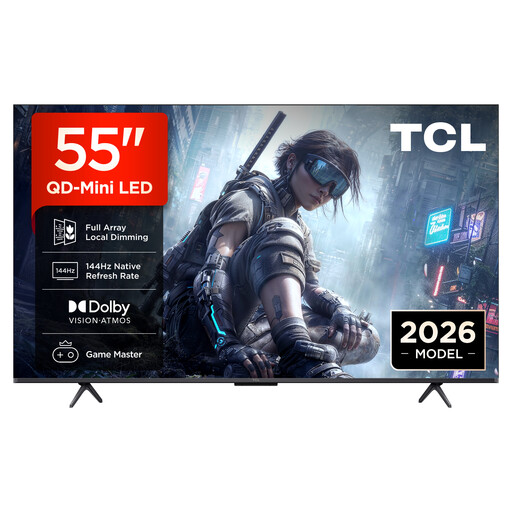 No image available
Could be a good fit if 55 inches suits your measured viewing distance and you also want to use the TV for suitable high-performance games.
55 inches; 4K QD-Mini LED; 144 Hz; HDMI 2.1, ALLM and AMD FreeSync Premium; casting via Miracast, Google Cast and AirPlay 2.
 No image available
Could be a good fit if your room and viewing distance can accommodate 75 inches and you also play suitable high-performance games.
75 inches; 4K QD-Mini LED; 144 Hz; HDMI 2.1, ALLM and VRR; Google TV.
 No image available
Could be a good fit if you’re looking for a 43-inch QLED TV and also use a suitable high-performance gaming source; check that this size suits your viewing distance.
43 inches; 4K; native refresh rate of 144 Hz; AMD FreeSync Premium Pro; HDMI connections and VIDAA Smart OS.
No. The usual way to play Jackbox is for one person to start the game on a suitable device, while the others join on their phones. Check how the host’s device sends the picture to the TV and whether everyone can see the screen clearly.
Measure from the seats you use and treat the viewing distance divided by 2.4 as a starting point, not a required size. The Dutch Consumers’ Association suggests using this ratio for the screen diagonal in centimetres; also compare nearby sizes and check visibility from the seats at the edges of the room.
Compare the energy use per 1,000 hours on the energy labels of TVs with a suitable screen size. Milieu Centraal also recommends adjusting the brightness to suit the room and avoiding placing the TV opposite a source of strong daylight.