First, measure the distance between your seat and the TV, then compare a few screen sizes. A bigger screen isn’t automatically more comfortable or the right fit. Consumentenbond recommends using viewing distance as a starting point when choosing a size. Then consider your room: compare reflections in daylight and contrast in dark scenes, and check whether your documentary source supports the picture quality you want.
Who is this buying guide for?
Viewers who sit far from the screen
If you want to follow landscapes and wildlife clearly from your sofa, compare screen sizes based on your viewing distance and the space available for the TV. Consumentenbond treats viewing distance as one factor when choosing a size.
Viewers in a bright living room
If you watch during the day, consider brightness and reflections where the TV will be placed. Consumentenbond highlights reflections as something to bear in mind; Sony describes its LCD TVs as delivering bright pictures in well-lit rooms.
Viewers who care about dark scenes
If details in shadowy or night-time footage matter most to you, compare OLED with LCD or mini-LED TVs. Sony and LG describe features of their own models, but also take your viewing environment and the exact model variant into account.
What should you look for when choosing?
Start with your measured viewing distance and the space available. Then compare picture features that suit the times when you usually watch.
| What to consider |
What should you check? |
Who is this important for? |
| Screen size and viewing distance |
Measure from your usual seat to where the screen will be. Compare a few screen sizes, and check the width and stand of the exact model too. |
I want to follow details from the sofa without choosing a screen that’s too big for the room. Around 36% of consumers put screen size first. |
| Daylight and reflections |
Look out for windows and lamps opposite the screen, and find information about reflections on the exact model variant. |
If I watch during the day, I want to know how the screen will perform where the TV is going. Around 29% of consumers prioritise visibility in daylight. |
| Contrast and dark details |
Compare dark scenes on the exact TV. For HDR, check both the TV’s support and the quality available for the documentary. |
I want to make out details in shadowy scenes and often watch in a darkened room. Around 21% of consumers put dark details first. |
| Source and energy information |
Check whether your service and the specific title offer the picture quality you want. Compare energy use for SDR and HDR on the energy label. |
I want to choose picture features that my documentary source supports, while also keeping energy use in mind. Around 14% of consumers prioritise running costs and source quality. |
Buying pitfalls
-
Assuming a long viewing distance means you need one specific screen size
Consumentenbond’s viewing-distance calculation is a starting point, not a rule you have to follow. Your chosen screen should also suit your seating position and the space available.
Measure from your usual seat and compare neighbouring screen sizes. Check the TV’s dimensions, including its stand, before deciding where to put it.
-
Assuming mini-LED or OLED guarantees a better picture
The name of a technology alone doesn’t tell you how a particular screen handles incoming light, reflections or dark scenes. Manufacturer descriptions aren’t independent comparative tests.
Compare the exact models in the viewing environment you’re most likely to have at home, and weigh up visibility in daylight and black levels separately.
-
Assuming every documentary is available in 4K or HDR
A 4K TV doesn’t automatically mean that a title or subscription will deliver 4K or HDR picture quality.
Check the picture quality shown for the title on your device, and make sure your subscription supports it. Netflix recommends these checks for its own service.
-
Looking only at the energy label or a commercial guarantee
The energy label provides information for SDR and HDR. A commercial guarantee doesn’t replace your statutory rights if a product is faulty.
Compare the energy labels for the exact model variants and read what any additional guarantee covers. ACM ConsuWijzer explains that statutory guarantees apply alongside commercial guarantees.
Brands to compare
Sony
The BRAVIA 5 K-75XR5 is a 75-inch LCD model with 4K, mini-LED backlighting and local dimming.
- These stated specifications give you specific features to compare with other large LCD TVs.
- Sony’s general description of bright pictures doesn’t show how this model compares with other TVs in your room.
LG
The OLED77C67LA from the C6 range is a 77-inch OLED model for anyone also comparing screen sizes for a longer viewing distance.
- LG lists OLED black levels as a feature of this model, which may matter if dark scenes are a priority.
- Consider reflections separately if you also watch during the day; manufacturers’ picture-quality claims aren’t an independent comparison.
Samsung
The 75-inch QE75QN90FATXXN is a Neo QLED mini-LED model to compare if you prefer a large screen.
- Samsung lists features including Glare Free and 4K upscaling for this model variant.
- The names and specifications don’t establish how the TV performs compared with other models in your viewing environment.
Philips
According to Philips, the 75MLED910/12 combines a 75-inch QD mini-LED screen with Ambilight.
- Ambilight is a distinctive extra to consider if you’d like this type of lighting.
- Philips’ description of the viewing experience doesn’t prove that it displays nature documentaries better; assess the screen with the lighting switched off too.
TCL
The 75C6K is a 75-inch QD mini-LED model to compare for screen size, dimming and audio features.
- TCL lists features for the C6K range including dimming zones and an ONKYO 2.1 system.
- The listed features don’t show that the 75C6K performs better than another TV of this size.
TVs at Joybuy
These TVs offer a range of large screen sizes and picture technologies to weigh up against your viewing distance, viewing environment and documentary source.
 No image available
OLED77G68LW 77-inch 4K OLED TV
An option to compare if dark scenes matter to you and 77 inches suits your viewing distance and room.
77 inches, 4K and OLED; the product description mentions pixel-level dimming and Dolby Vision.
With OLED, bear in mind the effect of leaving static images on screen for long periods, and follow the model’s care instructions.
View at Joybuy
 No image available
TCL T8D 85-inch 4K QD-Mini LED TV
Compare this large screen size with your measured viewing distance and the space you have for the TV.
85 inches, 4K and QD-Mini LED; the product information mentions features including Dolby Vision and HDR10+.
View at Joybuy
 No image available
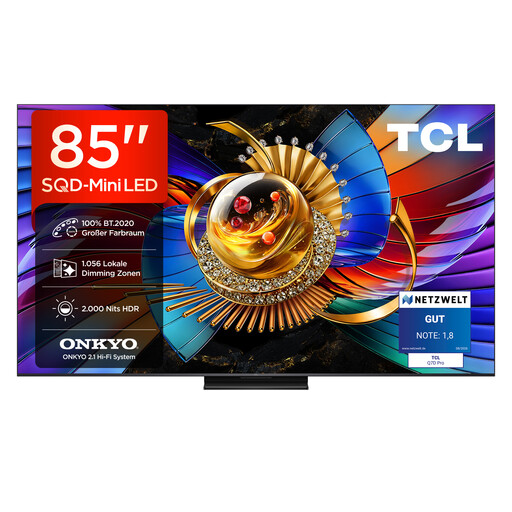
TCL 85Q7D PRO 85-inch 4K SQD-Mini LED TV
A large screen size to compare if you have a long viewing distance and enough room for the TV.
85 inches, 4K and SQD-Mini LED; the product title mentions local dimming and an anti-reflection feature.
View at Joybuy
 No image available
TCL 75T8D 75-inch 4K QD-Mini LED TV
Compare the 75-inch size with your viewing distance before weighing this model against larger screens.
75 inches, 4K and QD-Mini LED; the product information lists Dolby Vision, HDR10+ and 144 Hz VRR.
View at Joybuy
 No image available
METZ 86MQE8000Z 86-inch 4K QLED TV
The 86-inch screen is an option to compare with your viewing distance and the space available for placing the TV.
86 inches, 4K and QLED; the product title lists HDR10+ and Dolby Vision.
View at Joybuy
Frequently asked questions
Do you always need a 75-inch TV if your sofa is far away?
No. The right size depends on your measured viewing distance and the space available. For a distance of 400 cm, Consumentenbond gives a range of 55–77 inches; at 450 cm, it’s 65–85 inches. Use these distances as a starting point and compare nearby sizes.
How can you check whether your nature documentary is playing in 4K or HDR?
Check the quality label shown for the title on your device, and make sure your subscription supports the quality you want. Netflix recommends these checks for its own service; the information doesn’t automatically apply to other services.
What should you consider when positioning and maintaining your TV?
Check the width and stand dimensions of the exact TV before choosing a unit. For OLED, Sony highlights prolonged display of static images, such as menus and channel logos, as something to bear in mind; follow the instructions for your own model.
What do the energy label and guarantee tell you when buying in the Netherlands?
For TVs covered by the relevant EU rules, the energy label provides information to help you compare energy use for SDR and HDR. For consumer purchases in the Netherlands, statutory guarantee rights apply alongside any commercial guarantee; ACM ConsuWijzer explains the seller’s obligations if a product is faulty.
Can you return a TV bought online if you change your mind?
For online consumer purchases in the Netherlands, you generally have a statutory cooling-off period that ends 14 days after delivery. ACM ConsuWijzer advises notifying the seller within this period that you’re cancelling the purchase; also check whether an exception applies to your purchase.


