Start by measuring your viewing distance and the available width: a narrow living room doesn’t, by itself, determine which screen size will fit. For dark astronomy footage, OLED may be worth considering for its ability to display deep blacks, but brightness and reflections also matter in rooms with plenty of daylight. Check that the programmes you want are available through the app or source you plan to use. A 4K screen won’t automatically make a broadcast from a lower-resolution source 4K.
Who is this buying guide for?
Viewer with limited space
Compare your viewing distance and the width of the available space with the TV’s dimensions, including its stand or wall bracket. The Consumers’ Association suggests dividing the viewing distance by 2.4 to get a rough estimate of the screen’s diagonal in centimetres. Treat this as a guide, not a fixed measurement.
Evening viewer of space footage
You mainly watch in a dark room, so black levels and contrast are important to you. The Consumers’ Association explains that OLED TVs can generally display deeper blacks than LCD TVs.
Viewer in changing light
You also watch during the day or from different seats. In that case, reflections, brightness and viewing angle are all worth considering. A screen’s finish alone doesn’t determine how it handles reflections.
What should you look for when choosing?
Start with the available space and your viewing distance. Then compare picture technology and lighting conditions, and check whether you can watch the programmes you want through the built-in apps or an external source.
| What to consider |
What should you check? |
Who should pay particular attention? |
| Screen size and placement |
Measure your viewing distance, the width of the wall or furniture, the stand’s depth and the space needed for connections. The Consumers’ Association suggests dividing the viewing distance by 2.4 to get a rough estimate of the screen’s diagonal in centimetres. |
If space is limited, make sure the TV and its stand or bracket will fit where you plan to put it. Around 33% of consumers prioritise a suitable size and placement. |
| Contrast in dark space footage |
Compare specific models for their ability to display blacks in dark scenes. The Consumers’ Association explains that LCD backlighting may produce less deep blacks than OLED; performance varies by model. |
If you mainly watch dark space footage in the evening, black levels may matter more than other picture preferences. Around 27% of consumers give dark-scene performance top priority. |
| Daylight, reflections and seating position |
Look at the position of windows and lamps in relation to the screen, and the seats you’ll be watching from. Compare reflection and viewing-angle measurements for the exact model. |
If you watch during the day or don’t sit directly in front of the TV, make sure its handling of reflections and viewing angle suits your room. Around 20% of consumers prioritise these lighting and seating conditions. |
| Access to programmes |
Check that the specific app and broadcast are available, which subscriptions you’ll need, and whether you can connect a media player to an HDMI input. |
If you want to watch a particular astronomy programme, access to the right provider matters more than screen resolution alone. Around 13% of consumers give the source and programmes top priority. |
| Energy use and total costs |
Compare the EU energy label for the exact variant, including the SDR and HDR information. Ask separately about delivery and installation. |
If you want to consider energy use and installation costs as well as the purchase price, make sure you can compare these items separately. Around 7% of consumers prioritise total costs. |
Common buying mistakes
-
Assuming the screen diagonal tells you how much space you’ll need
The full TV and its stand may take up more room than the visible screen alone.
Measure the width and depth of the cabinet or wall space, and check the dimensions of the stand and any bracket for the exact variant.
You may need a different cabinet, bracket or placement if the TV doesn’t fit the space you measured.
-
Assuming every 4K screen shows every programme in 4K
The screen resolution doesn’t tell you which broadcasts are available or what resolution the provider streams them in. Apps can also change or disappear.
Check that the programme, provider and app you want are available before buying. Also make sure there’s a suitable HDMI connection for an external media player, if needed.
You may need a subscription or an external media player to access the source you want.
-
Choosing a TV based only on ‘OLED’ or ‘QLED’
Picture technology alone won’t tell you how a specific model will perform with the light in your room, your viewing position or your preference for dark-scene performance. The Consumers’ Association describes differences in black levels between OLED and LCD. Reflections depend on more than whether a screen has a matte or glossy finish.
Compare specific models in conditions similar to your living room, and consider reflections, brightness and viewing angle too.
Brands to compare
LG
The LG OLED42C5ELB is a 42-inch OLED model worth comparing if you’re looking for a relatively compact size.
- LG lists 4K and self-lit OLED pixels for this model. The Consumers’ Association describes OLED as a technology that can display deep blacks.
- Measure your available space and check for reflections in your room’s lighting. This model isn’t representative of every LG TV.
Samsung
The Samsung QE48S90FAEXXN is a 48-inch OLED model to consider if the space you’ve measured and your viewing distance can accommodate this size.
- Samsung lists OLED and energy rating G for this variant.
- A 48-inch TV won’t automatically fit in a narrow living room. Compare the exact dimensions with the space where you plan to put it.
Philips
The Philips 43PUS9000/12 is a 43-inch QLED/LCD model with built-in Ambilight, for anyone who’d also like lighting effects around the screen.
- Philips lists 4K, Ambilight and Dolby Vision for this model.
- Ambilight doesn’t replace a comparison of panel contrast. Philips’ statements about the preferences of participants in an Ambilight trial programme aren’t based on an independent survey of Dutch buyers.
Sony
The Sony K-43S3 is a 43-inch direct-LED LCD model with stated dimensions for placement.
- Sony lists 4K resolution, four HDMI inputs and a VESA size of 20 × 20 cm for the K-43S3.
- This is a 50Hz LCD TV. The specifications alone don’t determine how dark scenes or reflections will look in your living room.
TVs at Joybuy
This range of TVs at Joybuy includes compact OLED, LCD and QLED options, including models with Ambilight. Check the dimensions, lighting conditions and apps you want before choosing a model.
 Image unavailable
LG OLED42C68LA 42-inch 4K OLED Smart TV
A good option if you’re looking for a compact OLED TV for dark space footage. Measure the available space before choosing your screen size.
42 inches, 4K, OLED and Smart TV.
View at Joybuy
 Image unavailable
Philips 43PUS8001/12 43-inch 4K TV
A good fit if you’d like lighting effects around the screen as well as a great picture. Ambilight isn’t a substitute for assessing contrast in dark scenes.
43 inches, 4K and 3-sided Ambilight.
View at Joybuy
 Image unavailable
Philips 43PQS7801 43-inch 4K QLED Smart TV
A 43-inch QLED option to compare if you’re weighing up picture technology and the TV features you want as well as size. Check the contrast and reflections for the exact model.
43 inches, 4K, QLED and Smart TV.
View at Joybuy
 Image unavailable
METZ 43MQF7500Z 43-inch QLED 4K UHD Google TV
Worth considering if you’re looking for a 43-inch QLED TV with Google TV. Compare how it displays dark scenes and check that it fits where you plan to put it.
43 inches, 109 cm, QLED, 4K UHD and Google TV.
View at Joybuy
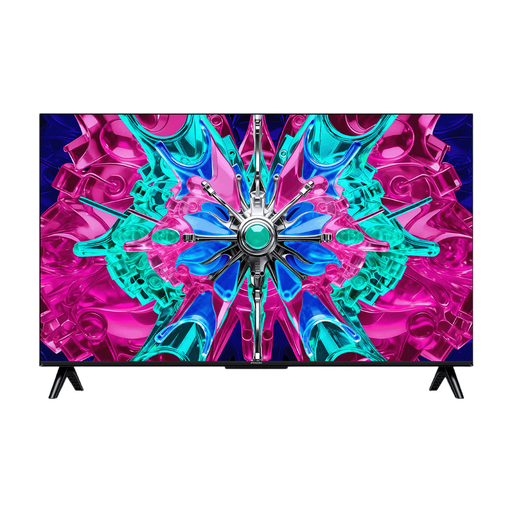 Image unavailable
iFFALCON U65A 43-inch 4K LED Smart TV
A 43-inch LED option to compare for black levels, reflections and access to the programmes you want, as well as the space available.
43 inches, 4K, LED and 50Hz.
View at Joybuy
Frequently asked questions
Is 43 inches always the right size for a narrow living room?
No, a 43-inch TV won’t automatically suit every narrow living room. Measure your viewing distance and the available width. The Consumers’ Association suggests dividing the distance by 2.4 to get a rough estimate of the screen’s diagonal in centimetres. Also check the full dimensions of the model you’re considering.
How can I make sure the TV fits on my cabinet or wall bracket?
Check the cabinet dimensions, stand measurements and VESA size for the exact variant. For example, Sony lists a VESA size of 20 × 20 cm for the K-43S3. Don’t assume this measurement applies to other models.
Will the apps I need for my programmes remain available?
There’s no guarantee. Before buying, check that the app you need is available, and make sure there’s a suitable HDMI connection for an external media player if required.
What does the energy label mean, and what are my rights when buying a TV online?
Compare the EU energy label for the exact model variant, including the information shown for SDR and HDR. According to ACM ConsuWijzer, when you buy a new TV online, you generally have a statutory cooling-off period of up to 14 days after delivery. The legal guarantee isn’t automatically limited to two years. If a product is faulty, the seller is responsible under the applicable terms.


