First, measure the distance from your eyes to where the TV will go, then compare the sound quality of the specific model. The Consumers’ Association recommends dividing the viewing distance in centimetres by 2.4 as a starting point for the screen size, not as a fixed rule. OLED may suit you if deep blacks and wide viewing angles matter. If you often watch during the day, compare LCD and mini-LED models too, and check the sound quality and whether there’s room for external audio.
Who is this buying guide for?
Musical film fans who put sound first
If you want to follow singing and dialogue clearly, compare the sound quality of the exact TV model and check whether there’s room for external audio. The Consumers’ Association highlights sound quality and soundbar connections as points to consider.
Viewers with limited space for a screen
Measure the viewing distance and the space where the TV will go, including room for the stand. The Consumers’ Association recommends using the viewing distance as a starting point when choosing a screen size.
Film fans with changing daylight
If you watch during the day as well as in the evening, weigh up black levels, viewing angles, brightness and reflections in your own room. The Consumers’ Association explains the differences between OLED and QLED TVs in these areas.
What should you look for when choosing?
Start by measuring, so the screen size suits your seating position and TV unit. Then assess the sound quality of the exact model and compare its display technology with the light levels in your living room.
| What to consider |
What to look for |
Who should pay extra attention? |
| Singing, dialogue and music |
Look for a review of the sound quality of the exact TV model. If you’re considering a soundbar, check that both the TV and soundbar have HDMI ARC or eARC, and that there’s room for the soundbar. |
If I mainly watch musical films, I want to follow the singing and dialogue clearly and hear music with a full sound. Around 26% of consumers put clear singing and dialogue, and full-sounding music, first. |
| Screen size and positioning |
Measure the distance from your eyes to the screen and the available space, including room for the stand. The Consumers’ Association recommends dividing the distance in centimetres by 2.4 as a starting point for the screen size. |
In a small living room, I want to know whether the screen and stand will fit and feel comfortable to watch from my seat. Around 26% of consumers make size and positioning their first consideration. |
| Contrast for evening films |
Compare the exact model and screen size. Also check whether your film source actually offers 4K or HDR before taking those features into account. |
For evening films, I pay attention to dark scenes and how the picture looks from my seat. Around 21% of consumers prioritise contrast and film picture quality for evening viewing. |
| Watching in daylight |
Compare the brightness and reflections of the specific screen in lighting conditions similar to those in your room. |
If I often watch during the day, I want the picture to remain visible in my living room’s light. Around 16% of consumers put daylight performance first. |
| Connections and energy use |
Check which audio connections you need and compare the EU energy label and product information sheet for the exact model. |
If I want to add external audio, I need to be able to compare the connections and energy use of the exact TV. Around 11% of consumers start with connections and running costs. |
Common pitfalls
-
Choosing based on screen size alone
Viewing distance and the space on your TV unit are two different measurements. A screen might suit your seating position but still be too wide for the unit once you include the stand.
Measure both before you choose. Use the Consumers’ Association calculation as a starting point, then check the TV’s external dimensions with the stand.
-
Assuming a slim TV or small soundbar will be enough for music
The Consumers’ Association explains how TV sound can vary and notes that smaller, lighter soundbars often sound less full. A separate soundbar also takes up extra space and is an additional purchase.
Compare the sound quality of the exact model, then decide whether you need external audio. Check the connections and available space in advance.
-
Confusing QLED with OLED or treating HDR logos as proof of quality
QLED is an LCD technology. The strengths of OLED and bright LCD screens can vary depending on your viewing conditions; a technology name or HDR logo alone won’t tell you what a film will look like on your TV.
Compare black levels, brightness and reflections in your room. Also check which picture formats your film source offers.
Brands to compare
LG
LG Netherlands describes the OLED42C67LA.AEU as a 42-inch OLED option for a compact film set-up.
- LG highlights black levels as a strength of this model; this is a manufacturer’s claim.
- An OLED panel doesn’t tell you how good the built-in sound is. Assess the sound and the exact model separately.
Samsung
Samsung’s Dutch product page describes the QE43QN90FATXXN as a 43-inch mini-LED TV.
- The model information offers a compact LCD option to compare with OLED.
- The screen technology and size don’t tell you how this model sounds or how its picture will look in your room. Compare the exact model.
Philips
Philips’ product specifications describe the 42OLED810/12 as a 42-inch OLED TV with Ambilight and Dolby Vision.
- The stated screen size and picture formats give you specific points to compare with other models.
- Ambilight and descriptions of cinema-style sound are the manufacturer’s presentation, not an independent listening assessment. Also consider whether the lighting suits your set-up.
Sony
Sony Netherlands’ specifications describe the K-43S3 as a 43-inch LCD TV with Dolby Vision and HDMI eARC/ARC.
- The stated connections are useful if you want to connect external audio.
- Sony lists a 50 Hz refresh rate for this model. The specifications don’t provide an independent assessment of its sound for musical films.
TCL
TCL describes the C6K range as mini-LED models starting at 50 inches; choose this size only if the viewing distance and available space in your living room allow for it.
- TCL lists an ONKYO 2.1 system and high brightness among the range’s features.
- These are manufacturer details or claims; they don’t prove that every screen size sounds the same or is a better fit. Check the exact model and dimensions.
TVs to compare on Joybuy
These TVs include options in the compact 42- to 43-inch range, with OLED and QLED models to compare. Check your viewing distance, available space and the sound quality of the exact model before choosing.
 No image available
LG OLED42C68LA 42-inch 4K OLED Smart TV
The 42-inch screen size is an option to weigh up against your viewing distance and available space.
4K resolution, 2.0-channel audio and HDMI eARC.
Joybuy
 No image available
METZ 43MQF7500Z 43-inch 4K QLED TV
The 43-inch screen size and QLED technology make this an LCD option to compare with OLED.
4K, Google TV, HDR10+ and Dolby Vision.
Joybuy
 No image available
TCL 43T6C 43-inch 4K QLED TV
The 43-inch screen size is one to consider for a small living room; measure the space for the TV and stand too.
4K QLED and 120Hz, as stated in the product name.
Joybuy
 No image available
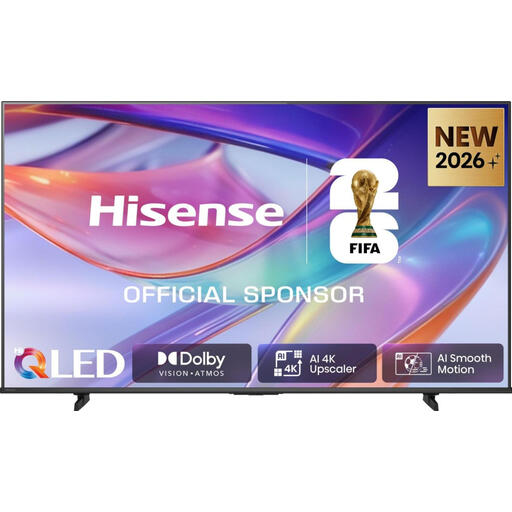
Hisense 43E7S 43-inch 4K QLED TV
The 43-inch screen size makes this model worth comparing with your available viewing distance and TV unit space.
4K QLED, HDR formats and eARC.
Joybuy
 No image available
CHiQ U43QM10E 43-inch 4K UHD QLED Smart TV
The 43-inch size and QLED screen are points to compare with your viewing distance and preferred display technology.
Google TV and HDR10.
Joybuy
Frequently asked questions
What size TV suits me if my sofa is 2 metres from the TV?
For a distance of 200 cm, the Consumers’ Association recommends a range of 32–43 inches. Measure the distance from your eyes to the planned screen position and check the external dimensions with the stand too. This range is a guideline, not a fixed limit.
How can I connect a soundbar later?
Check that both the TV and soundbar have HDMI ARC or eARC. The Consumers’ Association lists using one remote control as an advantage. Also measure whether there’s room for the soundbar in front of or beneath the screen.
How do I compare the energy use of two TVs?
Compare the EU energy label and product information sheet for both exact models. The European Commission states that the label for electronic displays runs from A to G and also gives information about energy use in HDR mode. To work out your own annual cost, you’ll also need your usage time and energy tariff.
Do I have a cooling-off period and legal guarantee when buying online in the Netherlands?
According to ACM ConsuWijzer, online TV purchases are generally covered by a statutory cooling-off period of up to 14 days after delivery. The Netherlands Authority for Consumers and Markets also states that the seller is responsible for the statutory guarantee if a product is faulty; there is no fixed general guarantee period in the Netherlands.
Is an energy label required for TVs?
Yes. The European Commission states that EU energy labelling rules apply to TVs and other electronic displays. Compare the label for the specific model you’re considering.


