
Viewers sitting a long way from the screen
You want to follow films and subtitles clearly from the back of the sofa. So start by considering the viewing distance and how much room the screen will take up.


First, measure the distance from the eyes of the furthest viewer and choose a screen size that also fits your room. At 4 metres, the Consumentenbond recommends a comfortable range of 55–77 inches rather than one fixed size. Then compare the viewing angle for guests sitting to the side, reflections and contrast in your living room, and check that the sound, connections and power consumption suit your film-night set-up.
You want to follow films and subtitles clearly from the back of the sofa. So start by considering the viewing distance and how much room the screen will take up.
If guests are sitting at an angle to the TV, it’s important to consider how the picture looks from the seats at either end. The Consumentenbond points out that viewing angles can vary between TVs.
Can’t always darken the room? Compare brightness and reflections as well as contrast. The Consumentenbond notes that LCD TVs can often be bright.
Best for: If you usually watch with the lights dimmed and guests also sit at an angle to the screen.
Bear in mind: Brightness, reflections and viewing angle depend on the exact model, so compare these features individually.
Best for: If your room stays relatively bright while you’re watching, or you’re looking for an LCD TV with Mini LED backlighting.
Bear in mind: Black levels, haloing, reflections and viewing angle vary by TV. The technology name alone doesn’t tell you what to expect.
Best for: If you want to compare TVs with a large screen within your budget, and the size suits your viewing distance.
Bear in mind: Check the contrast and viewing angle of the exact model, especially for dark films and guests sitting to the side.
First, choose a screen size based on the furthest seat. Then compare the viewing angle, the effect of room lighting and the equipment you’ll need for your film night.
| What to consider | What to look for when buying | Who should pay particular attention? |
|---|---|---|
| Screen size for your viewing distance | Measure the viewing distance from your eyes and check the TV’s width and height, including the stand. The Consumentenbond suggests a comfortable viewing distance of about 2.4 times the screen’s diagonal measurement. | From the back of the sofa, I want to follow films and subtitles clearly without choosing a screen that won’t fit in the room. For about 31% of consumers, screen size for their viewing distance is the top priority. |
| Viewing angle and contrast | Compare viewing-angle measurements for the exact model and assess the picture from the seats at either end. | When guests sit beside me, I want the picture to remain enjoyable to watch from their seats. For about 25% of consumers, viewing angle and contrast are the main concern. |
| Visibility in your room’s lighting | Compare both brightness and reflection measurements for the exact TV in lighting similar to your living room. | I can’t always darken the room, so I want the picture to remain visible without distracting reflections. Ambient light is the top priority for about 19% of consumers. |
| Sound and connections | Check sound ratings and the connections on the TV, your film source and any soundbar. | I want to hear dialogue clearly and connect my player or soundbar. About 13% of consumers start by considering sound and connections. |
| Total purchase and running costs | Compare energy use in kWh per 1000 hours and check what positioning or extra equipment you’ll actually need. The European Commission explains that energy labels show consumption in kWh per 1000 hours. | I want to weigh up the TV, its electricity use and the set-up I’ll need together. Total costs are the main concern for about 12% of consumers. |
The right size depends on the viewing distance and on how much room there is for the screen and stand.
First, measure the distance from your eyes to where you plan to put the screen, then check that the TV will physically fit. Use the size calculation as a guide, not a hard-and-fast rule.
Viewing angles can vary from one TV to another, even between sets with the same screen technology.
Look for measurements for the exact model or assess the picture from the seats at either end where your guests will be sitting.
Power consumption and the set-up you need also matter when buying a large TV. The energy label alone won’t tell you what your personal running costs will be.
Compare energy use on the same basis and check what positioning and equipment you’ll need for your film-night set-up.
The LG OLED77C67LA is a 77-inch OLED model worth comparing if you’re looking for a large screen.
The Samsung QE75QN90FATXXN is a 75-inch Neo QLED Mini LED model to compare for a room with ambient light.
The TCL 75C6K is a 75-inch QD-Mini LED model to include when comparing large screens.
According to Philips, the Philips 75MLED950/12 combines a 75-inch QD-Mini LED screen with Ambilight.
According to Sony, the BRAVIA 5 range includes a 75-inch Mini LED model.
This Joybuy selection includes large OLED and QD or SQD-Mini LED TVs for watching films from a distance. For each model, also consider your seating, the light in the room and the space available.
 Image unavailable
An OLED option for anyone considering a large screen for films. Check the exact screen size and dimensions for your viewing area.
 Image unavailable
A large QD-Mini LED option to compare for watching films from a distance. First, measure the viewing distance and the space available for the TV.
The product name lists Onkyo 2.1 sound, Google TV, 144 Hz, FreeSync Premium, VRR and HDMI 2.1.
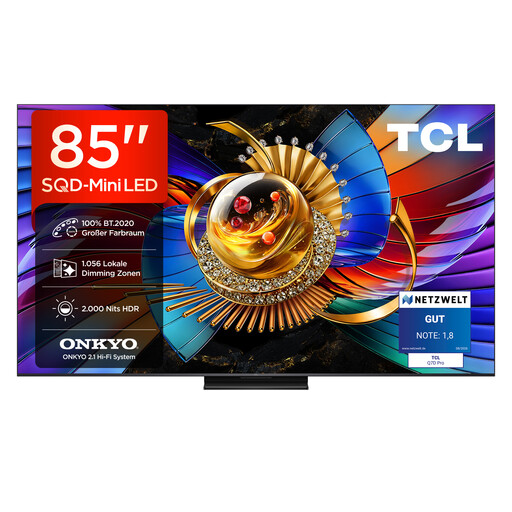 Image unavailable
A large SQD-Mini LED option to compare for a film night. Check that its dimensions will fit the space you have in mind.
The product name lists an anti-reflection screen, 144 Hz, Dolby Vision IQ and Dolby Atmos.
 Image unavailable
A 75-inch option to compare if that size is a better fit for your viewing distance and available space.
The product name lists 4K, Dolby Vision, HDR10+, 144 Hz VRR and Onkyo 2.1 sound.
 Image unavailable
A large QLED screen to compare for a long viewing distance. Check the dimensions before deciding where to put it.
The product name lists 3840 × 2160 pixels, HDR10+ and energy class E.
No. Measure the distance from eye level and use it as a starting point for the screen diagonal. At 4 metres, the Consumentenbond recommends a range of 55–77 inches. Also check the TV’s physical dimensions and the space available.
Start with the home settings rather than the often extra-bright shop mode. The Consumentenbond recommends adjusting the picture settings to suit your home lighting. Try watching a familiar scene with both light and dark areas.
Compare the consumption shown on the EU energy label in kWh per 1000 hours. To estimate your personal costs, you’ll also need to know your own viewing hours and electricity tariff. Bear in mind that consumption can differ between SDR and HDR use.
No. According to the Dutch government, there is no fixed term for the statutory warranty in the Netherlands: you’re entitled to expect the product to work properly, depending on what’s reasonable for that product. If something goes wrong, contact the seller. A manufacturer’s warranty or extended warranty is separate.
Yes. The Dutch government lists TVs as appliances that must have an energy label. TVs use the EU scale from A to G; the older plus-rated classes are no longer the current scale for these products.