What should you look for when choosing?
OLED
A good choice when: guests sit in different parts of the room and a clear view from the side is important; the Consumers’ Association generally describes OLED as a technology with a wider viewing angle.
The trade-off: a wide viewing angle doesn’t tell you how noticeable reflections will be. Check this where you plan to put the TV.
LCD, QLED or mini-LED
A good choice when: the TV will be in a bright spot and most seats are fairly straight on; the Consumers’ Association notes that QLED TVs can often produce higher brightness.
The trade-off: the technology name won’t tell you how well guests sitting to the side can see the picture or how that particular screen handles reflections.
Model with an anti-reflection claim
A good choice when: you can’t avoid having a window or light opposite the TV; compare the anti-reflection feature on the exact model you’re considering.
The trade-off: Samsung lists Glare Free on certain models. This is a manufacturer claim, not an independent comparison. Don’t assume all models have the same feature.
Start by looking at the light, viewing positions and distance. Then use panel type and motion specifications as additional points of comparison.
| What to consider |
What to look for |
Most relevant to |
| Visibility in daylight and under lights |
Assess the exact screen with light coming from the direction of the windows, and check whether that model lists an anti-reflection feature. |
If windows or kitchen lights shine on the screen, I want to be able to assess reflections where I plan to put it. Around 28% of consumers put daylight visibility top of their list. |
| Picture from the side |
Watch a match-like picture from the furthest seats to the side and check the colour, contrast and reflections from there. |
When guests are sitting at the table and to the side, I want to know whether they can follow the picture clearly. Around 22% of consumers prioritise the view from the side. |
| Screen size and viewing distance |
Measure the distance from both viewing positions and check the overall dimensions, including the stand. The Consumers’ Association suggests dividing the distance by around 2.4 as a starting point for the diagonal in centimetres. |
If I watch from both the kitchen and the dining table, I want to weigh up a size that suits both distances. Around 22% of consumers prioritise viewing distance. |
| Fast-moving action |
Distinguish the stated panel refresh rate from image processing, and assess a motion setting using a similar match signal. |
When watching football, I want to see how players and camera movement are shown, not just a high figure on the specifications list. Around 17% of consumers prioritise motion handling. |
| Mounting and energy use |
Compare the energy labels of suitable screen sizes, and check the stand or VESA dimensions and what’s included for mounting. |
If I want to put the TV on a unit or mount it on the wall, I want to know what I’ll need and how to compare energy use. Around 11% of consumers prioritise placement and energy use. |
TVs at Joybuy
The TVs below have different screen sizes and stated picture features for you to compare. First measure your viewing distance and assess the light where you plan to use the TV.
 No image available
LG 43NU800B6LC Nano UHD Smart TV, 43 inches
The 43-inch version is worth comparing if your measured viewing distance suits a smaller screen.
The product name lists 4K and “No Glare 94%”; check how reflections look in the light where you plan to put it.
View at Joybuy
 No image available
Hisense 55A6S Smart TV 2026, 55 inches
Compare the 55-inch size with the viewing distances from both the kitchen and the dining table.
The product name lists LED, 4K UHD and energy class E.
View at Joybuy
 No image available
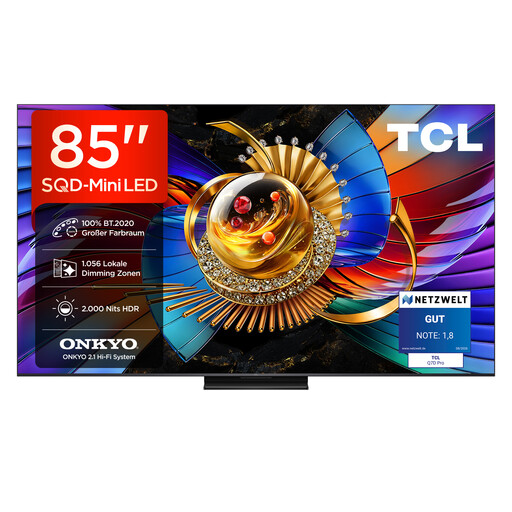
TCL 85Q7D PRO, 85 inches
Compare this large screen with your other options only after measuring the viewing distance and the space available.
The product name lists 4K, SQD mini-LED, 144 Hz and Anti-Reflection. Assess reflections and motion from your own viewing position using your match source.
View at Joybuy
 No image available
TCL 50Q6C QD mini-LED TV, 50 inches
The 50-inch size is worth comparing with other screen sizes once you’ve measured both viewing distances.
The product name lists 4K HDR and 144 Hz; assess the motion setting using a similar match signal.
View at Joybuy
 No image available
METZ 86MQE8000Z QLED Google TV, 86 inches
Compare the 86-inch version with your measured viewing distance and the space available for the screen.
The product name lists 4K HDR10+ and 144 Hz.
View at Joybuy
Frequently asked questions
What screen size should you choose if you’ll also watch from the kitchen?
Measure the distance from both the dining table and the spot where you’ll watch from in the kitchen. The Consumers’ Association uses distance divided by around 2.4 as a starting point for the screen diagonal in centimetres; also compare screen sizes close to that result.
Does 144 Hz automatically make a football broadcast look sharper?
No, a 144 Hz specification doesn’t guarantee a sharper picture during live football. According to the Consumers’ Association, a TV signal is usually 50 Hz, and interpolated frames can cause visible artefacts when movement is irregular. Assess the motion setting with a similar broadcast signal.
What should you check when placing or wall-mounting a TV in a kitchen-diner?
Check the stand or VESA dimensions for the exact model and follow the mounting instructions. LG warns that incorrect installation of a TV stand can cause the TV to fall and lead to injury; Sony states that a wall bracket isn’t included for wall mounting the BRAVIA 5. Make sure there’s enough ventilation too, and follow the model-specific safety instructions.
How can you compare energy use between TVs?
Compare the EU energy label and model information for TVs with a suitable screen size. The European Commission says the label also shows information about HDR use; actual energy consumption also depends on how you use the TV and its settings.
What are your rights if a TV bought online disappoints or breaks down too soon?
For a typical online purchase of a new TV, ACM ConsuWijzer says you have a statutory cooling-off period of up to 14 days after delivery, subject to applicable exceptions. If a product is faulty, the seller remains responsible under the statutory guarantee; in the Netherlands, this isn’t limited to a fixed two-year period.


