Who is this guide for?

Presenters with viewers spread around the room

You’re showing your work to reviewers who won’t all be sitting directly in front of the screen. So check your portfolio from the seats furthest to the sides. Philips describes the 65OLED810/12 as viewable from an angle, but this isn’t an independent measurement from every seat.

Presenters in a bright room

If you can’t control the light, check visibility and reflections where you plan to place the TV. RTINGS.com discusses OLED performance in moderately lit rooms, while Samsung lists anti-reflection coating only for certain models.

Presenters showing detailed or static work

For small text, colour-critical images or slides that stay on screen for a long time, file playback, picture settings and viewing time all matter. RTINGS.com identifies burn-in as a consideration with frequent, prolonged use of static images on OLED screens.

What should you look for?

OLED TV

A good fit when: viewers are spread around the room and you can control the light reasonably well.

Trade-off: factor in the risk associated with frequent, prolonged static images and check reflections on the specific model.

Mini-LED TV

A good fit when: you often present in bright surroundings or leave the same image on screen for a long time.

Trade-off: assess the viewing angle and dark details on the specific TV. Manufacturer figures won’t necessarily tell you how your portfolio will look in the room.

What to consider What should you check? Who should consider this?
Viewing angle View your own text and dark details from the seats furthest to the sides. If reviewers are sitting to the side, I want fine lines and details to remain clear. Around 31% of consumers prioritise viewing angle.
Light and reflections Test a light-coloured slide and check for reflections where the TV will be placed, under the lighting you usually use. If windows or lights can’t easily be moved, I want to know whether my portfolio will remain visible. Around 25% of consumers prioritise ambient light and reflections.
Design details Check small text, dark areas and picture settings using your own files. If colour differences and fine details matter, I want to see whether the picture suits my work. Around 25% of consumers prioritise how portfolio details are displayed.
Source and static images Test your files, cable and input; if you’ll use static images for long periods, factor in the risk of OLED burn-in. If I’m presenting from a laptop or USB and slides may stay on screen for a long time, I want to test the entire presentation setup in advance. Around 19% of consumers prioritise source compatibility and prolonged use of static images.

Common pitfalls

  • Assuming HDR peak brightness means your content will be easy to read

    TCL’s stated peak brightness for the C7K range isn’t a measure of how visible your portfolio will be under the room’s lighting.

    Try both light and dark slides in the intended location, and check for reflections too.

  • Only viewing the screen from directly in front

    The whole point is to show your work to several viewers. A screen that looks good from the centre won’t necessarily work as well from the seats furthest to the sides.

    Bring your own text and images, and view them from the seats at either end.

  • Showing the same slide for a long time without considering how you’ll use the TV

    Frequently displaying the same image for a long time can pose a burn-in risk on OLED. This doesn’t mean a typical portfolio session will cause damage.

    Compare OLED and mini-LED based on how often and for how long fixed slides will stay on screen.

  • Assuming every file or laptop will work straight away

    A stated USB format or available HDMI input doesn’t guarantee that your file and presentation source will work together.

    Test your own files, source, cable and chosen input in advance.

    You may need to prepare a suitable connection or convert files in advance.

Brands to consider

LG

The OLED55B46LA is a specific 55-inch B4 model to consider for a room where you can control the light reasonably well.

  • LG lists OLED technology and an α8 processor for the OLED55B46LA.
  • RTINGS.com reviewed B4 models with different regional model codes. Its test isn’t a measurement of the OLED55B46LA, and it highlights limitations in bright rooms and with reflections.

TCL

The C7K QD mini-LED range is worth exploring for bright presentation spaces.

  • TCL lists an HVA panel, QLED, HDR peak brightness of 2600 nits and dimming across up to 2048 zones for the C7K range.
  • The stated dimming figure doesn’t confirm the exact number of zones in every screen size. Manufacturer figures aren’t an independent measure of visibility or viewing angle in your room.

Sony

The BRAVIA 7 mini-LED range may be worth considering if you want to check connections and file support in advance.

  • Sony lists four HDMI inputs, two USB ports and support for JPEG and HEIF playback via USB, among other features, for the K-65XR70.
  • These specifications don’t prove that every portfolio file or laptop setup will work without testing.

Philips

The 65OLED810/12 is a 164 cm OLED model to consider if you’re looking for a larger screen.

  • Philips lists viewing from an angle as a picture feature.
  • That’s a manufacturer claim, not an independent measurement from the furthest seat. Also factor in prolonged use of static images on OLED.

Samsung

Certain TV ranges with Glare Free may be worth considering if reflections are an issue where you plan to set up the TV.

  • Samsung lists Glare Free for selected models, including The Frame (Pro) and certain OLED ranges.
  • This claim doesn’t apply to every Samsung TV and, on its own, says nothing about colour reproduction or viewing angle in a presentation space.

TVs at Joybuy

This selection of Joybuy products includes 4K TVs for portfolios with fine details and presentations to several viewers. Check the size, setup and compatibility with your own files before choosing a model.

LG 43NU800B6LC 43-inch 4K Nano UHD Smart TV

LG 43NU800B6LC 43-inch 4K Nano UHD Smart TV

A 43-inch model to consider if you’re looking for a 4K TV for your portfolio.

The product name lists 43 inches, 4K, Nano UHD, Smart TV and No Glare.

View at Joybuy
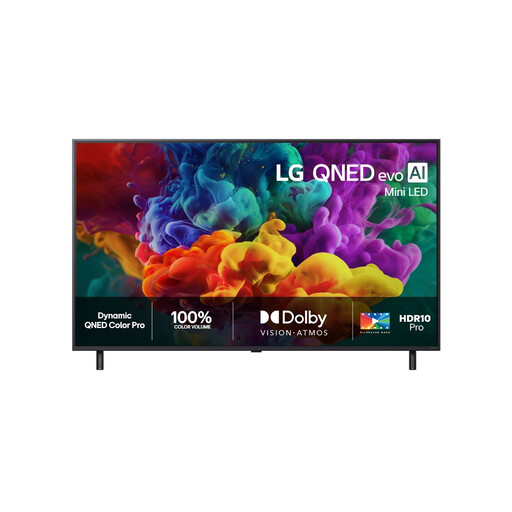
LG QNED85B6B QNED Evo Mini LED 4K Smart TV

LG QNED85B6B QNED Evo Mini LED 4K Smart TV

If you’re considering mini-LED for your presentation space, check the picture from the seats furthest to the sides too.

The product name lists QNED Evo Mini LED, 4K and Smart TV. Check that the screen size is right for your viewing distance.

View at Joybuy

Hisense 65A6S 65-inch 4K UHD Smart TV

Hisense 65A6S 65-inch 4K UHD Smart TV

A 65-inch 4K model to compare if you’re looking for a larger screen for several viewers.

The product name lists HomeOS U9.5, Dolby Vision HDR, Game Mode Plus with VRR 60 Hz and DTS Virtual:X.

View at Joybuy

TCL 65T8D 65-inch QLED QD-Mini LED 4K HDR TV

TCL 65T8D 65-inch QLED QD-Mini LED 4K HDR TV

If you’re looking at a QD-Mini LED model, test how visible your own portfolio is under the room’s lighting.

The product name lists 65 inches, QLED, QD-Mini LED, 4K HDR and 144 Hz VRR.

View at Joybuy

Frequently asked questions

How can I check that everyone will be able to see my portfolio clearly?

View your own examples, including small text and dark details, from the nearest seat, the furthest seat and the most off-centre seat. Do this under the lighting that will be used during the review. Screen technology alone won’t predict the result.

Can I show my portfolio directly from a USB drive?

It depends on the TV model and file format. Sony lists two USB ports and support for JPEG and HEIF playback via USB, among other features, for the K-65XR70. Test your own files in advance, and have an HDMI connection ready if you’re using a laptop.

What should I consider for long presentations?

If the same slides will be on screen often and for long periods, factor the risk of OLED burn-in into your choice. To compare power consumption, you can check the EU energy labels for the exact models: the European Commission lists consumption in kWh per 1,000 hours. The cost will also depend on how long you use the TV and your electricity tariff.

What warranty rights apply if a TV develops a fault?

For a consumer purchase, your statutory rights are separate from any shorter retailer or manufacturer’s warranty. According to ACM ConsuWijzer, if a product develops a fault sooner than expected under normal use, the retailer must offer an appropriate remedy at no cost. There isn’t one fixed statutory warranty period for every TV. If the school is buying for business use, check the terms that apply to that agreement.

Are there energy label rules for a new TV?

Yes. The European Commission states that energy labelling and ecodesign requirements apply to electronic displays, including televisions. Check the label or EPREL information for the exact EU model variant. These are product regulations, not permission to display a portfolio.
