What should you look for?
Start by checking whether your recording will play directly on the TV or whether you’ll need a separate player. Then consider the sound, how the picture looks in your room and the physical size of the screen.
| What to consider |
What should you look for? |
Who is this important for? |
| Playing files |
Compare the video and audio codecs used by your file with the manual for the exact model. Also check the file system used by your storage device and any subtitle requirements. |
If I want to play my recording without an extra device, both the picture and sound need to be recognised. Around 33% of consumers see file compatibility as their main concern. |
| Music playback |
Compare the TV’s outputs with the inputs on your audio equipment. Check the connection route for both the TV and the system. |
If music is the main focus during a performance, I want to know whether my speakers, soundbar or receiver will connect to the TV. Around 27% of consumers see their audio setup as their main concern. |
| Picture in the room |
Take daylight, reflections and seating into account. OLED and LCD each have their pros and cons, and performance also varies between models. |
If I watch during the day or with other people, I want to assess the picture from the seats in my own room. Around 20% of consumers see room lighting and viewing angles as their main concern. |
| Screen size and space |
Measure the viewing distance and available space, including the TV stand. The Dutch Consumers’ Association uses around 2.4 times the screen diagonal as a guide to viewing distance, not as a fixed rule. |
If the TV needs to fit into an existing room, I want to compare the screen size with the space required. Around 20% of consumers see size and total purchase cost as their main concern. |
TVs at Joybuy
These TVs suit a viewing setup with a separate media player or computer connected via HDMI. An external source is an alternative to the built-in media player, but it doesn’t in itself guarantee that every combination of file, TV and audio equipment will work.
 No image available
LG OLED83C67LA 83-inch OLED evo AI C6 4K Smart TV
An option if you want to use a large OLED TV with a separate media player connected via HDMI.
83 inches, OLED evo and 4K.
View at Joybuy
 No image available
LG OLED65C68LA 65-inch OLED evo AI C6 4K Smart TV
An option if you want to pair a 4K OLED screen with a separate HDMI source.
65 inches, OLED evo and 4K.
View at Joybuy
No image available
LG OLED55C68LA 55-inch OLED evo AI C6 4K Smart TV
An option if you want to use a 55-inch OLED TV with a separate media player connected via HDMI.
55 inches, OLED evo and 4K.
View at Joybuy
 No image available
LG OLED42C68LA 42-inch 4K Ultra HD OLED Smart TV
A more compact screen size to consider for a smaller viewing setup with an external HDMI source.
42 inches, 4K Ultra HD and OLED.
View at Joybuy
 No image available
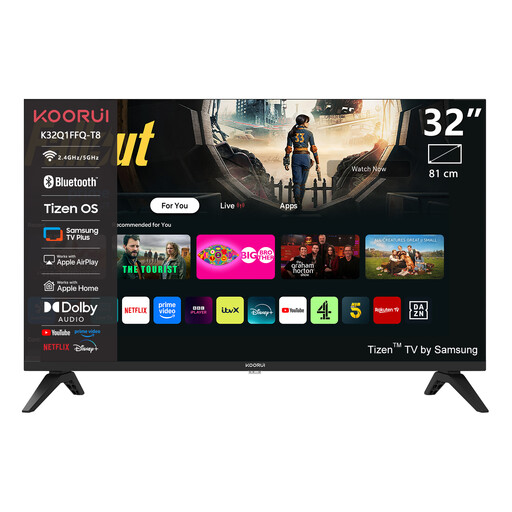
KOORUI K32Q1FFQ-T8 32-inch Full HD QLED Smart TV
A 32-inch option for a smaller viewing setup; check in advance that your external source connects to the TV as you’d like.
32 inches, Full HD and QLED.
View at Joybuy
Frequently asked questions
Is a USB port enough to play your concert recording?
No. A USB port alone doesn’t confirm that the TV can play your recording. For the exact model, check the file system, video and audio codecs and, if needed, the subtitles. LG explains that a file may not play if its codec isn’t supported.
How do you connect an existing audio system?
Compare the outputs on the exact TV model with the inputs on your system. For example, the Sony K-55XR80 lists HDMI eARC/ARC and a digital audio output; the right connection depends on your own equipment.
How do you choose the right screen size?
Measure the distance from your seat to the TV, and check the available space too. The Dutch Consumers’ Association suggests around 2.4 times the screen diagonal as a guide to viewing distance; also check the TV’s physical dimensions and the sizes available nearby.
What can you do if the TV doesn’t meet the stated specifications?
The Dutch government advises contacting the seller to discuss a solution. In the Netherlands, there is no fixed legal guarantee period; what you can expect from a product depends, among other things, on the product information and the circumstances. An unsupported file isn’t automatically a product fault.
What is the cooling-off period for an online purchase?
For a distance purchase, you generally have a 14-day cooling-off period, as explained by the Dutch government. Check the seller’s information for the terms and any exceptions. This cooling-off period says nothing about whether your recording is compatible with the TV.


