Start by measuring your viewing distance, then compare a few screen sizes that will fit in your room. A bigger TV isn’t automatically the right choice. The Consumers’ Association (Consumentenbond) recommends a viewing distance of around 2.4 times the screen diagonal as a useful guide. Next, consider your viewing conditions: OLED can work well for dark concert scenes and seating at different angles, while an LCD TV is worth considering if you watch a lot in daylight. For each model, also check how you plan to listen to the sound.
Who is this buying guide for?
Watching from a long distance
You want to follow the band members and see the stage clearly from your usual seat. First, measure the viewing distance, then check whether the TV and its stand will fit in the available space. The Consumers’ Association uses viewing distance as a starting point when choosing a screen size.
Watching concert films in the evening
You often watch with the lights dimmed and want to take dark scenes and seating at different angles into account. The Consumers’ Association highlights contrast and viewing angle as things to consider when assessing TVs.
Watching in a bright room or using your own audio system
You want to account for reflections during the day or connect an existing sound system. Check the relevant features and connections on the exact model. The Consumers’ Association includes visibility in direct light and screen reflections among its test criteria.
What should you look for when choosing?
OLED TV
A good fit for: frequent evening viewing, when dark stage scenes and viewing angle are key considerations.
Things to weigh up: OLED isn’t necessarily the best choice for a sunny room. Image retention can also be a concern if a static image is displayed for a long time.
Mini LED LCD TV
A good fit for: daytime viewing, when visibility in the room matters.
Things to weigh up: viewing angle and black levels vary by model. The mini LED label alone doesn’t tell you how dark scenes will look.
Large LCD TV
A good fit for: when finding the right screen size is your top priority.
Things to weigh up: assess contrast, viewing angle and built-in sound for each model. A large screen diagonal alone won’t tell you enough.
Measure the distance from your eyes to the intended screen position and compare more than one screen size. The Consumers’ Association recommends a viewing distance of around 2.4 times the screen diagonal. Also check the TV’s actual width and where it will go.
| Consideration |
What to look for |
Who it matters to |
| Screen size at a distance |
Measure the viewing distance and compare nearby screen sizes. Also check the TV’s width and the space needed for its stand or mounting. |
If I want to follow the stage clearly from my usual seat, I need a screen diagonal that’s right for the distance and fits in the room. Around 39% of consumers put screen size at a distance first when making this choice. |
| Dark scenes |
Compare dark scenes and viewing angles on models in your preferred size. With LCD, also consider the effect of the backlighting. |
If I mostly watch in the evening, I want to assess dark stage scenes rather than just look at a bright demo image. Around 23% of consumers focus on how dark scenes are displayed. |
| Daylight and seating positions |
Take windows and viewers’ seating positions into account. Compare reflections and viewing angles on the exact model. |
If daylight falls on the screen or people sit in different places, I want to know how visible the picture will be in those conditions. For around 23% of consumers, visibility in daylight and from different seats matters most. |
| Sound and connections |
Assess the sound on the exact model and check the connections on both the TV and your existing sound system. |
If I already have a soundbar or amplifier, I want to be able to connect it without making assumptions about sound based on screen size. Around 15% of consumers prioritise concert sound or connecting to their existing audio system. |
Common buying mistakes
-
Choosing the largest screen diagonal without considering anything else
A bigger TV needs more room and isn’t necessary for every viewing distance.
Measure the distance from your seat and the available width. Compare a few screen sizes and check the dimensions, including the stand or mounting requirements.
A larger set may need more space for positioning or mounting.
-
Assuming mini LED displays dark stages in the same way as OLED
Mini LED is a type of LCD with backlighting. Black levels and viewing angles can vary by model; the Consumers’ Association highlights these as things to consider in TV tests.
Compare dark scenes and viewing angles on the models you’re considering rather than relying on the technology name alone.
-
Forgetting about built-in sound and installation
Screen size doesn’t tell you how a TV sounds. An existing sound system will also need suitable connections.
Assess the sound on the exact model, check the connections and find out what installation you’ll need before buying.
A separate sound solution or installation service may involve extra costs or arrangements.
-
Comparing an old energy label rating directly
The European Union says the old energy label system with plus signs has not been used for televisions since 2021.
Compare the current energy label for the exact model variant.
Brands to compare
LG
A specific OLED model to compare if both a large screen and dark scenes matter to you.
- LG lists a 77-inch 4K OLED screen and upscaling picture processing for the OLED77C5ELB.
- The OLED77C41LA is a different model, so check the full model code when comparing.
Samsung
A 75-inch Neo QLED 4K Mini LED model to compare for a bright room.
- Samsung lists Mini LED and Glare Free for the QE75QN90FATXXN.
- Glare Free is a claim made by Samsung. Assess reflections and viewing angle in your own room too.
Philips
A 75-inch QD MiniLED model to consider if lighting effects around the screen are important to you.
- Philips lists Ambilight for the 75PML9009/12.
- Whether the lighting effect works well with concert films depends on personal preference. Compare the screen and sound too.
TCL
The 75Q6C is a 75-inch mini LED LCD model to compare for its size and features.
- The product listing identifies the 75Q6C as a QD-Mini LED TV.
- The features of one model don’t automatically apply to other models from the same brand.
TVs at Joybuy
This selection of TVs at Joybuy includes OLED, LCD and mini LED models with large screens. Compare the screen diagonal with your viewing distance and check which picture and sound features suit your room on each set.
 No image available
LG OLED77G68LW
A 77-inch OLED TV to compare if you want to assess dark concert scenes from a long viewing distance too.
77 inches, 4K OLED and Dolby Atmos.
View at Joybuy
 No image available
LG 85NU800B6LA
An 85-inch TV to consider alongside your measured viewing distance and available space.
85 inches, 4K UHD, Direct backlighting, HDR10 and HLG.
The stated audio system is 20 W 2.0.
View at Joybuy
 No image available
TCL T8D 85-inch
An 85-inch mini LED LCD TV to compare if you’re looking for a large screen and want to factor in your sound set-up too.
4K QD-Mini LED and Onkyo 2.1 audio system.
View at Joybuy
 No image available
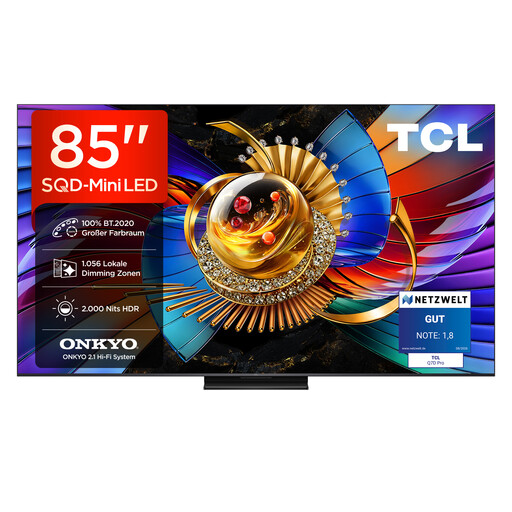
TCL 85Q7D PRO
An 85-inch model to compare with your available space and viewing distance.
85 inches, 4K SQD-Mini LED and a 2.1 Onkyo audio system.
View at Joybuy
 No image available
METZ 86MQE8000Z
An 86-inch QLED TV to compare with your viewing distance and available space.
4K HDR10+, Google TV and 144 Hz.
The product name lists a 2.1.2 sound system with an integrated subwoofer.
View at Joybuy
Frequently asked questions
How do I choose a TV size without assuming a fixed minimum viewing distance?
Measure the distance from your eyes to where the screen will be and use that as your starting point. The Consumers’ Association recommends dividing the distance by 2.4 to get a guide to the screen diagonal in centimetres. Compare nearby sizes too and check that the TV will physically fit.
Is a mini LED TV the same as an OLED TV?
No. Mini LED is a type of LCD with backlighting, while OLED pixels produce their own light. The Consumers’ Association highlights contrast, viewing angle and visibility in direct light as points to compare between TVs. Check these features for the exact model and your own room.
What should I consider when positioning the TV and connecting concert audio?
Before positioning the TV, check its actual width and the space needed for its stand or mounting. If you have a soundbar or amplifier, compare the connections on both devices. A large screen diagonal says nothing about sound quality.
Are the manufacturer’s warranty and the statutory guarantee the same thing?
No. According to the Dutch government, you’re entitled to a product that is fit for purpose in the Netherlands, with no fixed statutory guarantee period. A manufacturer’s or seller’s warranty is in addition to this. If there’s a problem, contact the seller.
What should I know about buying a TV online and its energy label?
For distance purchases from a business, the Dutch government says you generally have a 14-day cooling-off period. Check the information and terms for your specific purchase. The European Union says the old energy label system with plus signs has not been used for televisions since 2021. Compare the current label for the exact model variant.


