Who is this choice for?

Organiser with seating spread around the room

You’re setting up the room for several viewers and want people at the back and sides to be able to follow the picture too. The Consumentenbond lists viewing angle and viewing distance as factors to consider when choosing a TV.

Club that mainly wants to hear the performance clearly

You’re screening a music performance and want to assess the vocals, instruments and speech clearly, not just enjoy a large picture. The Consumentenbond points out that sound quality varies considerably between TVs.

Volunteer in charge of playing the recording

You need to get the existing video file or connected laptop working during the event. The Consumentenbond advises taking the source and the TV’s connections into account.

What should you look for?

OLED TV

When: if many club members will be watching the screen from an angle and you can darken the room for the screening.

Consider: check the screen size, reflections and sound quality of the specific model; OLED alone says nothing about how the recording will sound.

Bright LCD TV, such as QLED or mini-LED

When: if there will be a lot of ambient light in the room during the screening.

Consider: compare the picture from the seats at the sides too; the Consumentenbond notes that a more limited viewing angle is a general trade-off with LCD.

TV with a separate sound system

When: if music playback matters more to the club than keeping the set-up simple.

Consider: you’ll need extra equipment and a suitable connection. Consumentenbond tests show that TV sound varies considerably; with a soundbar too, the result depends on the specific model.

What to consider What to look for when buying Who this matters most to
Visibility across the room Measure the viewing distances and assess the picture from the seats at the sides; consider a larger screen if viewers will be sitting further away. If I want people in the back or side seats to be able to follow the details too, I’ll prioritise visibility across the room. Around 25% of consumers give this need their highest priority.
How clearly the music can be heard Listen to your own recording and, if using external speakers, check that the TV and sound system have compatible connections. If vocals and instruments are central to the event, I want to assess the sound for myself rather than rely on an audio format logo. Around 25% of consumers prioritise music sound.
Playing the recording Choose your source in advance, such as a laptop or USB stick; check that the connections are suitable and test the entire file with both picture and sound. If I need to use the existing file or playback device, I want to know the whole set-up works before the event. Around 20% of consumers make playback their top priority.
Picture quality in the room’s lighting Compare TVs in the lighting conditions you’ll have during the screening, and check the picture from different angles at the same time. If the room can’t be darkened enough, I want to assess the picture in the available light. Around 15% of consumers prioritise viewing in a bright room.
Total cost of the set-up Compare the TV with any extra audio equipment you may need, and check the energy label for the specific model. If the club’s budget determines the choice, I want to factor in the cost of the complete set-up. Around 15% of consumers make the total purchase and running costs their top priority.

Common pitfalls

  • Judging the picture only from directly in front of the screen

    With seats spread around the room, the picture may look different from an angle than it does head-on. The Consumentenbond generally describes OLED as offering a wider viewing angle, though viewing angle still depends on the model and set-up.

    View the TV you’re considering from the seats at the sides and in the lighting conditions you’ll have during the screening.

  • Assuming an audio format or screen resolution proves the recital will sound good

    A mention of Dolby Atmos, for example, is a product specification, not an assessment of how the built-in speakers sound. Consumentenbond tests show that sound quality varies between TVs.

    Listen to your own recording and, if necessary, check whether you can connect an external sound system to the TV.

    A separate sound system may need space and a suitable audio connection.

  • Assuming a USB port will play any video file

    Playback and file format support vary by model; a USB connection alone doesn’t confirm that your chosen recording will work.

    Compare the file details with the model specifications and test the entire recording, including picture and sound, before the event.

    If the file can’t be played directly, you may need another playback source or to convert the file.

  • Confusing buying a TV with getting permission to screen the recording

    The rights to music and images are separate from owning the TV. The Rijksoverheid distinguishes between a private copy for personal use and making content available to the public; the permission you need depends on the specific recording and screening.

    Before the event, establish who manages the recording and the works performed, and what permission is needed for this particular screening.

Brands to compare

LG

The Dutch OLED B5 range includes models in various screen sizes. The OLED65B56LA is a 65-inch model to consider as an OLED option.

  • LG specifies the OLED65B56LA as an OLED TV. The Consumentenbond generally describes OLED as offering a wider viewing angle.
  • This general characteristic isn’t an independent viewing-angle measurement of this model; also assess reflections and sound in your own room.

Samsung

The Dutch QE65QN70FAUXXN is a 65-inch Neo QLED mini-LED TV to compare if there will be ambient light during the screening.

  • Samsung lists mini-LED as a feature of this model.
  • This model specification isn’t an independent measurement of brightness or viewing angle; compare the picture in your own lighting and seating conditions.

Philips

The Philips 65PUS8001/12 is a 65-inch 4K LED TV with Ambilight to include when comparing large-screen TVs.

  • Philips lists Ambilight and support for Dolby Atmos and DTS:X.
  • These features don’t prove how the built-in speakers will sound when playing a music performance; listen to your own recording.

Sony

The Sony BRAVIA 5 K-65XR5 is a 65-inch mini-LED LCD model to consider if you want to try playing the recording directly from USB.

  • For the K-65XR5, Sony lists USB stick formats and playback codecs, among other specifications.
  • Compare the specifications with your own file and test the entire recording; support for a format doesn’t guarantee that every recording will work straight away.

TVs at Joybuy

These models are included for comparison when choosing a TV for a group screening. They include OLED, LCD, QLED and mini-LED options in various configurations.

LG OLED65C68LA 65-inch 4K OLED TV

LG OLED65C68LA 65-inch 4K OLED TV

A 65-inch OLED model to compare for a group screening.

Specifications: 4K OLED, 40 W sound system, Dolby Atmos, HDMI 2.1 and USB connections.

View at Joybuy

LG 65NU800B6LA 65-inch 4K UHD TV

LG 65NU800B6LA 65-inch 4K UHD TV

A 65-inch 4K UHD model to compare if you want to connect an external playback source.

Specifications: Nano screen, three HDMI inputs, one USB port, eARC, optical audio output and a 20 W, 2.0-channel sound system.

View at Joybuy

Hisense 65A6S 65-inch 4K UHD TV

Hisense 65A6S 65-inch 4K UHD TV

A 65-inch model to compare if you want to try playing the recording directly from storage.

Specifications: 4K UHD, USB connections, built-in speakers and DTS Virtual:X audio processing. Supported video formats vary by model; check that your file is compatible.

View at Joybuy
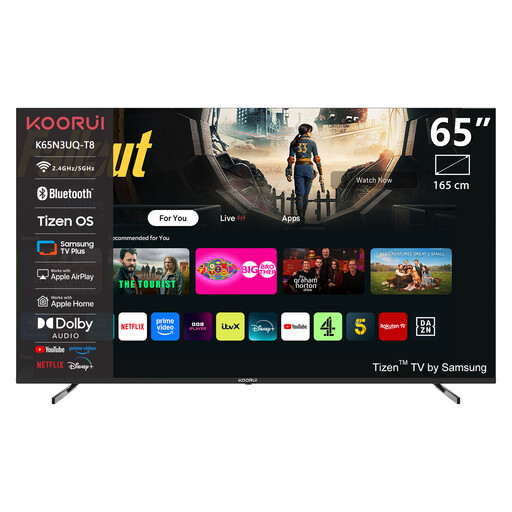
KOORUI K65N3UQ-T8 65-inch 4K UHD QLED TV

KOORUI K65N3UQ-T8 65-inch 4K UHD QLED TV

A 65-inch QLED model to compare with other screen technologies for a group screening.

Specifications: 4K UHD, Tizen TV, LAN connection and Dolby Audio.

View at Joybuy

TCL 65T8D 65-inch QD-Mini LED TV

TCL 65T8D 65-inch QD-Mini LED TV

A 65-inch model to compare if both screen technology and built-in sound matter to you.

Specifications: QD-Mini LED dimming, 4K, integrated Onkyo 2.1 sound system, HDMI 2.1 and Dolby Atmos support. These sound features aren’t an independent assessment of audio quality.

View at Joybuy

Frequently asked questions

How can you check the recording works before the event?

Test the recording using the source you plan to use at the event. If you’re using USB, try your own stick and the entire file; if you’re using a laptop, test the connection you intend to use and check which speakers the sound will come through. A list of supported formats isn’t a substitute for testing it yourself.

Can you connect a soundbar later?

It depends on the connections available on both devices. The Consumentenbond advises checking whether the TV and soundbar have HDMI (e)ARC; if they don’t, an optical connection may be an alternative. Also check how you’ll control the sound.

What does the statutory guarantee mean when you buy a TV?

When a consumer buys a product, statutory rights apply in addition to any manufacturer’s or seller’s guarantee. According to ACM ConsuWijzer, if a TV breaks under normal use sooner than you could reasonably expect, the seller must repair or replace it, or resolve the purchase, free of charge and in accordance with the applicable conditions. There isn’t one fixed statutory guarantee period of two years for every TV; if a club or association is making the purchase, check which consumer rules apply to that agreement.

Can a local club screen a recorded recital for members without further permission?

You can’t determine this without considering the rights to the specific recording and how it will be used. The Rijksoverheid distinguishes between a private copy for personal use and making content available to the public. Government information also refers to licences for certain screenings of film or TV footage to audiences, and permission for public use of music. The permission needed for this recital and event depends on the rights holders and the circumstances. Buying a TV doesn’t grant these rights.
