What should you consider when choosing?
Start by checking how the TV will fit in your room, then compare picture quality, lighting conditions and how you’ll use it. What matters most will depend on what you watch most often and where the TV will go.
| Factor to consider |
What should you check? |
Who is this important for? |
| Screen size and placement |
Measure your viewing distance and the available width. If you’re putting the TV on a stand, check its dimensions with the stand attached too. |
If I want to know first whether the screen will fit in my living room, I’ll measure my viewing area and the space for the TV. Around 31% of consumers put fit first. |
| Colour, contrast and detail |
Compare a familiar scene with light and dark areas in your usual room lighting; assess the picture processing of each model. |
For artwork, I want to compare colour and shadow detail side by side, rather than relying on a technology label alone. Around 25% of consumers make picture quality their top priority. |
| Daylight and viewing angle |
Look at the picture in your usual lighting and from your usual seats; a brightness claim alone doesn’t tell you how well the screen handles reflections. |
If I watch during the day or don’t sit directly in front of the screen, I want to know what the picture looks like from my seat. Around 19% of consumers prioritise visibility in their own lighting conditions. |
| Static images |
Think about how often the same artwork stays on screen for a long time. The Consumers’ Association doesn’t specify a fixed safe number of hours for OLED. |
If I often leave artwork or a paused image on screen for a long time, I’ll take that into account when choosing. Around 13% of consumers consider static images their main buying concern. |
| Documentaries and running costs |
Check that the app you want is available on the TV platform and compare the EU energy label for electronic displays. |
I want to watch my documentaries and take energy consumption into account too. Around 12% of consumers make access to services and running costs their top priority. |
TVs at Joybuy
This selection features compact 42- or 43-inch TVs, including an OLED model and several QLED models to compare side by side. Measure the space available and assess the picture of your chosen model in your usual lighting conditions.
 No image available
LG OLED42C68LA 42-inch 4K OLED TV
The 42-inch size gives you a specific OLED screen size to compare with your viewing distance and available width.
The product name lists 4K, Dolby Vision and HDR10.
Image retention can’t be completely ruled out if the same static image is displayed for a long time; the Consumers’ Association highlights this as a consideration with OLED.
View at Joybuy
 No image available
METZ 43MQF7500Z 43-inch 4K QLED TV
This 43-inch QLED model is an alternative to compare with OLED; the screen technology alone won’t predict how the picture looks in your room.
The product name lists 4K, Google TV, HDR10+ and Dolby Vision.
View at Joybuy
 No image available
TCL 43T6C 43-inch 4K QLED TV
Use the 43-inch size to check whether this screen will suit your viewing distance and available space.
The product name lists 4K, QLED and 120 Hz.
View at Joybuy
 No image available
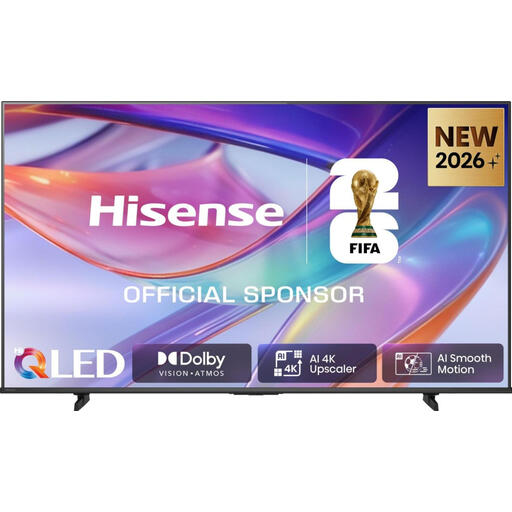
Hisense 43E7S 43-inch 4K QLED TV
This 43-inch QLED model gives you another option to compare with OLED; check the picture from your seats and in your room’s lighting conditions.
The product name lists 4K and 120 Hz.
View at Joybuy
 No image available
CHiQ U43QM10E 43-inch 4K QLED TV
The 43-inch size helps you assess whether the TV will suit your viewing distance and available width.
The product name lists 4K, QLED, Google TV, HDR10, VRR and ALLM.
View at Joybuy
Frequently asked questions
Can I choose a screen size based on my narrow living room?
No. Measure your viewing distance and the space available for the screen and stand too. The Consumers’ Association suggests around 2.4 times the screen diagonal as a guide to viewing distance, not a fixed measurement that suits everyone.
How should I adjust the picture for paintings and dark museum scenes?
Watch a familiar scene with light and dark areas in the lighting you usually use. Then choose a picture mode you like and adjust the brightness and contrast so details remain visible in both areas.
What should I check before putting the TV on a stand or wall-mounting it?
Compare the dimensions of the exact TV with the space available, including the stand if you’ll be using it. For wall mounting, check the bracket and mounting details for that specific model; the screen diagonal alone doesn’t confirm that it will fit.
What if my documentary app stops working in the future?
The apps available vary by smart TV, and apps can be discontinued. Before buying, check that the service you want is available on your chosen model; a separate media player connected via HDMI could be an alternative.
Which Dutch rules are relevant to warranties and energy information?
There is no fixed statutory warranty period in the Netherlands. According to the Dutch government, you’re entitled to a product that works properly, and the retailer is your point of contact if something is faulty. Televisions are covered by the EU energy labelling rules for electronic displays; compare the label and the information about the model.


