First, measure your viewing distance and the space available for the screen and stand. Then choose a size that fits, rather than automatically opting for the biggest one. Decide whether you’ll play the showreel from a laptop via HDMI or directly from USB, and test your chosen connection with your own exported file. The Consumers’ Association says OLED TVs generally offer a wider viewing angle and deeper blacks, while LCD TVs can often be brighter. Suitability also depends on the room’s lighting and where people will be sitting.
Who is this buying guide for?
Showreel creator with limited viewing space
You want the TV and stand to fit in the space you’ve chosen and be comfortable to watch from your seat. The Consumers’ Association suggests a viewing distance of around 2.4 times the screen diagonal; also measure the available width and depth.
Presenting from a laptop
You want your own animation to play without any surprises. Decide in advance whether you’ll use a laptop connection or USB playback. For example, Sony publishes model-specific information about supported USB formats and codecs for the K-43S3.
Host with guests sitting to the side
You want guests sitting away from the centre to be able to follow the showreel. The Consumers’ Association generally describes OLED TVs as having a wider viewing angle. Check the specific screen and lighting from the seats you plan to use, too.
What should you look for when choosing?
First, measure your viewing distance and the space available for the TV. Then choose how you’ll play your showreel and assess the picture from your seats in your usual lighting.
| What to consider |
What should you check? |
Who should take this into account? |
| Screen size and placement |
Measure the viewing distance and the available width and depth. The Consumers’ Association uses viewing distance divided by 2.4 as a starting point for the screen diagonal in centimetres. Then check the TV’s actual overall dimensions with the stand. |
I want to make sure the screen and stand will fit and choose a size that suits my viewing distance. Around 31% of consumers prioritise screen size and placement. |
| Playing the showreel |
Choose between a laptop via HDMI and direct USB playback, then test your final file, including its aspect ratio and audio. For USB playback, check which file systems and codecs the exact model supports. |
I want to test my own exported file using my chosen connection in advance. Around 25% of consumers prioritise reliable playback. |
| Viewing angle and picture |
View the model from the seats furthest to the sides and compare light and dark scenes using your home settings. The Consumers’ Association says OLED TVs generally offer a wider viewing angle and deeper blacks, but the results still depend on the model. |
If guests are sitting beside me, I want them to be able to follow the showreel from those seats. Around 25% of consumers prioritise visibility from multiple seats and picture quality. |
| Lighting and energy use |
Check for reflections in the lighting you’ll use during the screening. Energielabel.nl lists energy use per 1,000 hours; compare the figures for standard and HDR playback on the model’s label. |
In a bright room, I want to check for reflections. If energy use matters, I’ll compare the labels for each model. Around 19% of consumers prioritise ambient lighting or electricity use. |
Common mistakes
-
Measuring only the screen diagonal
The diagonal doesn’t tell you how much space the screen and stand will take up. So the TV may still not fit on your unit or in the space you’ve chosen.
Measure the available width and depth and compare them with the model’s full dimensions.
-
Assuming USB will play any video file
Support depends on the file system and the video and audio codecs used by the specific model.
Test your final showreel in advance. Keep a tested HDMI connection as an alternative playback option.
-
Assuming the picture in the shop will look the same at home
The Consumers’ Association notes that shop settings are often brighter than you need at home. That picture won’t necessarily give you a good idea of how your own animation will look in your living room.
Compare a familiar scene using your home settings and the lighting you’ll use during the screening.
-
Assuming OLED burn-in is either inevitable or impossible
In an older, limited test, the Consumers’ Association saw temporary image retention after unusually prolonged display of static images. This doesn’t prove what will happen with every new OLED model.
Avoid leaving title screens or paused images on screen for longer than necessary, and take your viewing habits into account when choosing.
Brands and models to compare
LG
The OLED42C5ELB is a 42-inch OLED model worth comparing if you have limited space or guests will be viewing the screen from an angle.
- The Consumers’ Association lists four HDMI inputs, three USB ports and a width of 93,5 cm with the stand for this model.
- Measure your available space and test your own playback connection. These specifications don’t prove that the TV will show your animation with the most accurate picture.
Sony
The K-43S3 is a 43-inch LCD model to consider if you want to check playback from a laptop or USB.
- Sony lists four HDMI inputs and two USB ports for the K-43S3 and publishes a list of supported USB codecs.
- The specifications don’t provide independent measurements of viewing angle or colour accuracy. Check that your own exported file is supported.
Philips
The 43PUS8500/12 is a 43-inch QLED LCD model to compare with OLED and other LCD TVs.
- Philips lists 4K, QLED, Ambilight and Titan OS for this model.
- The listed features don’t confirm that this model has been tested for codec support or viewing angle. Don’t assume the QLED label alone guarantees picture quality for your showreel.
Joybuy TVs for a compact living room
The models below have 32- or 43-inch screens and offer LCD or QLED options to compare with your viewing distance, available space and playback connection.
 Image unavailable
LG 43NU800B6LC Nano UHD Smart TV, 43-inch
A 43-inch option to compare with your viewing distance and available space.
4K UHD, HDR10/HLG, direct LED screen, three HDMI inputs and one USB input. The stated width with the stand is 957 mm.
Joybuy
 Image unavailable
Philips PQS7801 4K QLED Smart TV, 43-inch
A 43-inch QLED option to compare with your viewing distance and available space.
4K playback, HDR10+, HLG and Titan OS.
Joybuy
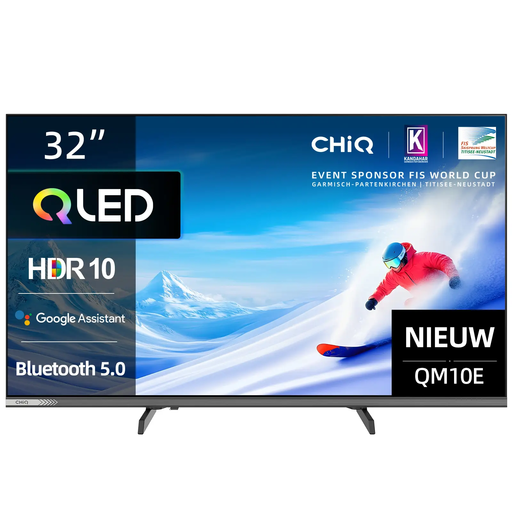 Image unavailable
CHiQ L32QM10E QLED Smart Google TV, 32-inch
A 32-inch option to compare if you have less space available.
QLED, HDR10, HDMI and USB connections, and wireless screen mirroring. The description mentions tabletop placement and wall mounting.
Joybuy
 Image unavailable
METZ 43MQF7500Z QLED 4K UHD Google TV, 43-inch
A 43-inch QLED option to check against your available space and planned playback connection.
4K UHD, HDR10+, Dolby Vision and HLG. The description lists VESA wall mounting at 200 × 200 mm.
Joybuy
 Image unavailable
TCL 43T6C 4K QLED Smart TV, 43-inch
A 43-inch option to compare with your viewing distance and the width of your TV unit.
4K resolution, QLED, HDR10+, Dolby Vision and HLG.
Joybuy
Frequently asked questions
How do I work out an initial screen size for a narrow living room?
Measure from your eyes in your seat to where you plan to put the screen. The Consumers’ Association says dividing the viewing distance in centimetres by 2.4 gives you a starting point for the screen diagonal in centimetres. Then check the model’s width and depth with the stand.
Can I play my animation showreel directly from USB?
Only if the specific TV model supports the file system and the video and audio codecs used in your exported file. Sony publishes this information for the K-43S3. Test your final file in advance, and don’t assume other models offer the same support.
Which picture settings should I use for the first screening?
Start with a home setting rather than the often extra-bright shop mode. Use a familiar scene in your usual room lighting to check that details in both light and dark areas remain visible.
What if a TV I buy online doesn’t fit in my living room?
When you buy online from a business in the Netherlands, you generally have a 14-day cooling-off period. The Dutch government explains the conditions and exceptions. The cooling-off period for distance purchases is separate from your rights if a product is faulty.
What information is shown on a TV’s energy label?
The label includes the energy class and consumption in kWh per 1,000 hours, including for HDR playback. The European Commission outlines the EU information requirements for sellers. Compare the details for the models you’re considering.


