
A household with several LP listeners
Wants controls everyone at home can use easily, without having to position the tonearm by hand every time. Audio-Technica Netherlands and Denon Netherlands describe fully automatic models for this kind of use.


For shared use, start by choosing a turntable that works with your speakers or amplifier and is easy for everyone at home to operate. Fully automatic operation takes care of starting and stopping the tonearm; a model with adjustable settings is a better fit if you want to manage the setup yourself. Bluetooth or a particular drive type alone won’t tell you how well a turntable will sound in your setup.
Wants controls everyone at home can use easily, without having to position the tonearm by hand every time. Audio-Technica Netherlands and Denon Netherlands describe fully automatic models for this kind of use.
Wants to play classic LPs through active speakers or an amplifier, and needs to match the phono and line inputs. Audio-Technica explains that passive speakers need an amplifier.
Is happy with manual operation or extra adjustments to have more control over the setup and cartridge. Denon lists adjustable balance and anti-skating for the DP-300F; Rega describes the Planar 1 Plus as having pre-set bias.
A good fit if: several people at home will use the turntable and you want to get started with minimal effort.
The trade-off: models vary in their connections and adjustment options; this doesn’t prove that one sounds better than another.
A good fit if: you want to operate the tonearm yourself and having control over the settings matters to you.
The trade-off: tasks such as moving the drive belt can be less convenient if people at home often switch between speeds.
A good fit if: you’re interested in a direct-drive model and are happy to start it manually.
The trade-off: lifting the tonearm at the end of a record isn’t the same as fully automatic playback.
Check that the connections match your existing system before comparing controls or adjustment options.
When choosing a turntable for classic LPs in a shared living room, these are the key things to consider:
| Key consideration | What should you check? | Which consumers does this matter to? |
|---|---|---|
| Shared operation | Check whether starting and returning the tonearm are automatic, or whether the arm is simply lifted at the end. | If several people at home play LPs, I want it to be easy to get started without having to position the tonearm myself each time. Around 40% of consumers prioritise ease of shared use. |
| Connection to your audio system | Check whether your speakers are active or passive, and whether your amplifier has a PHONO or line input. Don’t connect two phono preamps in sequence. | If I want to use my existing speakers or amplifier, the signal path needs to work with them. Around 30% of consumers put system compatibility first. |
| Placement and record care | Choose a flat, stable surface away from direct speaker vibrations, and check which replacement stylus is compatible with the model. | If the turntable is going in a shared living room, I want to find a suitable spot and know how to care for the stylus. Around 20% of consumers prioritise placement and record care. |
| Making your own adjustments | Compare the settings available on the specific model; don’t assume every manual turntable offers the same options. | If I want to adjust the tonearm myself, I look for settings that the model actually offers. Around 10% of consumers put adjustability first. |
Passive speakers don’t have their own amplifier. A phono output, line input and speaker amplification all serve different purposes.
Check the inputs on your system and the type of speakers you have before choosing a turntable. Depending on your equipment, you may need an amplifier or phono preamp.
The tonearm lift on the Technics SL-1500C raises the tonearm at the end of a record, but it doesn’t start playback automatically.
Compare automatic starting, stopping and returning separately from simply lifting the tonearm at the end.
Audio-Technica warns that speaker vibrations can affect the stylus and cause it to skip.
Plan for a stable spot away from the speakers; you may need to arrange the living room differently.
According to Audio-Technica Netherlands, the AT-LP70XBT combines fully automatic operation with a switchable phono preamp and Bluetooth.
The Denon DP-300F combines fully automatic operation with adjustable balance, anti-skating and a switchable phono preamp.
Sony describes the PS-LX310BT as a fully automatic option with a switchable phono output and Bluetooth.
The Technics SL-1500C features direct drive, a built-in phono equaliser, a supplied cartridge and automatic tonearm lift at the end of a record.
The Rega Planar 1 Plus is a manual alternative with a built-in MM phono stage.
These turntables are suited to sharing classic LPs, with fully automatic operation and connection options for an existing audio system.
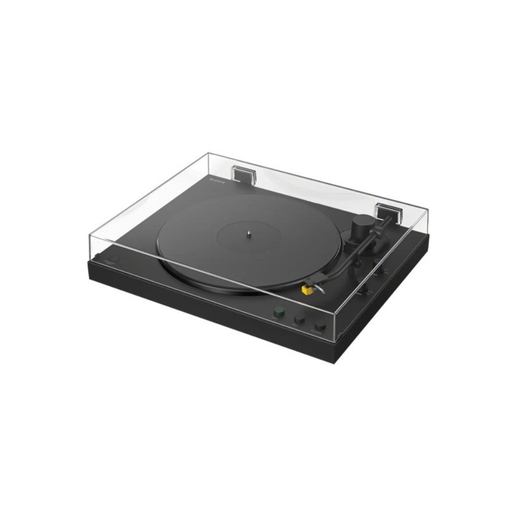 No image available
The stated fully automatic operation and automatic return make this a good option for shared use, when people at home would rather not position the tonearm themselves.
The product information lists Bluetooth, a built-in phono equaliser with a PHONO/LINE switch, and support for 33⅓ and 45 rpm. Check that the version on offer has the required product marking and information.
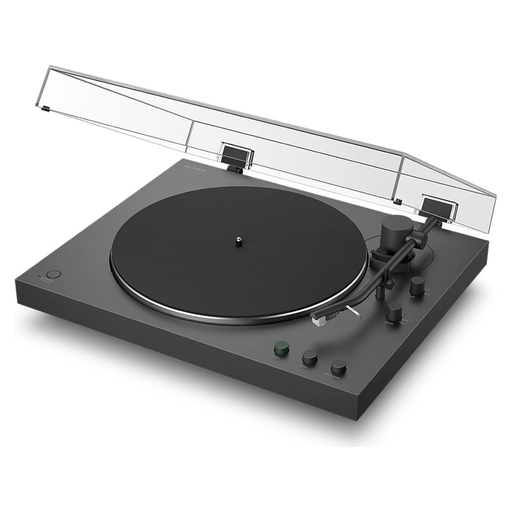 No image available
The stated fully automatic operation and automatic return make this a good choice for a shared listening space where several people play LPs.
The product information lists Bluetooth, a built-in phono equaliser with a PHONO/LINE switch, and support for 33⅓ and 45 rpm. Check that the version on offer has the required product marking and information.
First, check whether your speakers are active or work through an amplifier. Audio-Technica explains that passive speakers need an amplifier. With a turntable that has a switchable phono stage, you would generally use LINE for a line input, or PHONO for a suitable phono input; connecting two phono stages in sequence can distort the sound.
Place the turntable on a stable surface, away from speakers that transmit vibrations. Audio-Technica recommends checking the stylus for dirt and following the cleaning instructions for the specific cartridge.
That depends on your existing system: passive speakers need an amplifier, while a turntable without a suitable built-in phono stage or a compatible PHONO input may need a separate phono preamp. Also check which replacement stylus is compatible with the model you choose.
For eligible distance purchases by consumers, a 14-day cancellation period applies in many cases; exceptions and the specific type of sale matter. The Dutch government also states that sellers must provide a solution if there’s a problem with a product.
For electrical appliances sold on the EU market, the product information and marking must be appropriate for the specific version. The Dutch government refers to the CE marking for electronic devices; check the listing, as a model appearing on a manufacturer’s website doesn’t by itself prove that every unit conforms.