
Listeners with limited space near the wall
If your speakers can barely be moved forwards, it’s important to consider how the bass sounds in the space available and where your turntable can sit securely.


First, find a flat, stable spot for your turntable where speaker vibrations will have as little impact as possible. A different turntable won’t, by itself, solve boomy bass caused by speaker placement. Then choose a wired or Bluetooth connection that suits your speakers or amplifier, and check whether you have the phono stage you need.
If your speakers can barely be moved forwards, it’s important to consider how the bass sounds in the space available and where your turntable can sit securely.
If your turntable and speakers may need to sit on the same unit, finding a separate, stable spot for the turntable is an important consideration.
If you already have active speakers, an amplifier or Bluetooth speakers, you’ll want to know whether the turntable can connect to them and whether the signal path requires a phono pre-amplifier.
When choosing a turntable for live albums with speakers close to a wall, consider four things: speaker placement, vibration, connectivity and operation.
| What to consider | What should you check? | Who is this important for? |
|---|---|---|
| Bass near the wall | Check the placement guidance for your exact speaker model. ELAC notes that speakers with a rear-facing port may sound different when placed close to a wall. | If your speakers have to sit close to the wall because space is limited, you’ll want to know whether that position suits your model. Around 36% of consumers are primarily concerned with speaker placement. |
| Vibration around the turntable | Plan for a flat, stable spot away from the speakers. Audio-Technica recommends this for the AT-LP70XBT. | If you want to place the turntable beside the speakers or on the same unit, you’ll need to consider vibration transfer. Around 29% of consumers prioritise finding a low-vibration spot for their turntable. |
| Connecting to your setup | Check the inputs on your speakers or amplifier and whether the turntable has a suitable phono or line connection, or a Bluetooth transmitter. The Dutch Consumers' Association points out that amplifiers don’t always include a phono pre-amplifier. | If you want to keep using your current speakers or amplifier, the signal path needs to work with them. Around 21% of consumers focus primarily on connectivity. |
| Operation and stylus care | Compare the model’s tonearm and stop controls, and check which replacement stylus is compatible. | If you want to keep handling to a minimum or find out how to care for the stylus in advance, you can check these points for each model. Around 14% of consumers prioritise operation and stylus care. |
Bass response is also affected by speaker placement. A different turntable won’t change where your speakers are positioned.
First, check the guidance for your speaker model and see how much room you actually have for positioning it.
Changing your speaker setup may require more space or a different layout for your audio unit.
A turntable needs a suitable phono stage, which may be built into the turntable or available through a compatible amplifier input.
Before you buy, check which inputs your amplifier has and whether the turntable can be switched between phono and line output.
If the required signal path isn’t available, you may need additional audio equipment.
Bluetooth replaces an audio cable to a suitable receiver, but it doesn’t change the physical position of your turntable.
Even if you listen wirelessly, find a flat spot away from the speakers.
According to Audio-Technica, the AT-LP70XBT combines automatic operation with Bluetooth and a wired connection.
According to Denon, the DP-300F is a wired, fully automatic turntable with a switchable phono pre-amplifier.
According to Pro-Ject, the E1 Phono is a manually operated, belt-driven turntable with a switchable phono pre-amplifier.
Lenco describes the LBT-188PI as featuring a Bluetooth transmitter, USB connection and switchable pre-amplifier.
According to Rega, the Planar 1 Plus is a wired turntable with a built-in MM phono stage.
These Joybuy models include Bluetooth turntables and all-in-one models with built-in speakers. Check the connections on each model, and bear in mind that the placement of external speakers is a separate consideration.
 No image available
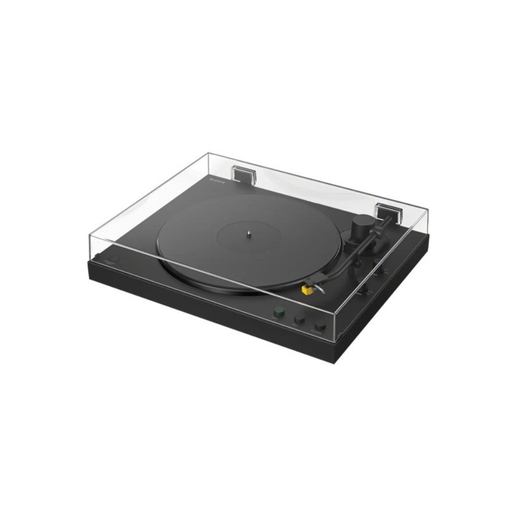
An option to compare if you use Bluetooth speakers or would also like a wired connection.
The product description lists belt drive, automatic operation and support for 33⅓ and 45 rpm.
Bluetooth and a wired PHONO/LINE connection with a built-in phono pre-amplifier are listed.
 No image available
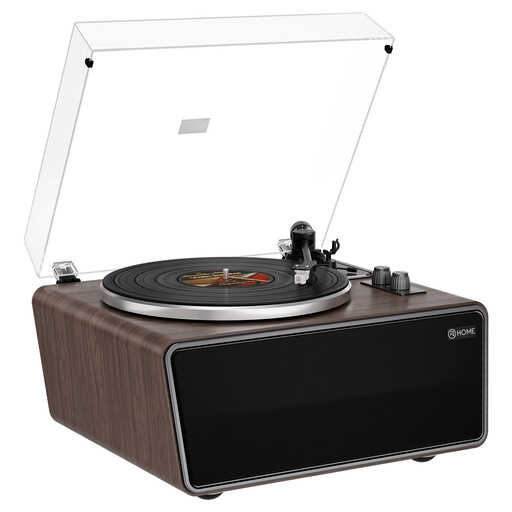
An all-in-one option to compare if you want speakers built into the same device.
The product description lists four built-in speakers, an AT-3600L cartridge and belt drive.
Support for 33⅓ and 45 rpm, plus Bluetooth and AUX/RCA connections, is listed.
 No image available
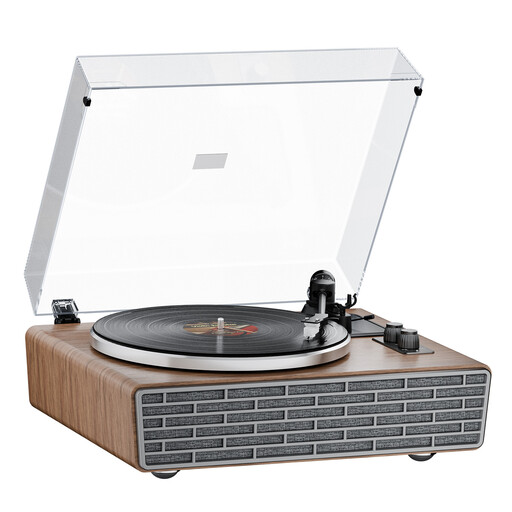
An all-in-one option to compare if you’re looking for built-in speakers and Bluetooth connectivity.
The product description lists four built-in speakers, an AT3600L cartridge and belt drive.
Support for 33⅓ and 45 rpm, plus Bluetooth, AUX and RCA connections, is listed.
 No image available
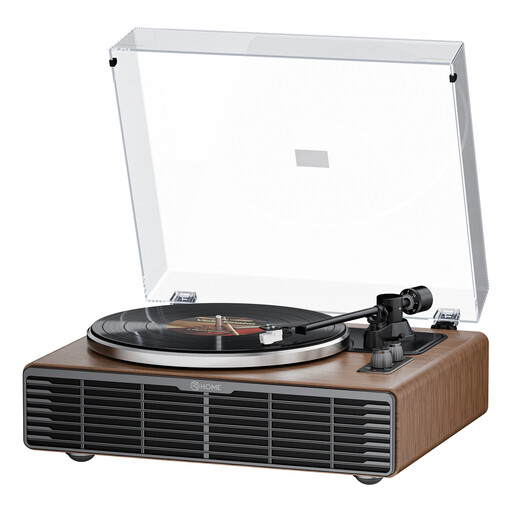
An all-in-one option to compare if you want built-in speakers and external connection options.
The product description lists four built-in speakers, an AT-3600L cartridge and belt drive.
Support for 33⅓ and 45 rpm, plus Bluetooth and AUX/RCA connections, is listed.
Don’t assume that it’s fine to do so. For the AT-LP70XBT, Audio-Technica recommends a flat spot away from speakers because of vibration and acoustic pressure. Check the manual for the model you’re considering.
Only if neither the turntable nor the amplifier input you’re using provides the required phono stage. Check whether the turntable is set to phono or line, and which input you’re connecting it to.
Follow the manual for the exact model and use a method that’s suitable for the stylus. Audio-Technica warns that dust build-up can reduce playback quality or damage the stylus assembly.
When you buy from a business online under a distance-selling agreement, you’re usually entitled to a 14-day cooling-off period, subject to exceptions. The Dutch Government distinguishes this from buying online from a private seller. You’re also entitled to a product that is fit for purpose. The Dutch Government states that there is no fixed statutory guarantee period in the Netherlands; if a product is faulty, you should contact the seller.
Bluetooth equipment is radio equipment and is subject to the relevant EU rules for placing products on the market. The European Commission sets out the framework for radio equipment. Check the product information and applicable CE marking for the specific model. A Bluetooth claim on its own doesn’t confirm that a particular product meets all the requirements.